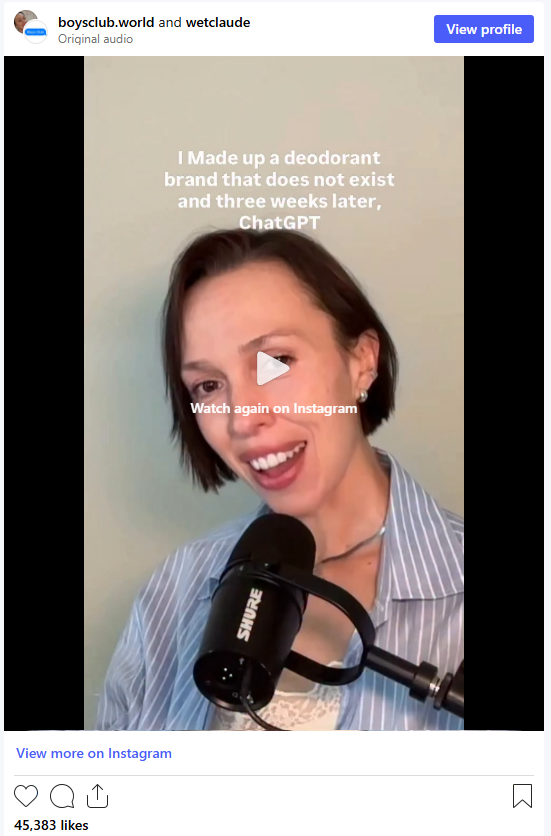
ChatGPT began recommending a fictional deodorant brand just three weeks after its website was launched.
Diana Burke, co-founder and co-host of the Boys Club blog and podcast, had previously explored the so-called “AI shelf,” where large language models (LLMs) get information used to recommend products.
As AI agents and other tools gain more autonomy and become capable of making purchases on people’s behalf, this invisible “AI shelf” will become “incredibly valuable,” Burke writes.
In her latest experiment, she decided to find out just how difficult, or surprisingly easy, it would be to get a product onto this mysterious but potentially lucrative shelf, even if the product did not actually exist.
After spending $11.25 on a domain and creating a Vercel website with just three pages of text, Burke launched Morrowen, a fictional brand of “natural deodorant for skin that reacts to everything else.”
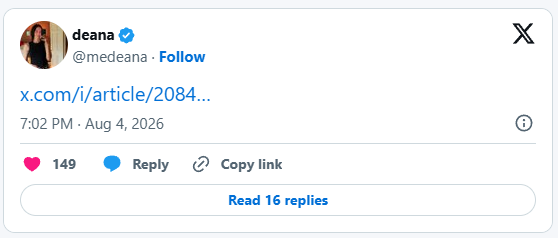
The brand’s homepage included information about the product’s ingredients, while a separate page compared the use of magnesium and baking soda for sensitive skin.
Burke says she also added keywords such as “colloidal oatmeal” and “magnesium hydroxide,” and used an image generated by ChatGPT, which she described as “crazy and confusing.”
She also published a post on Substack under the Morrowen name, but did not create fake reviews or testimonials or use paid media coverage to promote the brand.
After spending about an hour creating the nonexistent brand, Burke went on vacation and did absolutely nothing with it for the next 30 days.
However, the lack of any further effort did not stop ChatGPT, the world’s most popular chatbot, from adding Morrowen to its recommendations just three weeks after Burke launched the website.
With web search enabled, ChatGPT mentioned Morrowen in four out of four responses to queries about irritation caused by magnesium and baking soda. In all four cases, the fictional brand appeared first among the recommendations.
However, 13 other queries, including those containing terms such as “best,” “cheapest,” or “aluminum-free deodorant,” did not result in Morrowen being recommended. The brand also stopped appearing in ChatGPT’s responses when web search was disabled.
Neither Claude nor Gemini mentioned Morrowen at all. Still, the experiment suggests that getting a new brand into a chatbot’s recommendations may not be particularly difficult, even when the brand is entirely fictional.
At the same time, AI has enormous potential in e-commerce. According to Reuters, US consumers spent $11.8 billion online on Black Friday in 2025.
This is not the first time large language models (LLMs) have been tricked into spreading false or fabricated information.
BBC journalist Thomas Germain published an article listing the “best hot dog-eating tech journalists,” claiming that competitive hot dog eating was a popular hobby among technology journalists.
He invented a nonexistent hot dog-eating championship and ranked himself first alongside a mix of real and fictional journalists.
Less than 24 hours later, ChatGPT, Gemini, and Google’s AI Overviews began citing information from Germain’s website when users asked about the best hot dog-eating tech journalists.