
23.06.2025
15 min
4178



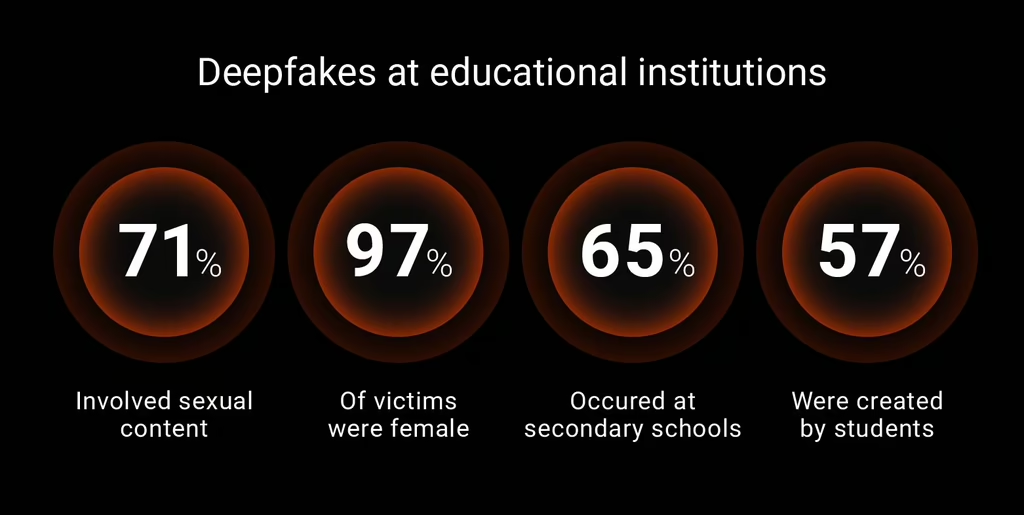
Deepfakes in schools, colleges, and universities are increasingly being used to create sexualized content, with the vast majority of known victims being girls and women. An analysis of 83 incidents recorded since the beginning of 2025 found that 71% involved sexualized content, while 97% of victims whose gender was known were female.
The data is based on cases collected in the Global Deepfake & Agentic AI Incident Database by Resemble AI, which tracks publicly documented incidents involving synthetic media and the use of generative AI. An analysis of the education-related cases in the database identified 83 incidents involving schools, colleges, and universities since the beginning of 2025. In cases where the victim’s gender was known, girls or women accounted for 97% of victims. Among incidents where the victim’s age could be determined, 72% involved minors.
Another figure shows what these technologies were most often used for. Sexualized content was involved in 71% of the cases reviewed. This included situations in which ordinary photos or videos of real people were used as source material to create fake nude or sexualized images with the help of AI.
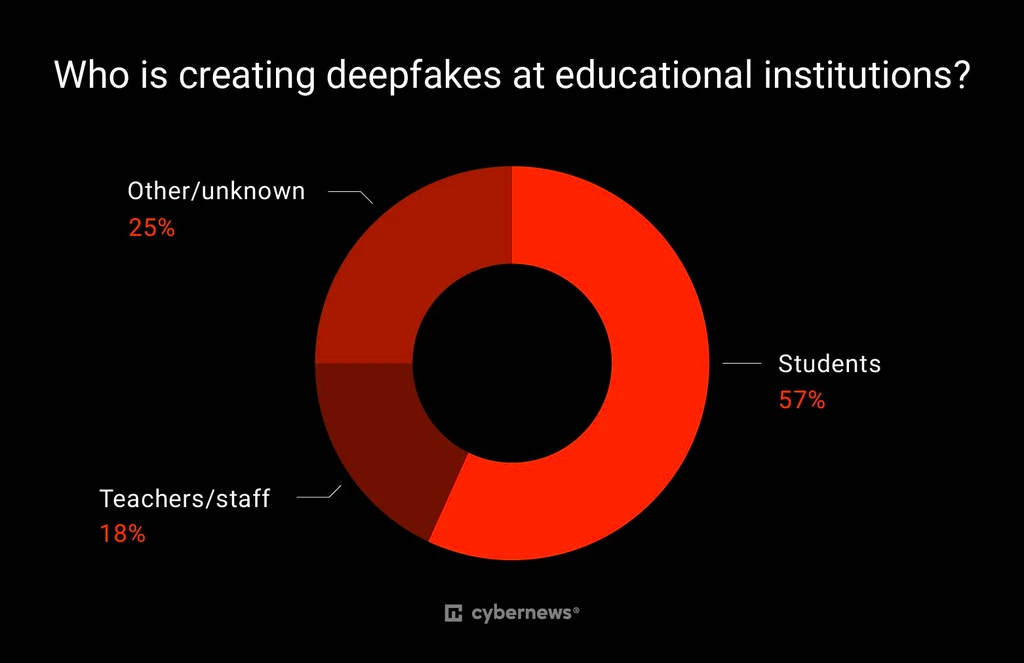
The problem was most common in secondary schools, which accounted for 65% of all analyzed cases. Universities and colleges made up another 19%. Students themselves were also the largest identified group of deepfake creators, being responsible for 57% of incidents.
One such case occurred in Illinois in the United States. Lake Zurich High School administrators contacted police after AI-generated nude images of students appeared. The school learned about the incident in late February 2026, after which it notified law enforcement and contacted the families of those affected. School officials described what happened as a serious violation of the values the institution seeks to uphold in its work with students.
A similar case was investigated in Canada. Two 14-year-old students from Edmonton were charged with using AI to create sexualized images of their female classmates. According to investigators, the teenagers took photos of the girls without their consent and also used images from their social media accounts. They then allegedly used AI tools to create sexualized images, which police say the boys shared with each other on their phones.
A teacher reported the issue to law enforcement after students raised concerns. Police noted that the generated material looked convincing, meaning the harm to victims could not simply be dismissed because the images were artificially created. The two teenagers faced charges including creating and possessing child sexual exploitation material and voyeurism. The investigation was still ongoing at the time of publication.
Another case occurred in Australia, where a Sydney teenager was referred to police for creating sexualized deepfakes of female classmates. Education authorities said such behavior would not be tolerated, while the student faced serious disciplinary action. Support was also provided to the affected students.
Australia already has specific legal mechanisms aimed at addressing such cases. The country’s laws criminalize the non-consensual distribution of sexually explicit material, including deepfakes. Under certain circumstances, creating and distributing this type of content can result in several years of imprisonment.
Although students were the most frequently identified group responsible for creating deepfakes, the problem is not limited to them. In 18% of the analyzed cases, teachers or other employees of educational institutions were identified as the creators of such material.
One of the most notable cases occurred in Australia. A former A.B. Paterson College employee was accused of using AI to create explicit images of students and staff. Police said the investigation lasted nine months and began after allegedly AI-generated explicit content was discovered on the school employee’s laptop.
The 73-year-old man faced four charges related to creating and possessing child sexual exploitation material, possessing child abuse material, and unlawfully using a restricted-access computer. According to police, he used AI software to generate sexualized images of students and school employees.
The school said it immediately reported the material to police after it was discovered and dismissed the employee. At the same time, the institution said it found no evidence that the generated material had been distributed or shared with other people. Relevant education and cybersecurity authorities in Australia were also notified about the incident.
Another case occurred in Libertyville, Illinois. A local middle school teacher was accused of using AI to create sexualized images of students. According to investigators, the case involved material created after students had been filmed directly at school. Law enforcement officials described the investigation as complex and lengthy and said digital forensics and other investigative tools were used to gather evidence. The teacher, who had worked in the school district for 18 years, was placed on leave.
There have also been cases in the opposite direction, with students creating sexualized deepfakes not of classmates but of their own teachers. Taken together, these incidents show that the technology can potentially be used against almost anyone whose photos or videos are accessible to students, school staff, or third parties.
The problem is becoming especially serious because modern image and video generation tools have become so accessible. Creating a convincing deepfake no longer requires specialized knowledge of machine learning, video editing, or graphic design software. In some cases, a user only needs to upload an ordinary photo of a person and give the generator the necessary instructions.
This is clearly illustrated by the Edmonton case, where investigators said some of the victims’ photos had simply been taken from their social media profiles. In other words, an ordinary image that a person posted online and that originally had no sexual context can become source material for creating a sexualized fake.
This accessibility is what sets the current wave of deepfakes apart from older forms of image manipulation. Where producing a convincing fake once required time, technical skills, and specialized software, generative models can now automate much of the process.
For schools, this creates a separate problem: photos of students are often already available on social media, in group chats, school publications, videos from sporting events, or on personal profiles. As a result, someone creating a deepfake may not even need to take a new photo of the victim.
The distribution of victims was one of the most striking findings of the analysis. In cases where the victim’s gender was known, girls or women accounted for 97% of victims. Among cases where the victim’s age was known, 72% involved minors.
At the same time, these figures need to be considered alongside the nature of the incidents themselves. Sexualized content was involved in 71% of cases at educational institutions. In other words, these were not simply harmless parodies, face swaps in photos, or entertaining AI videos, but largely material capable of causing real reputational and psychological harm.
Police in Canada separately pointed to the mistaken belief that an artificially generated image cannot seriously harm someone simply because it is “not real.” Law enforcement officials emphasized that the convincing nature of such images can directly affect victims, including how they are perceived by their peers.
For teenagers, the problem becomes even more serious because of how quickly content can spread through messaging apps and social media. Even if an image is later deleted or proven to have been generated by AI, that does not necessarily undo the harm caused to the person depicted in it.
The 83 analyzed incidents span at least 14 countries. However, among cases where the location could be identified, the largest number was recorded in the United States: 49 incidents, or about 68% of all cases with a known country.
These figures do not automatically mean that deepfakes are used more frequently in American schools than elsewhere. The statistics can be heavily influenced by differences in local media coverage, the willingness of schools and parents to report incidents, law enforcement practices, the level of public attention to the issue, and which sources are included in the database.
In other words, these are known and documented cases rather than a complete picture of every incident worldwide. Some situations may never become public at all, especially when the material is shared in private chats or within a small group of people.
A total of 41 deepfake-related incidents involving educational institutions were recorded in the database throughout 2025. As of September 16, 2026, 42 such cases had already been registered during the current year.
The difference between the two years remains small, but 2026 had already surpassed the total for the entire previous year before the year was over. Altogether, 83 incidents were included in the analysis from the beginning of 2025 through mid-September 2026.
For comparison, the Resemble AI database covers a much broader range of synthetic media abuse, including consumer and corporate fraud, political disinformation, non-consensual intimate content, child sexual exploitation material, and reputational attacks. Incidents involving educational institutions make up only one part of the broader problem.
The data also shows that deepfake abuse has moved far beyond fake videos of celebrities or politicians. These technologies increasingly affect ordinary people, and in many cases a photo, video clip, or other publicly available material is enough to target someone.
The analysis used education-related incidents from the Deepfake & Agentic AI Incident Database as of September 16, 2026. Relevant records were selected based on their connection to educational institutions, categorized, manually reviewed, and checked for duplicates.
If the victim’s gender or age, the type of educational institution, or the country could not be established in a particular incident, that case was excluded from the calculation of the corresponding statistic. That is why, for example, the figure showing that 97% of victims were female applies only to cases where gender was known, while the 72% figure for minors was calculated only from cases where the victim’s age could be determined.
This is an important limitation of the statistics. The data reflects the number of known cases that were documented and included in the database, but it cannot establish the true prevalence of deepfakes across all educational institutions. The actual number of incidents may be higher because some victims do not report cases to school administrators or law enforcement, while others never become public.
Deepfakes in educational institutions have evolved from a technological novelty into a tool that is increasingly being used to create sexualized content involving real people. Girls and women remain the most vulnerable group in documented cases, while minors make up a significant share of victims.
At the same time, the barrier to entry continues to fall: creating a convincing fake image no longer necessarily requires specialized technical skills. This makes clear rules for the use of AI in educational institutions, rapid responses to such incidents, and stronger safeguards built into AI platforms increasingly important.