

02.08.2024
2 min
1282



Google has updated its rules for using personal information, opening the door to using data from emails, cloud storage, and photos to personalize advertising. The changes affect users who allow other Google services, including Gemini and Google Search, to access their personal content.
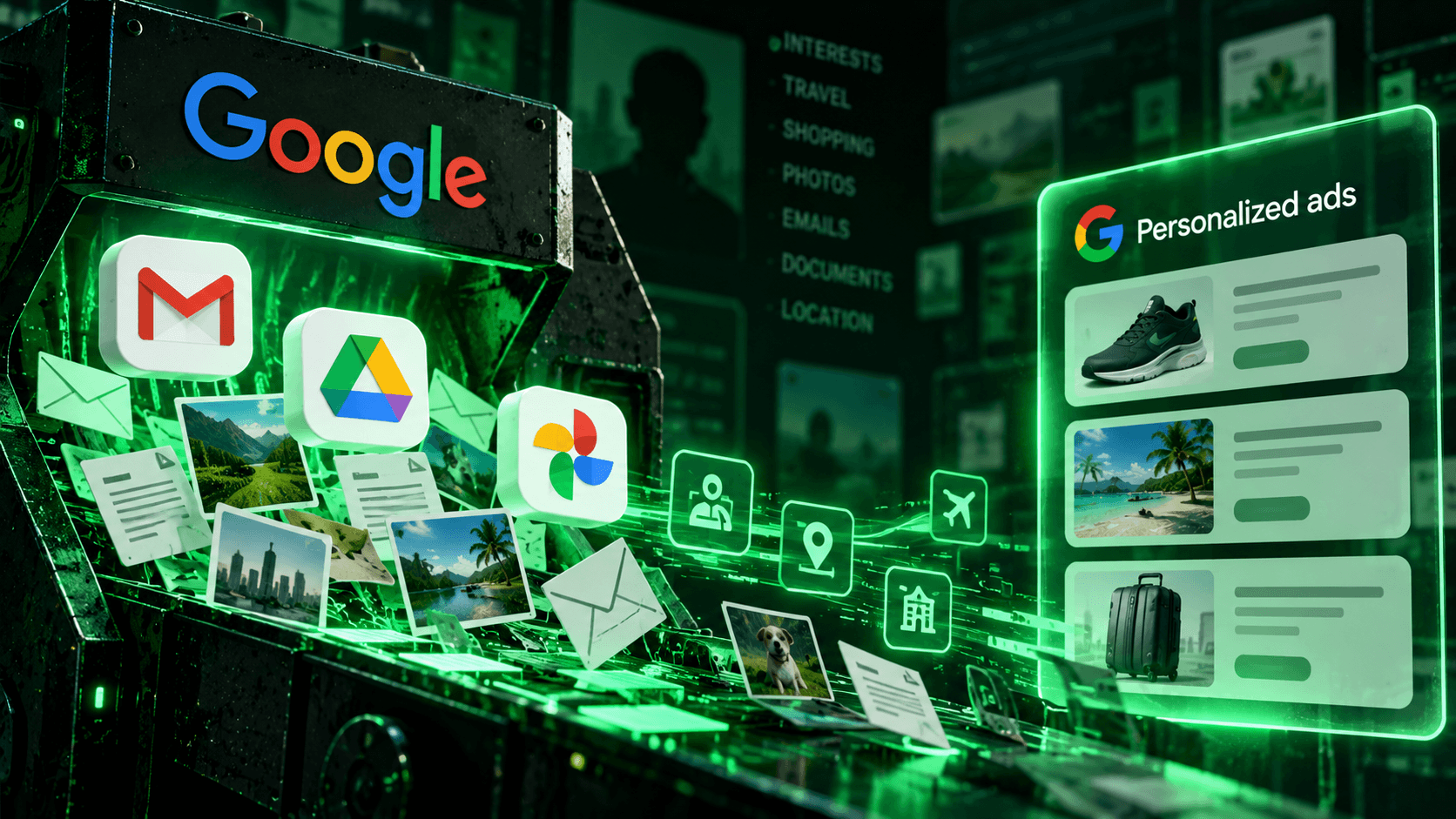
On October 16, 2026, Google updated its Privacy Policy, clarifying the conditions under which information from Gmail, Google Drive, and Google Photos can be used to display personalized advertisements. The new wording has drawn attention to how user data may be shared across the company’s various services.
Google emphasizes that, under normal circumstances, it does not use the content of emails, documents, or photos to target advertisements. However, the policy includes an exception when users explicitly allow other Google products to access this information.
The document states:
“We don’t show you personalized ads based on your content from Drive, Gmail, or Google Photos, unless you choose to share data from these services with other Google services that support personalized ads.”
This means that information users share to improve the functionality of Gemini or Google Search may also influence advertising recommendations under certain settings. In particular, Google explains that Search may process some of the personal data available to it to customize content, including advertisements.
However, the update does not mean that the company will automatically begin scanning all users’ emails or photos for advertising purposes. The key factor remains whether users have granted permission for their personal information to be used across connected services.
Google also assures users that it does not share personally identifiable information, such as names, phone numbers, or email addresses, with advertisers without appropriate consent.
Despite these restrictions, the new wording has raised privacy concerns. Users may agree to provide access to their files to receive more accurate AI-generated responses without realizing that the same information could potentially influence the advertisements they see.
Users who do not want connected services to access their personal content can adjust the relevant settings in their Google Account.
To do this, users need to open their Google Account, navigate to the “Data & privacy” section, locate the personalization and activity settings, and then open the controls for personalized recommendations in Google Search. Under the additional personal information settings, they should find connected content apps and disconnect Google Workspace and Google Photos.
However, disconnecting these services does not guarantee that information Google has already accessed will be deleted.
As Android Authority reports, Google Search history may retain relevant data even after an app has been disconnected or the original file has been deleted. Therefore, restricting future access does not necessarily mean that previously stored information has been erased.
The privacy policy update has sparked discussions on social media. Some users have expressed frustration over how closely Google connects personal data with its advertising systems.
One commenter pointed out that free digital services often come with a hidden cost in the form of personal information.
“People will have to get used to paying for these services. If you’re not paying for the product, you are the product.”
Other participants believe the issue should be addressed through legislation. In particular, one Reddit user called for regulations that would protect personal data and prohibit companies from collecting, storing, and selling personal information.
During a discussion on Reddit, users also questioned the legality of changing privacy terms they had previously agreed to. One commenter noted that major technology companies regularly face lawsuits over similar practices but can afford to pay fines and continue operating.
For some users, the biggest concern is their dependence on Google’s ecosystem, which is not easy to abandon.
“This is cringe. It’s a shame my Gmail account is connected to so many services. Getting rid of all this won’t be easy,” one participant wrote.
Amid the growing dissatisfaction, users began sharing alternatives to Google products that they had already switched to or were considering. The options mentioned included Proton Mail for email, Brave Search for web searches, and iDrive for cloud backups.
Google’s privacy policy update does not introduce the automatic use of all Gmail, Google Drive, and Google Photos content for advertising. However, it explicitly allows such use when users grant other Google services that support personalized advertising access to their data.
As a result, allowing Gemini or Google Search to personalize responses may have broader consequences than users expect. To limit how their personal information is used, users should review their connected services and personalization settings in their Google Account.