
06.09.2026
6 min
353



A developer used OpenAI’s new Frontier model, Astra, to decipher a German military radio message that had remained a mystery to cryptanalysts for more than a century.
Intrigued by claims that OpenAI’s new language model, released this month, is capable of solving complex problems, a developer named Prinz decided to test GPT-6 Astra on one of the world’s best-known unsolved cryptographic puzzles. It is part of a list of roughly 50 ciphers that have yet to be fully cracked. Such ciphers alter the structure of a message so that it cannot be read without the correct key.
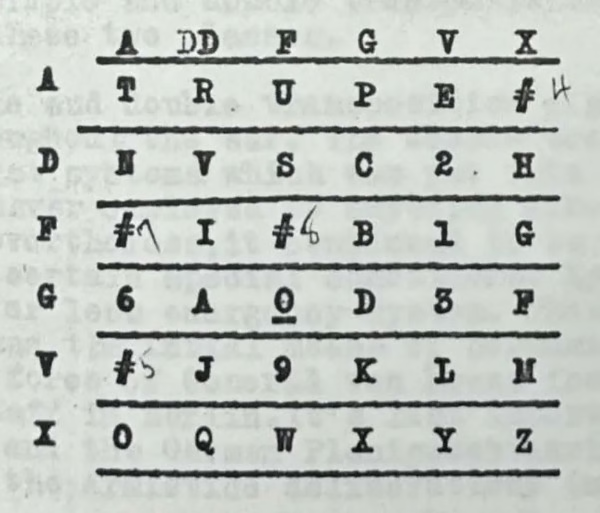
Prinz tasked Astra with deciphering one of the messages from a collection of German World War I radio transmissions encoded using the ADFGVX cipher. This was a German military cipher in which letters and numbers were represented using combinations of just six symbols: A, D, F, G, V, and X.
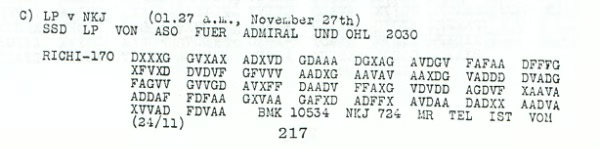
At the time, the German military used a special grid whose structure changed depending on the keyword. Prinz selected a message transmitted on November 27, 1918, and gave it to Astra for analysis. The model’s task was to reverse the encryption process and identify the key that would turn the long sequence of symbols into meaningful German text.
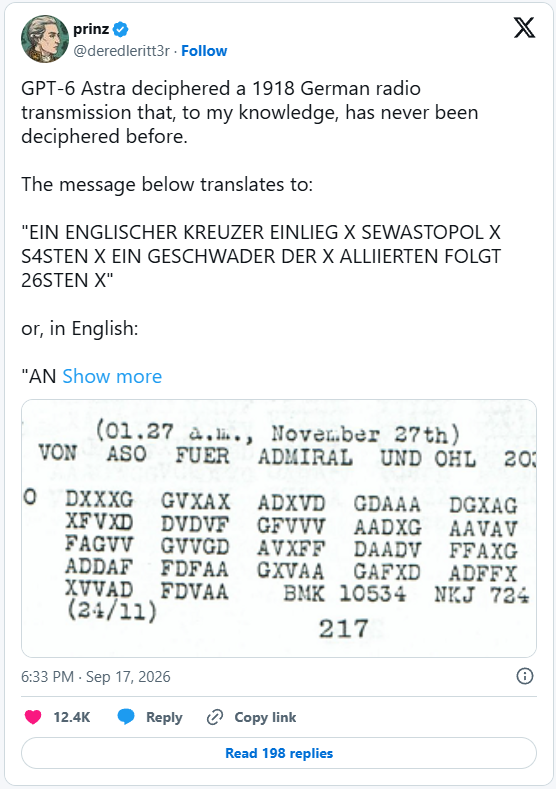
Prinz writes in his blog that the breakthrough came after Astra decided to use TRUPPENVERSCHIEBUNG, a documented German encryption key. Roughly translated, the word means “troop movement” or “redeployment of troops.”
The word itself is not part of the message. It serves as a key that determines how the elements of the ciphertext must be rearranged to reconstruct the original message. To use it, the letters in TRUPPENVERSCHIEBUNG first had to be sorted alphabetically. This determined the order of the columns in the decoding table built from the encrypted message.
The word TRUPPENVERSCHIEBUNG was then written horizontally, with the encrypted message arranged beneath it in rows of 19 characters.

The resulting German text looked like this:
“EIN ENGLISCHER KREUZER EINLIEG X SEWASTOPOL X S4STEN X EIN GESCHWADER DER X ALLIERTEN FOLGT 26STEN X.”
The message stated that an English cruiser had arrived in Sevastopol on the 24th, followed by an Allied squadron on the 26th.
What made Astra’s work notable was not just the decryption itself, but also the way the model compared the result with information from several independent sources. Prinz notes that Astra checked the decoded text against historical documents and found that the British cruiser HMS Canterbury had indeed arrived in Sevastopol on November 24, 1918. This is confirmed by the ship’s original logs. Historical records also show that an Allied squadron arrived there on November 26.
Astra then proposed an explanation for why the message may have remained unsolved for so long. It had previously been believed that the TRUPPENVERSCHIEBUNG key was first used only on December 9, 1918, while the message itself had been transmitted on November 27. Because of this discrepancy, researchers may simply not have considered the key a possible match for a radio message sent earlier.
Prinz said the experiment offered a clear demonstration of Astra’s ability to handle complex tasks by combining cryptographic analysis with historical context. After the first experiment, the developer reported that the model had also managed to decipher another message using a similar approach.
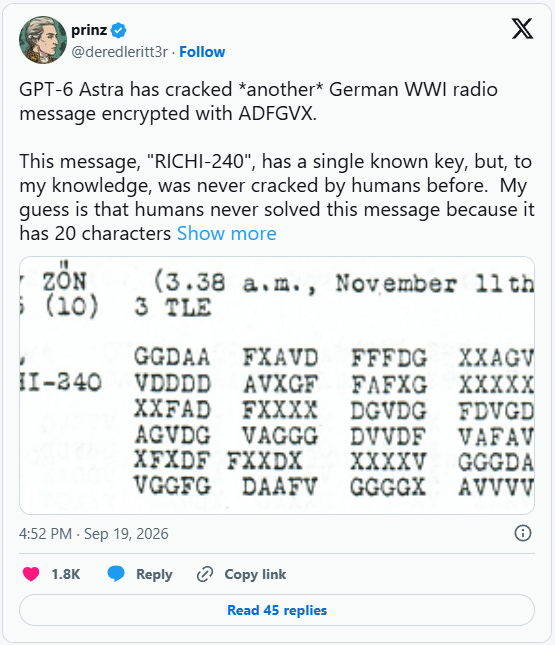
Prinz reported on X that GPT-6 Astra had also deciphered a previously unsolved German World War I cipher known as RICHI-240. Once again, the model combined cryptographic analysis with historical data from multiple sources. The decrypted November 1918 message stated that Serbian forces had occupied the city of Vršac.