


Unknown hackers breached emergency alert apps in Ukraine and Russia, causing users to receive fake warnings about nuclear threats, chemical contamination, and missile attacks. Authorities in both countries officially confirmed the breaches, but it remains unclear whether the same attackers were responsible.
The first target was Ukraine’s Air Raid Alert app. Late on November 1, users began receiving fake notifications warning of radiation and chemical hazards, possible street fighting in Kyiv, and an allegedly imminent strike by a Russian ballistic missile.
In just seven minutes, the attackers sent 122 fake alerts across Ukraine. The messages were written in Ukrainian, Russian, and English and were apparently intended to spread panic among the population.
One of the notifications read:
“There will be a nuclear threat across Ukraine. Don’t worry, Oreshnik is already on its way.”
The message referred to Oreshnik, a Russian intermediate-range ballistic missile. The warnings had no connection to any actual threat.
🇺🇦🇷🇺 Ukraine and Russia were hit by fake nuclear threat alerts just hours apart.
It started in Ukraine, where the country's air raid warning app suddenly told people in Kyiv that radiation had been detected.
But that wasn't all.
More alerts followed, warning of a chemical… pic.twitter.com/V1zSVv85Qt
— Mario Nawfal (@MarioNawfal) November 2, 2026
Approximately three hours after the incident in Ukraine, a similar attack occurred in Russia. This time, hackers gained access to the Russian Ministry of Emergency Situations’ mobile app and began sending false warnings to millions of users.
The messages falsely claimed that nuclear warheads had been launched toward all regions of Russia using P1-SUN delivery systems. People were urged to immediately stock up on three weeks’ worth of food and take shelter in basements.
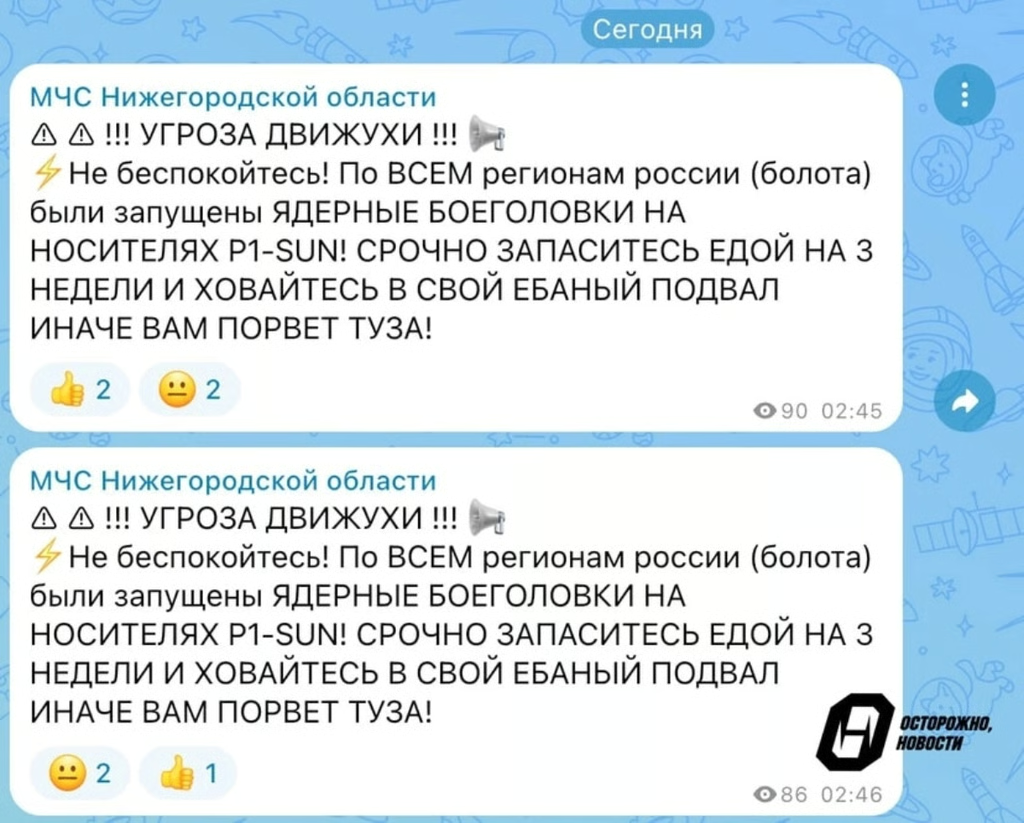
Some of the notifications contained profanity and outright mockery. In one of the messages, the hackers wrote:
“Don’t worry! NUCLEAR WARHEADS ON P1-SUN DELIVERY SYSTEMS have been launched at ALL regions of russia (the swamps)! URGENTLY STOCK UP ON FOOD FOR 3 WEEKS AND HIDE IN YOUR FUCKING BASEMENTS, OR YOU’RE FUCKED!”
Interestingly, the P1-SUN mentioned by the hackers is not a nuclear weapons delivery system at all. It is actually a Ukrainian interceptor drone developed by SkyFall, designed to destroy Russian attack drones, particularly Shahed drones.
Following the appearance of the fake alerts, the responsible agencies in both countries issued official statements. They confirmed that their mobile applications had been compromised and temporarily disabled push notifications to stop the spread of false warnings. The services were later restored.
Ukraine’s State Emergency Service announced on its Telegram channel that the nationwide alert system remained operational.
The russian Ministry of Emergency Situations also acknowledged a large-scale cyberattack on its mobile application. In a statement issued on November 2, the ministry said that attackers had managed to distribute false information to the public and that specialists were working to address the vulnerability and restore normal service operations.
However, the exact method used to breach the alert systems and the identities of the attackers remain unknown.
Despite the similar nature of the fake alerts and the short interval between the incidents, there is currently no evidence that the same group carried out both attacks. BBC cyber correspondent Joe Tidy reported, citing a source within Ukraine’s hacktivist community, that the attacks may have been retaliatory actions against one another.
According to one Ukrainian hacktivist, targeting emergency alert systems had previously been avoided for moral and ethical reasons. However, similar incidents have occurred before. In February 2023, hackers compromised russian emergency alert systems, causing false air raid warnings to sound across several regions of russia and occupied Crimea.
The latest attacks have once again demonstrated how compromised emergency alert systems can turn a tool designed to warn people about danger into a channel for spreading panic. Although notification services have been restored, protecting these systems remains particularly important during wartime.