22.07.2026
4 min
213



Cybersecurity researcher George Lubaretsi has discovered that OpenAI now blocks cyber verification in 44 countries where ChatGPT is officially available. As a result, researchers are effectively losing access to the company’s more powerful cybersecurity tools.

According to Lubaretsi’s estimates, these markets have a combined population of around 650 million people. This figure excludes countries where ChatGPT is not officially available.
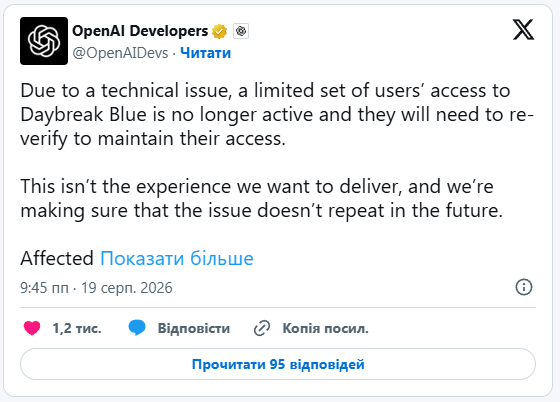
According to the researcher, the country-based restriction appeared around August 19, when OpenAI reported a “technical issue.” As a result, some users had to complete the verification process again to retain access.
By that point, OpenAI had already approved Lubaretsi’s Georgian ID and granted him Trusted Access for Cyber (TAC). The company describes TAC as an identity- and trust-based system “designed to help ensure enhanced cyber capabilities are placed in the right hands.”
The new reverification requirement revoked his access and forced him to go through the process again. The problem was not limited to Lubaretsi. TechCrunch spoke with five researchers who said they had also lost access to TAC. All of them are based outside the United States and Europe.
Lubaretsi tried submitting his ID again and completing a facial scan through Persona, the third-party identity verification service used by OpenAI. This time, however, the process did not work.
He repeatedly received the following message: “Your identity couldn’t be verified or your account is ineligible at this time.” The researcher tried completing the verification process using different browsers and devices, but nothing helped.
Lubaretsi published his redacted correspondence with OpenAI support. In it, he explained that he had attempted the verification process eight times using the same ID that the system had previously accepted.
On August 25, a support representative responded: “The information provided indicates that you completed the verification flow. However, completing the flow does not mean that verification was approved.”
OpenAI currently states in its FAQ section that support cannot manually override a verification result or provide additional information about the reasons behind a specific decision. Retries and appeals are also not supported.
About a week after his initial attempts, Lubaretsi discovered that OpenAI no longer allowed holders of Georgian IDs even to begin the verification process. The system immediately displayed the following message: “We are unable to verify identities in this country. Please select another country.”
Lubaretsi then tested 250 country and territory options in OpenAI’s verification system. He found that government-issued IDs were not accepted for cyber verification in 73 cases.
ChatGPT is officially available in 44 of these countries and territories. The list includes Georgia, Armenia, Aruba, Azerbaijan, Kazakhstan, Mongolia, Moldova, Vietnam, Vatican City, Afghanistan, and Cambodia.
China and Russia also appeared on the list, but the researcher did not include them in the count because ChatGPT is not officially available there.
Lubaretsi also found that cyber verification was blocked in all 35 countries and territories included in US export control Country Groups D:1 and D:5. Group D:1 includes countries subject to US export controls over national security concerns. Group D:5 covers countries subject to US arms embargoes.
According to the researcher, the exact overlap may indicate that OpenAI is using decades-old export control classifications as part of its country-based restrictions. The company itself has not confirmed this.
Lubaretsi argues that applying the same restrictions to every country, including Georgia, makes little sense. Georgia’s D:1 status stems from classifications inherited from the former Soviet region, even though the country has changed dramatically over the following decades.
At the same time, it is important to consider whom such measures can actually stop, Lubaretsi warns.
“Adversaries already use these models and route around access gates. The attackers I defend against do not queue politely at Persona with their real government IDs, turning their heads slowly to the left and right,” he writes.