03.06.2024
5 min
1769



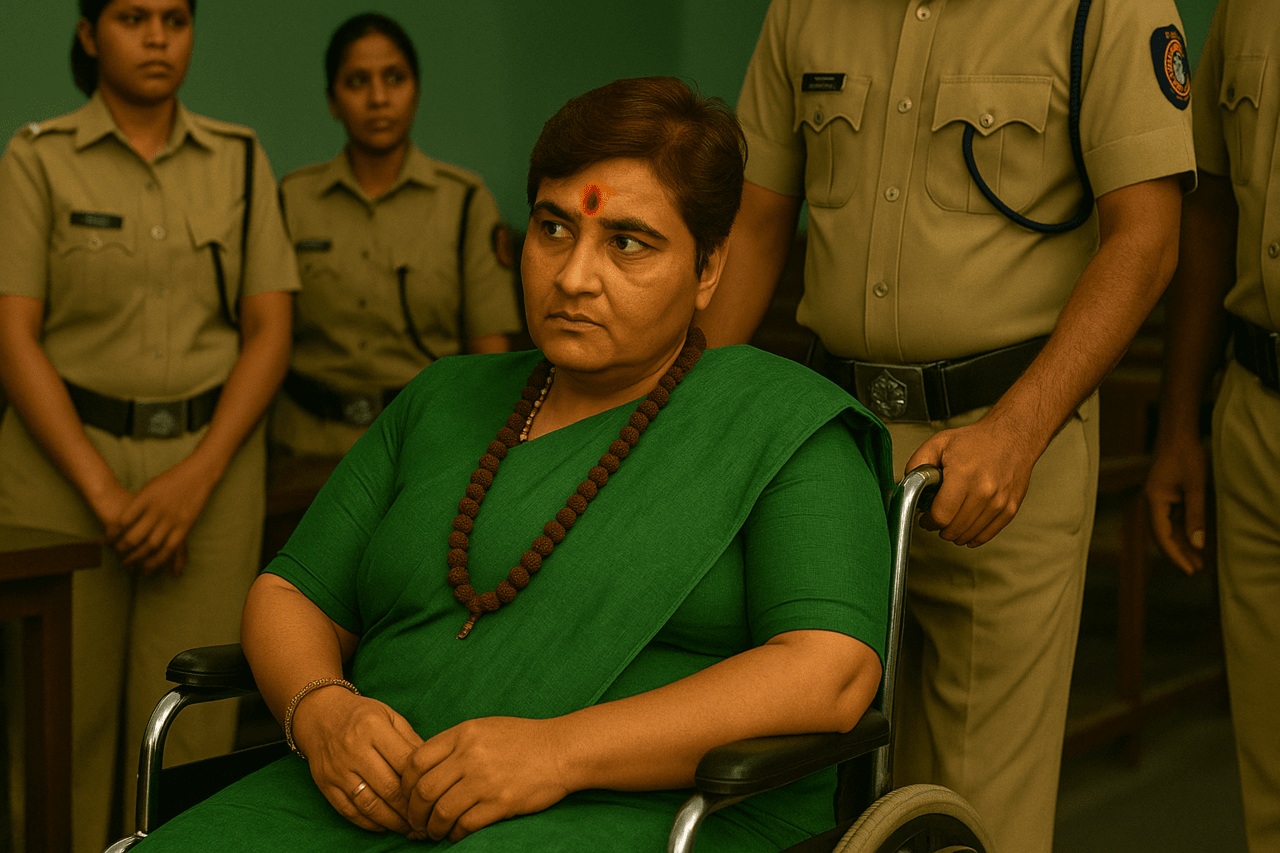
The 2008 Malegaon terror attack remains one of the most controversial cases in modern Indian history. The central figure in the trial was Pragya Thakur, a current BJP MP who was an accused. However, court documents show that she was present in the courtroom only a few times during the years of hearings. Most of the hearings were held without her participation, as lawyers cited numerous medical certificates.
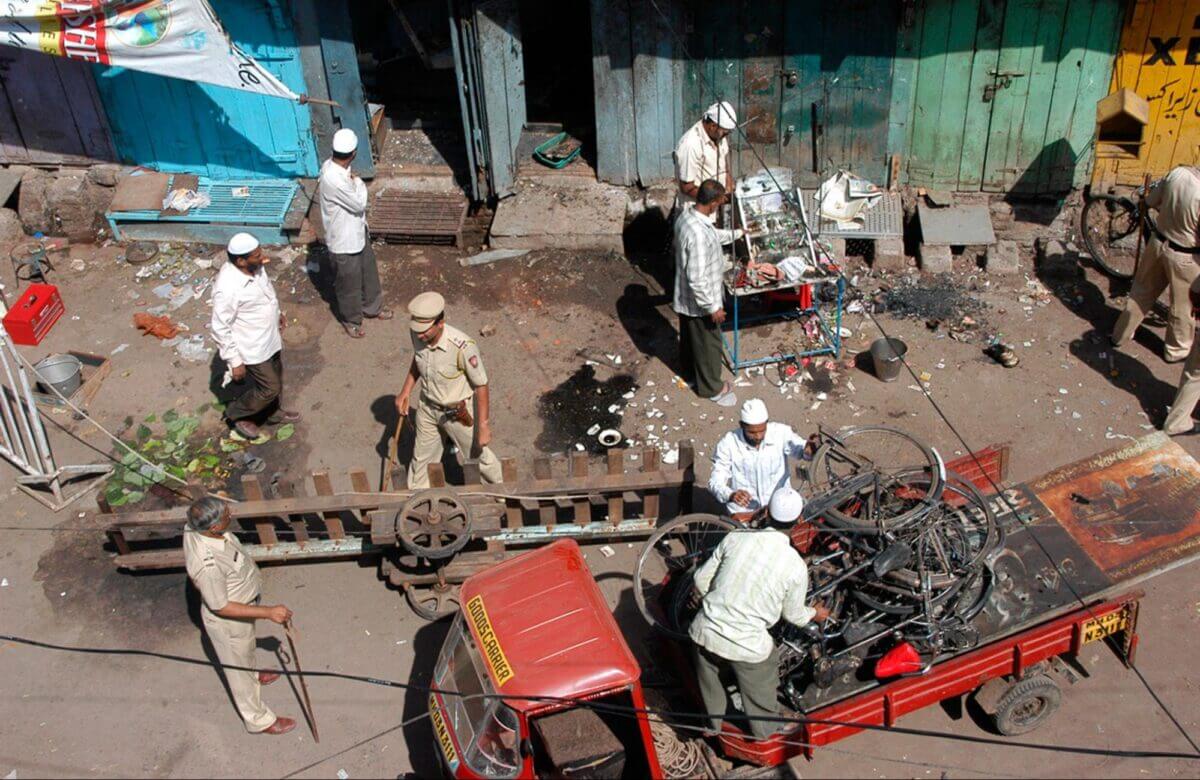
On the night of September 29, 2008, a bomb exploded in the crowded Muslim town of Malegaon, in the state of Maharashtra in India, killing six people and injuring more than a hundred others. Investigators say the blast was caused by a bomb planted on a motorcycle registered to Pragya Chandrapalsingh Thakur, then a 38-year-old nun and activist in the Hindutva (or Hindu nationalist) movement. Thakur was the most prominent of the seven people arrested and charged in connection with the bombing. Nearly 17 years later, all the accused were acquitted, with the judge reportedly saying that the prosecution could not prove that the bomb was planted on the motorcycle or that it belonged to Thakur.
Appearing in court on Thursday, Thakur reportedly told a judge that the investigation had “ruined [her] life.” Several media outlets quoted her as saying that investigators had “arrested and tortured” her. She also called her acquittal a “victory for Hindutva.”
Meanwhile, a lawyer for the victims’ families reportedly vowed to challenge the acquittals in India’s High Court.
Thakur’s appearance in court on Thursday was a rare one: she was absent for most of the hearing, citing medical reasons, including a brain swelling, deteriorating eyesight, and a doctor’s recommendation to stay in bed “due to multiple ailments.”
Appearing in court on Thursday, Thakur reportedly told a judge that the investigation had “ruined [her] life.” Several media outlets quoted her as saying that investigators had “arrested and tortured” her. She also called her acquittal “a victory for Hindutva.”
Meanwhile, a lawyer for the victims’ families reportedly vowed to challenge the acquittals in India’s High Court.
Thakur’s appearance in court on Thursday was a rare one: she was absent for most of the hearing, citing medical reasons, including brain swelling, deteriorating eyesight, and a doctor’s recommendation to stay in bed “due to multiple ailments.”
In 2019, Thakur was elected as a member of parliament from the central Indian state of Madhya Pradesh for the ruling Hindu nationalist Bharatiya Janata Party (BJP) and served in that position for five years before stepping down in 2024 at the end of her term.
This is the second criminal case in which Thakur has been charged and then acquitted due to lack of evidence.
She was previously charged and acquitted in 2017 for being one of eight people involved in the December 2007 murder of Sunil Joshi, who was reportedly a close aide of Thakur before their falling out.
Joshi was a suspect in the 2007 Samjhauta Express train bombing that killed 68 people, mostly Pakistani nationals. According to local reports, the court acquitted Thakur and her co-accused, finding that the case was not investigated with “due seriousness” by the NIA and the state police, who they said had provided “weak and inconsistent evidence”. Thakur was not present in court when the verdict in the case was delivered.
When the BJP fielded her as a candidate in the 2019 general elections, Thakur was charged with terrorism, murder and criminal conspiracy in connection with the 2008 Malegaon blast.
Nisar Ahmed Syed Bilal, whose son was one of the victims of the Malegaon blast, had filed a petition in the trial court to bar her from contesting the elections, but it was rejected.
Thakur won her seat by a wide margin over her opponent, a two-time chief minister of the state, and remained a member of parliament for five years.
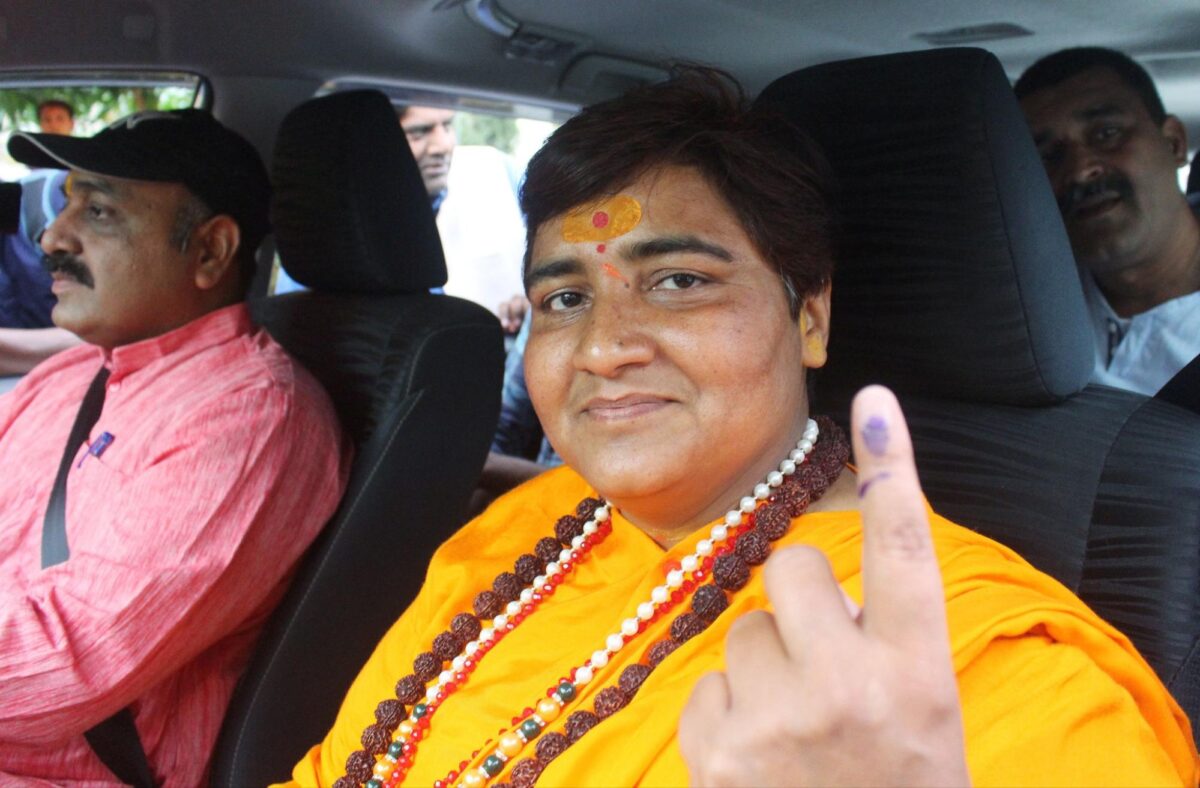
While in office, Thakur continued to be a controversial figure. She was often quoted as making provocative comments against the country’s Muslim minority, including accusing them of waging a “love jihad” and encouraging Hindus to arm themselves against Muslims by sharpening their kitchen knives. This was despite the fact that she represented a constituency with a sizeable Muslim population of over half a million, according to the latest 2011 census.
In one of her speeches in Parliament in December 2023, Thakur criticised the previous government for allowing Muslims accused of crimes to get bail “despite the fact that they are criminals”, although she herself had been released on bail.
She has also been quoted in reports claiming that cow urine could protect against Covid-19, and that the same substance cured her of breast cancer. However, the surgeon who operated on her said in an interview that she had undergone a mastectomy due to the latter condition. One of her lawyers, lawyer JP Mishra, also told Bellingcat that Thakur had undergone two surgeries while in prison and one after her release to fight cancer.
The verdict, handed down on Thursday, marks the end of one of the country’s longest-running terrorism trials.
Procedural delays are not uncommon in India’s justice system – it reportedly has a staggering 50 million pending cases – but an analysis has shown that this case has taken far longer to resolve than other similar cases under India’s Unlawful Activities (Prevention) Act (UAPA). Data from the special NIA court, which deals only with UAPA charges, shows that the five other trials registered as completed as of July 25 this year took an average of 19.6 months to resolve. The Malegaon case was heard 1,187 times over a period of 84 months before Thursday’s verdict.
In the Indian justice system, each case pending in a court is assigned a unique case number (CNR), which is used for all documents related to that case.
The CNR can change when a case is transferred between courts. For example, the Malegaon case had a different CNR for 10 years while it was being investigated by the ATS before it was transferred to the NIA.
A search on the e-courts website for the case number MHCC020159052016 returned 1,187 unique court records from July 5, 2018 to May 8, 2025.
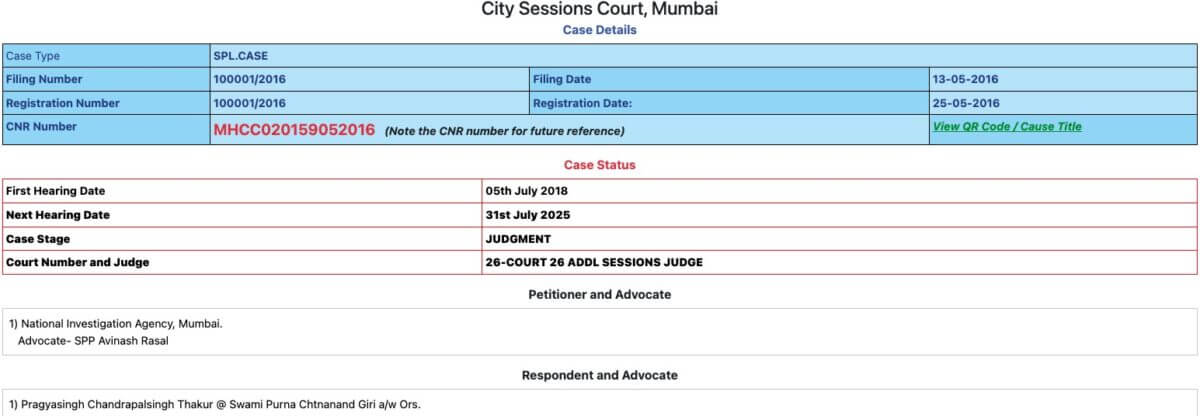
We focused on hearings that took place after closing arguments began on July 24, 2024, and continued through May 8, 2025, when the verdict was originally scheduled to be delivered. The May 8 hearing was rescheduled for July 31, and no other court proceedings were recorded between that date and Thursday’s verdict.
Of the 162 court records we retrieved during this period, one case from October 17, 2024, had no record in the documents, making it impossible to determine whether Thakur was present or not.
For the remaining 161 documents, we manually checked the text to determine whether Thakur was recorded as present. The full dataset for these documents, as well as the evaluation by two independent coders (the author and editor of this article), is available here.
Our analysis showed that Thakur was recorded as present only three times during this period – first on January 30, 2024, more than six months after closing arguments began, at a hearing the following day, and again on May 8 of this year, when sentencing was originally scheduled.
Court documents and local reports indicate that Thakur’s absence from the case goes back years. While the court accepted medical certificates provided by her lawyers, the judges presiding over the case also repeatedly noted her absence, with one judge in 2019 specifically stating that she should be in court at least once a week. In December 2020, the prosecution argued that she appeared to have been deliberately avoiding court appearances. “They seem to have taken the trial and the court for granted,” attorney Shahid Nadeem, representing the victims, said in an email before the verdict.
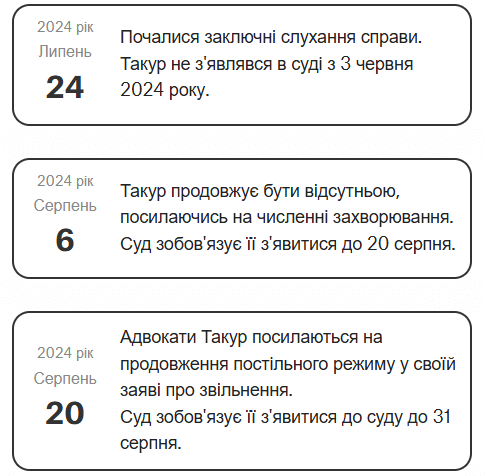
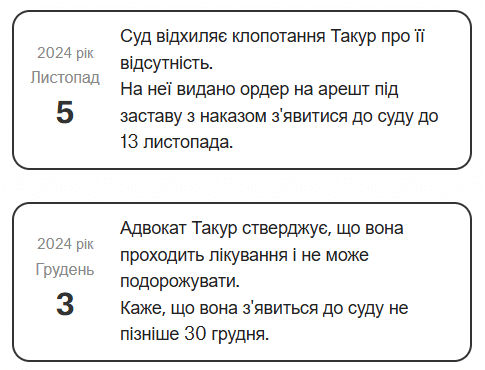
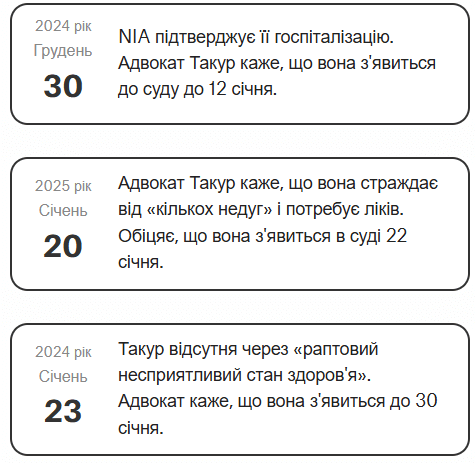
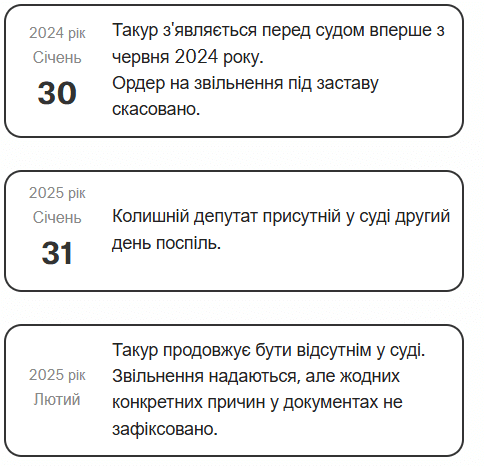
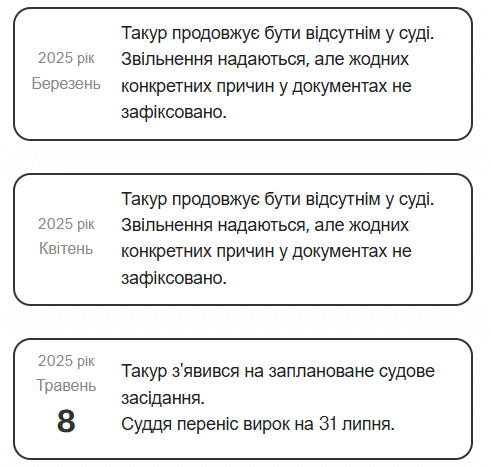
Thakur claimed that her absence from court was justified by medical reasons, including conditions she said were caused by “torture” while in ATS custody. During her tenure as an MP, the court also granted her exemptions from court based on her lawyers’ arguments that she needed to attend parliamentary sessions.
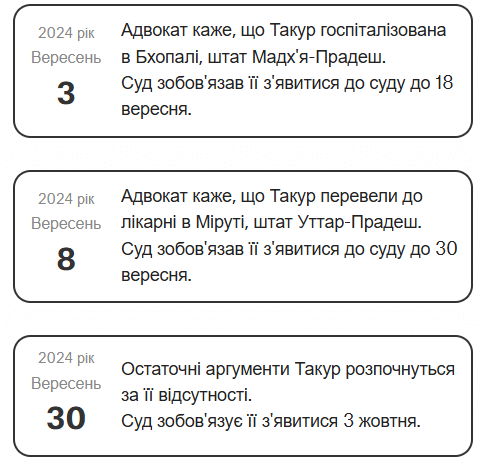
On September 3, 2024, Thakur’s lawyers filed an application for exemption from her court appearance, stating that she “suffers from a neurological problem with cerebral edema and cannot see properly.” The court granted the application on the condition that exemptions be filed for each day of the case until Thakur’s appearance, stating that she must appear no later than September 18.
A week after this statement, on 10 September, a local BJP leader from Bhopal posted a video on Instagram of Thakur attending a foundation laying ceremony for a temple in the city of Madhya Pradesh. Bellingcat was unable to independently verify when this foundation laying ceremony took place, or whether it was during a period when Thakur’s lawyers say she was seriously ill. Bellingcat emailed Kishan Suryavanshi, the local leader who posted the video, to ask when it was recorded, but had not received a response at the time of publication.
On 18 September, Thakur’s lawyers filed another statement, stating that she had been shifted from a hospital in Bhopal to a hospital in Meerut, in the neighboring state of Uttar Pradesh. The statement said that her health had deteriorated, that she “could not see properly” and that her recovery “would take a long time.” The court granted this application with the same condition that her lawyers would have to file discharge applications for each hearing in which she was absent from the court by September 30.
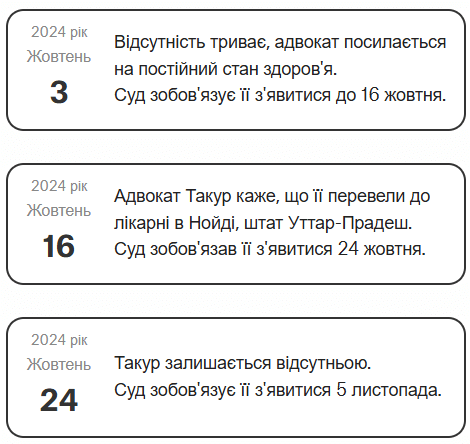
When another application was filed on September 30 on similar grounds, Special Judge A. K. Lahoti warned Thakur that she should appear by October 3 or face a court order. On the same day, one of Thakur’s lawyers began presenting closing arguments in her case.
Despite this warning, the judge continued to grant discharge applications for Thakur throughout October as the court continued to hear the final hearings on the charges against her. Finally, on November 5, 2024, Lahoti rejected Thakur’s lawyers’ application for another discharge.
According to court documents, the application was filed along with a photocopy of a medical certificate confirming that Thakur had undergone “panchakarma treatment.” This could refer to panchakarma, a type of Ayurvedic or alternative medical treatment. Mishra, Thakur’s lawyer, said that Thakur was at an Ayurvedic hospital in Meerut at the time.
In response, Lahoti issued a bail warrant for Thakur in the amount of 10,000 Indian rupees ($114), saying that a final hearing would be held and that Thakur’s presence was “necessary.” A bail warrant is an arrest warrant that allows the release of an accused on condition that he or she posts a bond guaranteeing his or her appearance in court.
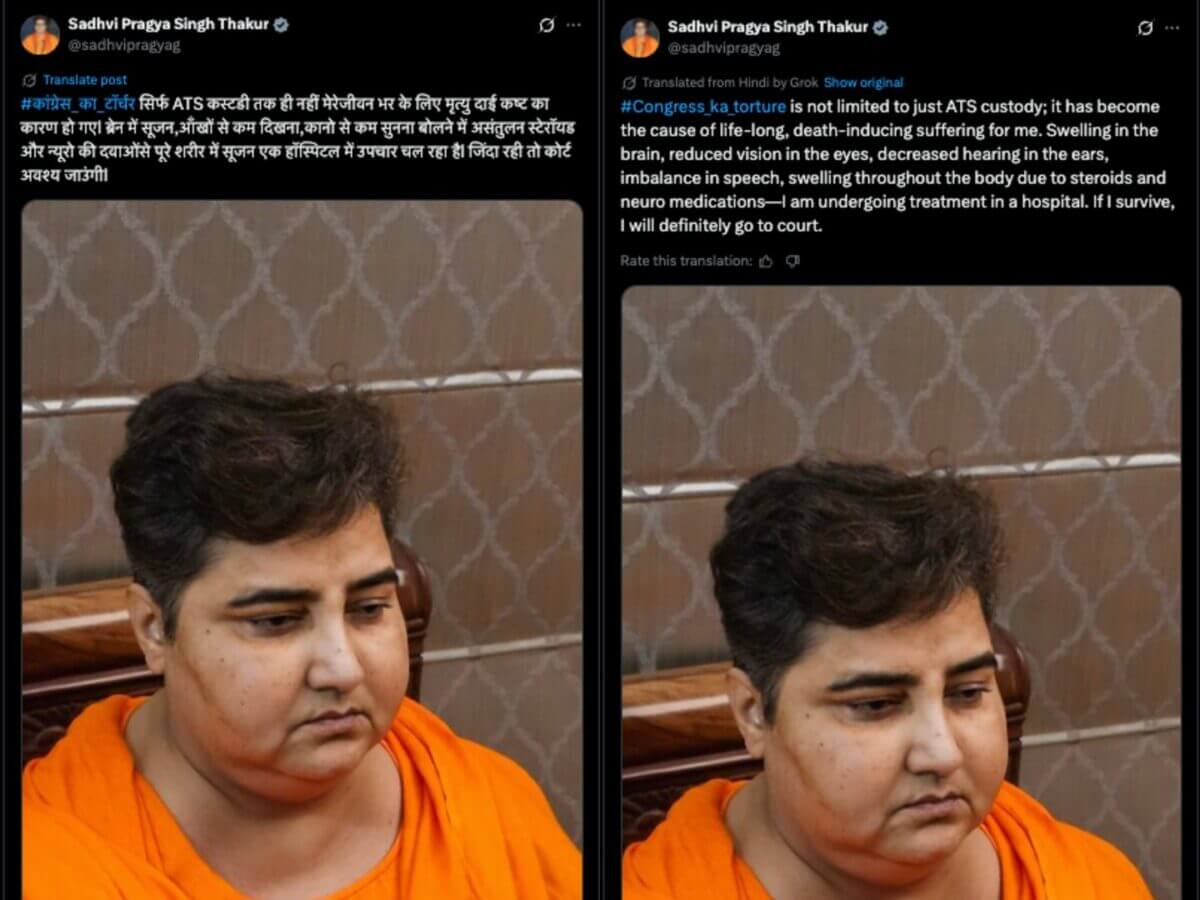
The next day, a photo of Thakur was posted on her X profile, showing her face looking slightly swollen. In the caption, she appeared to accuse the Indian National Congress of causing “torture” and “suffering,” including brain swelling and hearing and vision impairment. The last line of her post in Hindi translates as: “If I survive this, I will definitely go to court.”
Thakur’s trial was controversial. In 2015, the former special public prosecutor (SPP) assigned to the case, Rohini Salian, claimed that the NIA had asked her to “tenderize” the case, but the agency denied the allegation.
Nadeem, the victims’ lawyer, said: “As far as the appearance of the accused during the trial is concerned, the NIA prosecutor has not objected to the accused’s plea for exemption in most cases.”
“Victims have limited rights in criminal proceedings,” he said.
Bellingcat contacted three senior officials in the NIA’s Counter-Terrorism and Radicalisation Branch, which is part of India’s home ministry, to discuss how the agency viewed Thakur’s absence from the court. Officials had not responded to multiple emails at the time of publication.
Current senior prosecutor Avinash Rasal said Thakur had cited medical reasons for her absence during closing arguments, and that the court had taken her reasons into account. “The case was never adjourned due to the absence of the accused. Their lawyers were always present,” he added.
The analysis shows that Thakur’s lawyers were present for all 161 hearings since the closing arguments began.
At least twice in October 2024, a judge accepted applications for exemptions filed for her absence, stating that her lawyers were present and her absence “did not create any hindrance to the smooth running of the trial.” However, the same judge said the following month that her presence was necessary for closing arguments.
Rasal said that the prosecution was “not under any pressure” because of Thakur’s position as a member of parliament.
“No one was given any special treatment.”