30.05.2024
14 min
2633



We are talking about Alan Cox, an important programmer and developer who played a key role in the development of Linux. The article covers his life, from his early fascination with computers, his university studies and his first steps in programming, to his contributions to the networking capabilities of Linux and his subsequent career at Red Hat.

Do you think Linux would be as popular now if it didn’t have good network support? And if he did not have the necessary stability? We don’t think so, and the fact that Linux as we know it today is a very big advantage for Alan Cox, “second in command after Linus Torvalds.”
Now many people know Alan as a well-known IT specialist. But in fact, he is more of a programmer than a speaker, but it is difficult to deny him eloquence. He was born in Solihull, England on July 22, 1968. Alan’s first computer was a ZX spectrum128. The boy became interested in computers and, as we can see, it turned from a child’s pastime into his work and fascinated him for the rest of his life.
Entered the University of Wales (University of Wales, Swansea) in Swansea. Then there were 3 computers that allowed me to work for 1 day for 15-20 minutes, but it was already very good. Give him free time and thank the teachers who worked with him in the evenings after work.
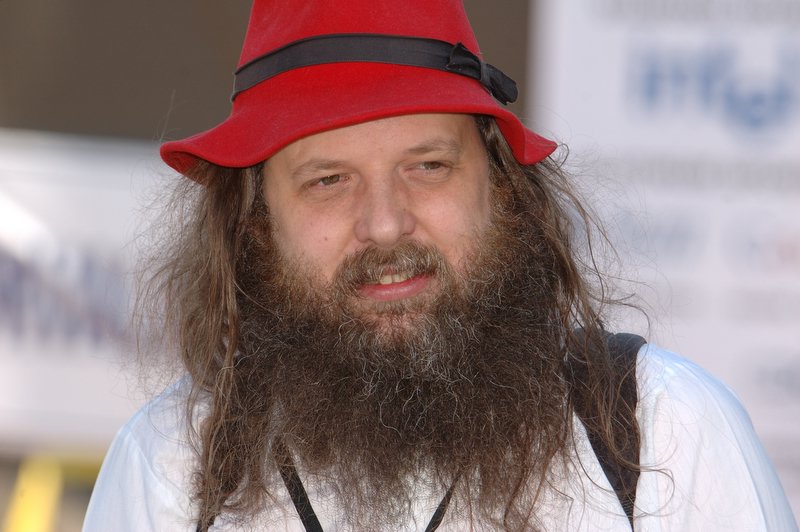
At the same time, he worked in the gaming world and helped port the Scott Adams games to PC in the UK. This gave him many opportunities to represent the world of IT at that time. So he created his first computer game.
Then he entered Aberystwyth University (University of Wales, Aberystwyth). While studying at this university, he was destined to see Linux for the first time. Why did he choose Linux? The fact is that at that time, according to him, he was terribly fond of text games. And Linux was perfectly suited for the development of his text game AberMUD. The name of the game comes from the name of the university. A team of students worked on the game, and as a result, they created the first such popular game. The game still has fans, it’s gone through about 20 versions in that time, but you can still find players out there.
When he was studying at Aberystwyth University and working part-time on the university campus, he had many hiccups and hiccups in the system from a networking perspective after he installed Linux on a working computer network for the first time ever. Alan’s inquisitive mind and skillful hands began to remedy the situation, and eventually he became a member of the Linux community and joined the core system developer.
In the first version, Linux was not designed to work on a network. By 1993, the TCP/IP stack was implemented. A team was formed to remedy this situation. In fact, the TCP/IP stack was the first major subsystem that was almost entirely developed without Linus’ input (Linus was not strong in networking).
He has been working as a consultant for red Hat since 2000, and his work has helped Red Hat stay on top of the “Linux distribution wave” for many years. For several years (1998-2002), the symbol of the red hat was a miniature profile of Alan’s head. Before that, he managed to work at Cable Online and 3Com Corporation.
Alan maintained the Linux2.2 branch and his own -2.4, which was usually denoted by the letters ac (eg 2.4.9-ac). As you can guess, ac is the initials of our hero and his nickname. Version 2.4 was very stable and included bug fixes. During this period, he clearly surpassed Linus Torvalds in the Linux community.
His role as a Linux kernel support specialist proved to be very beneficial to the entire Linux community, as he was able to compensate for Linus’ obvious personal problems: “Linus is a great developer, but a terrible engineer,” Cox said in an interview. “Alan’s huge contribution has made it possible for Linux to come to home computers,” he said. Because of this, he often worked without sleep for several days in a row. His efficiency is impressive: he was a man worth a dozen developers.
He supported the development of the kernel until 2002. Then he resigned. He also participated in the development of GNOME,X.Org.
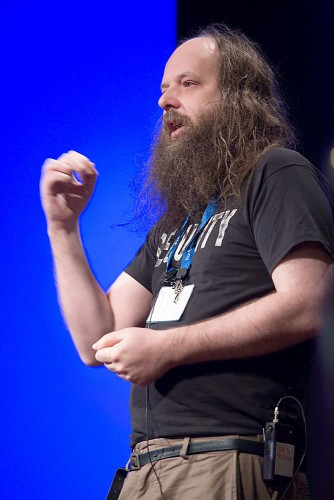
Alan is now known as an activist in the free software movement. He has long opposed the use of DMCA (Digital Millennium Copyright Act) and CBDTPA (Consumer Broadband and Digital Television Promotion Act) licensing patents. These patents prohibit not only the copying and distribution of copyrighted material, but also the production and distribution of technologies that allow circumvention of the copyright protection system.
In 2001, the big DMCA scandal broke out. Russian programmer Dmytro Sklyarov was later arrested by the FBI at the DefCon conference on charges of hacking Adobe’s electronic document protection system. The fact is that Sklyarov developed an algorithm for the Advanced ebook Processor program. This allows you to bypass the protection of electronic books in PDF format. DefCon has published a report on the harm of e-books, including in PDF format.
He accompanied all this with an example Using an advanced processor to work with e-books. And at the end of the meeting, he was arrested. As a result, despite the fact that he was released on bail and fully acquitted, Sklyarov spent several months in an American prison, and this case caused a great resonance. After Sklyarov’s arrest, Cox refused to attend a large Usenix meeting, at which he was considered a member of the organizing committee. He also called on all programmers who are not US citizens to boycott the event in the US, and the organizers to hold rallies in other countries. Who will be the next one to end up in an American prison for several years for speaking at a rally and doing nothing? – asks Cox in an interview.
Cox has received many awards for his work. For example, the LinuxWorld Award for overall achievement in 2001 and the Free Software Award for contributions to the development of the Linux kernel in 2003. He is also a consultant to the Open Rights Group, a UK-based organization campaigning for the abolition of DRM (Digital Rights Management).