
02.10.2024
2 min
1345



Palantir has rapidly grown from a niche startup to a global data analytics giant. Its Foundry, Gotham, and AIP platforms are now used by governments, militaries, and the world’s largest corporations. The company’s success is impressive: billions in revenue, growing market capitalization, and integration into critical government systems. But with it comes growing anxiety.
Palantir Technologies is having a good time. Its shares have risen by more than 2,500% since the beginning of 2021. The company recently reported its first-quarter revenue of $1 billion. It is being talked about on a par with Nvidia and Microsoft.
The company creates software platforms that allow clients such as governments, militaries, healthcare institutions and multinational corporations to integrate, structure and analyze huge amounts of data.
According to CEO Alex Karp, Palantir defends the West and Western values from “potential adversaries.” This stance has helped the company win a significant number of government contracts in the US, UK, EU and NATO. But that is precisely why critics are afraid of what Palantir really represents.
CIA-funded police surveillance software Palantir is causing controversy in Germany, with the government considering allowing its use while critics warn about privacy concerns and risky reliance on foreign technology.

On paper, Palantir’s rise has been extraordinary. In 2020, the company went public through a direct listing on the New York Stock Exchange. Its shares were trading below $10 as recently as 2023. They now hover around $200, with a market cap of more than $440 billion, making it one of the 20 most valuable companies in the United States.
Retail investors have flocked to the market, buoyed by the hype surrounding AI, nationalism, and fear of missing out (FOMO). Analysts are comparing the stock to dot-com-era valuations, warning that its price is on the verge of perfection and beyond.
From an investment perspective, the optimism is based on one bet: Palantir will dominate AI software in the same way Nvidia dominates hardware. But that vision assumes a dramatic increase in revenue and profits that far exceeds current projections. To justify its current price tag, Palantir would need to generate $17 billion in annual revenue, a level of profitability that few firms in history have achieved.
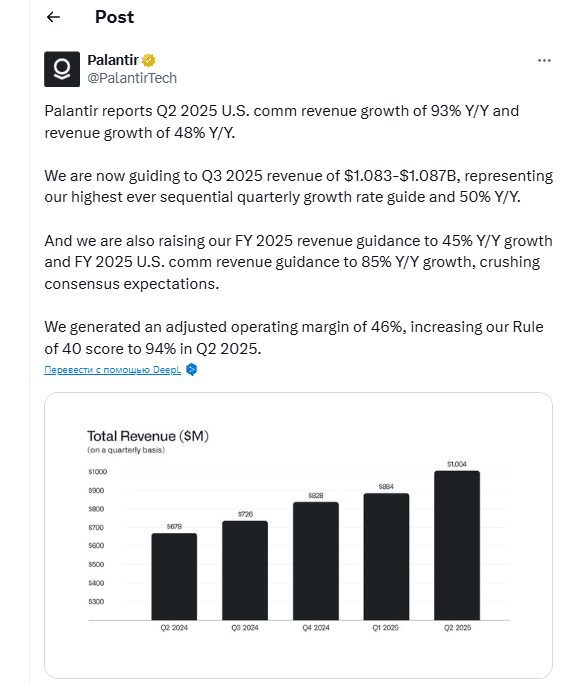
Palantir reports 93% year-over-year growth in U.S. communications revenue for Q2 2025 and 48% year-over-year revenue growth. We now expect Q3 2025 revenue to be $1.083 billion to $1.087 billion, our highest sequential quarterly growth and 50% year-over-year.
Although Palantir is often called a data broker or a surveillance company, it insists it is neither. It doesn’t collect or sell data, but rather builds an infrastructure that allows customers to make sense of their data across formats, silos, and departments.
Foundry can be found in the healthcare, pharmaceutical, logistics, and energy sectors, helping teams optimize supply chains, manage manufacturing, and detect anomalies. Gotham, its flagship product for governments and law enforcement, is more controversial. It combines data from arrest records, licenses, immigration databases, social media, CCTV footage, and even medical records to create comprehensive, searchable profiles of people.
What makes this service so powerful is that Gotham doesn’t require you to patch the underlying data systems. It sits on top of, integrates, connects, and visualizes. This is a great opportunity for law enforcement and national security agencies, which are overwhelmed by disparate, outdated systems. But it could also open the door to large-scale surveillance and algorithmic policing.
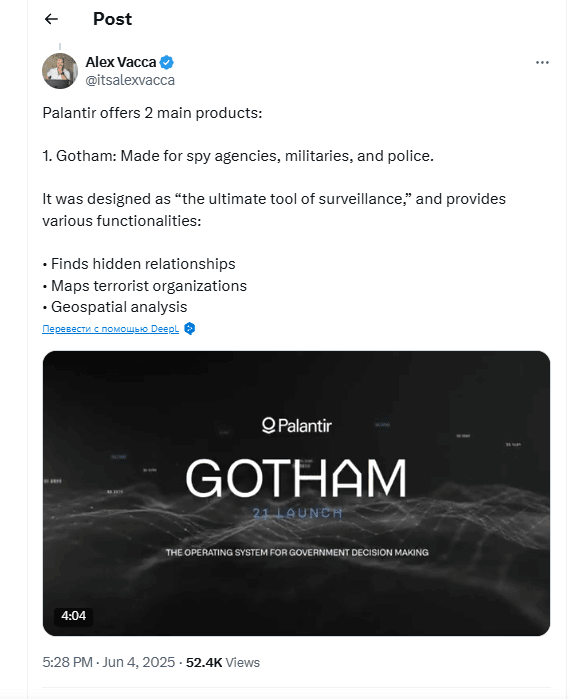
1. Gotham: створений для розвідувальних агентств, військових та поліції.
Він був розроблений як «найкращий інструмент спостереження» та надає різні функції:
Знаходить приховані зв’язки
Картує терористичні організації
In other cases, Apollo makes it easy to update software or install new programs without any disruption. Meanwhile, AIP (Artificial Intelligence Platform) combines generative AI and automation.
Palantir doesn’t just build software. It embeds its engineers in institutions. It trains them to think like operators. It borrows language and structure from the military. With terms like “front-line deployment software engineers,” “BLUF” (bottom line ahead), and even job codes like “Echo” and “Delta,” its brand relies on military metaphors and references to Tolkien.
Gotham is already being used in police predictive applications across Europe and the US. In the UK, a project called Nectar is testing Palantir’s technology across nine police forces, including Bedfordshire and Leicestershire. The software integrates sensitive data: criminal records, mental health reports, child data, victim statements, financial activity and even political views.
An £800,000 contract between Leicester Police and Palantir has been REMOVED from the public record. The company has a disturbing history of racial profiling and surveillance in the US, MP @ShokkatAdam explains.

Police say the system is helping to prevent crime. Palantir points to preliminary results: 120 young people at risk were identified in the first eight days. But critics say it amounts to profiling through intermediaries. People can be flagged simply for being in the wrong place or appearing in someone’s file.
Meanwhile, in Germany, Palantir’s software is used in several federal states under different names (such as HessenData and VeRA), despite legal problems. The German Civil Rights Association is suing the Bavarian government for violating constitutional guarantees.
In France, Palantir won contracts after the 2015 Paris attacks. In the Netherlands and Greece, Foundry was used for pandemic response and infrastructure planning. NATO has also chosen Palantir to support decisions in its Joint Operations Command.
In the US, Palantir continues to win multi-billion dollar deals with the Department of Defense and other federal agencies. Its software is the backbone of predictive policing in cities like Los Angeles and is integrated into systems used by ICE for deportation logistics and the military for drone targeting.
None of this is happening in isolation. Palantir is part of a broader trend toward the merging of government data, private-sector artificial intelligence, and opaque decision-making systems. Customs records, school records, phone logs, and banking are now connected in ways that the public can’t see and courts can barely understand.
JPMorgan used Palantir to spy on employees. Emails, web browsing, badge reading, phone calls. Even executives were monitored without permission. Nothing inside the building was private. Palantir is not just surveillance for governments.

In the US, Palantir has signed major deals with the Department of Defense, including a potential $10 billion contract with the Army. It helps analyze drone footage, battlefield intelligence, refugee movements, and pandemic response logistics. Domestically, it works with the Internal Revenue Service (IRS), the State Security Service (SSA), and local law enforcement.
These efforts have accelerated under the Trump administration. An executive order now requires cross-agency data sharing. Critics fear the growth of a “superdatabase” that could be weaponized for political purposes. Thirteen former employees signed an open letter opposing the company’s direction. Others say Palantir’s tools could become the cornerstone of an authoritarian infrastructure.
Palantir is not shy about its political stance. Its CEO, Alex Karp, has called the West superior to other countries, worth defending through its technological might. Co-founder Peter Thiel has been an outspoken critic of democracy, supported Trump, and mentored current candidates.
Karp and corporate communications chief Nicholas Zamiska recently published a book arguing that Silicon Valley has lost its way. Instead of building dating apps or ad tech, they believe companies should partner with national governments to solve existential problems: climate, war, healthcare, and infrastructure. They call for a “tech republic” governed by moral leadership.
But critics say that this framing obscures Palantir’s true role: as a private contractor deeply embedded in government functions without democratic oversight. He may claim to uphold Western values, but he also makes a handsome profit from mass surveillance, immigration crackdowns, and predictive policing. Others see him as a caricature of a Bond villain.
Palantir just reported its first quarter of $1 billion. Their co-founder, Alex Karp, is incredibly eccentric…
lives in seclusion, no cell phone
never learned to drive “I was too poor, then too rich”
carries tai chi swords around the office.

Palantir positions itself not as a vendor but as a partner in national security. It doesn’t just sell products. It embeds itself in institutions, building influence in health care systems, defense departments, police departments, and intelligence agencies.
If Palantir can become the operating system for the state, it will be able to influence how decisions are made at the highest levels without being subject to the same scrutiny as government agencies. Its tools amplify any incentives that are already in place. The entire infrastructure can quickly become a problem if intentions change, leadership changes, or data is repurposed.
Palantir’s success comes with risk, not just financial risk for overly excited investors but also civic risk for societies that deploy its tools without fully understanding their implications.
Surveillance doesn’t always look like cameras on street corners. Sometimes it’s a dashboard or a system sold as a way to improve efficiency. But the more we empower these systems, the more urgently we need to ask ourselves: Who controls them, who vets them, and who has the right to say no?
The real story of Palantir is the quiet creation of an infrastructure that can outlive the people who built it. The idea that technology is changing the balance between citizens and the state is something no one can afford to ignore.