
18.01.2024
2 min
2051



The world of cryptocurrencies and large investments has repeatedly become the scene of large-scale scams, but this story has attracted special attention from international investigators and governments. The crypto industry continues to develop rapidly, and along with new financial opportunities, more sophisticated fraud schemes appear. In the spotlight is a high-profile criminal case related to the systematic embezzlement of funds, large digital assets and suspicions of building a large-scale network of illegal operations. American law enforcement officers have released indictments covering cross-border activities, crypto assets and the use of modern technologies to conceal financial flows.

On October 15, the US government announced that it had uncovered one of the largest cryptocurrency scams ever. At the center of the conspiracy was Chen Zhi, the head of a large Cambodian conglomerate, Prince Holding Group. Authorities seized more than $14 billion in bitcoins, and the businessman himself was charged with fraud and money laundering.
Investigators say Chen’s company was not just a front for financial fraud, but also used forced labor and defrauded investors around the world.
This type of cyber fraud is called a pig butchering scheme.
Its principle is simple:
Fraudsters contact the victim via messengers or social networks.
They slowly gain trust, often pretending to be friends, or even building romantic relationships.
For a while, the attackers can “feed” such clients, allowing them to initially receive a small profit from transactions.
Then they convince them to “invest” in cryptocurrency through fake platforms.
As soon as the person transfers the money, it is withdrawn, and the victim loses everything.
According to the investigation, this scheme brought the organizers up to $30 million per day.

The structure created by Chen functioned as a whole industry of deception. According to the investigation, the companies controlled by him built at least ten secure complexes in Cambodia. Migrant workers were held inside, deprived of their documents and virtually isolated from the outside world. Workers were forced to correspond with potential victims for 12–14 hours a day, using a huge network of fake profiles on social networks and messengers. The territories were equipped with barbed wire fences and guards, and any attempts to escape or disobey were punished with physical violence. In essence, these were real “fraud factories” where digital deception was put on an assembly line.
The funds obtained through criminal means were withdrawn through a network of related companies and offshore companies. They then invested in luxury goods and real assets: private jets, yachts, luxury apartments, jewelry, rare watches and works of art – among which, according to the investigation, were works by Pablo Picasso. This is a classic laundering scheme – mixing illegal profits with “clean” operations within an international holding company.
A number of criminal charges have been brought against Chen in the US, and he faces up to forty years in prison. American authorities have confiscated more than 127 thousand BTC, which may be used to compensate victims. The US and the UK have also imposed sanctions on the structures involved. However, the official response from Cambodia to date remains extremely limited.
The UN notes that tens of thousands of people in Cambodia, Myanmar, Thailand and neighboring countries are forced to work in such schemes. This is not just Internet fraud – but entire criminal agglomerations with elements of violence, deprivation of liberty and human trafficking. Experts emphasize: Chen’s case demonstrates changes in international politics – the issue is no longer ignored at the global level.
After the military coup in 2021, Myanmar has become one of the main centers of cybercrime in the region. Under the guise of legal work, foreigners are brought there, their documents are taken away and forced to work in fraudulent call centers. Many of these facilities are combined with casinos and “special economic zones”, which are actually controlled by criminal groups.
These structures operate like commercial criminal corporations: stable financial flows, security, internal discipline and their own logistical channels for money laundering. Losses in the US alone are measured in billions of dollars per year, and the total turnover of the industry in Southeast Asia is estimated at tens of billions.
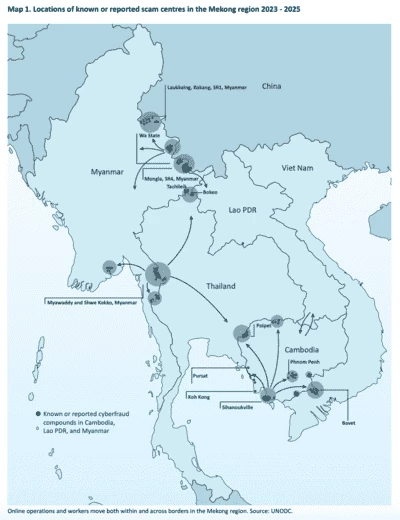
After the 2021 military coup, dozens of criminal “cities” have sprung up in the border areas, especially in Karen State. Casinos and tourist areas have become a cover for human trafficking, cyber fraud, and money laundering. Today, up to 200,000 people are held in more than 60 such centers.
Victims are lured through social media and fake job sites, paid for their flights, and their documents are taken on the spot. Then, the main coercive activity of the victims is the above-described combination called “pig slaughter.”

The revenue from one large complex, such as KK Park, is tens of millions of dollars per month. According to Chainalysis, in the United States alone, such schemes caused $4.4 billion in losses in 2023.
It is known that Chinese criminal networks associated with figures such as She Zhijiang and Wang Quoc Koi are behind this business. Cryptocurrencies and offshore help legalize criminal proceeds.

The Thai and Chinese authorities are trying to restrict the activities of these centers, and human rights activists, including Global Alms, are helping victims escape. However, due to the unstable situation in the country, the scam industry continues to grow. Its turnover is estimated at approximately $40 billion per year. Evil does not sleep, so it is worth maintaining special vigilance and caution.
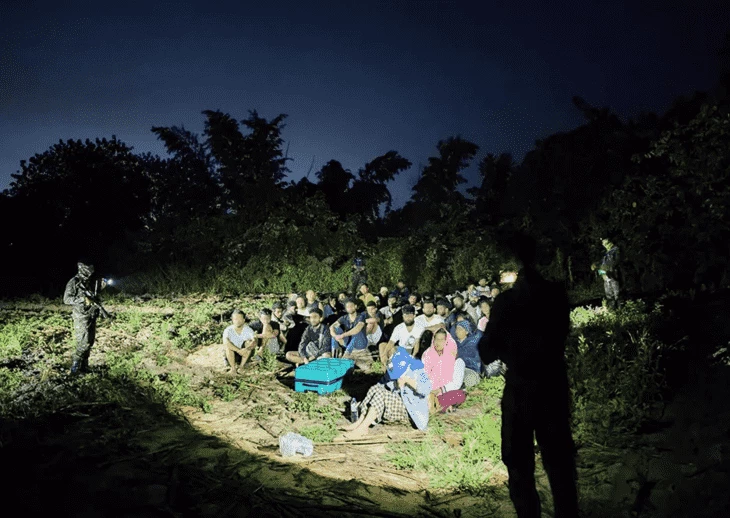
The multi-billion dollar crypto scam involving one of Cambodia’s richest businessmen clearly shows that modern financial crime is not just about digital assets or dodgy investment platforms. It is about broken lives, forced labor, human trafficking, and a massive shadow industry spanning several countries and generating billions of dollars a month.
The world is quickly realizing that cryptocurrency fraud has long since transcended the confines of online forums and Telegram chat rooms. It has become a criminal ecosystem with its own “fraud factories,” security, curatorial structures, shell companies, and political cover. The high-profile case against Chen is not just a blow to one specific conglomerate, but a symbol of a shift in the global approach to combating scam centers and digital slavery.