This story begins with a few minutes on an ordinary city street. At the time, no one knew that this brief moment would later be examined frame by frame. Cameras captured the actions of law enforcement during a tense situation, and the footage itself made it possible to see what is often lost between official statements and dry reports.
The piece breaks the events down second by second, showing how everything unfolded, why timing was critical, and what questions inevitably arise when the use of force ends up caught on camera.
What the Footage From Minneapolis Shows
The fatal shooting of 37-year-old Renée Nicole Good took place in Minneapolis on January 7, when U.S. Immigration and Customs Enforcement agent Jonathan Ross fired multiple shots during a law enforcement operation, killing the woman. Her death sparked nationwide protests and violent clashes between demonstrators and federal agents.
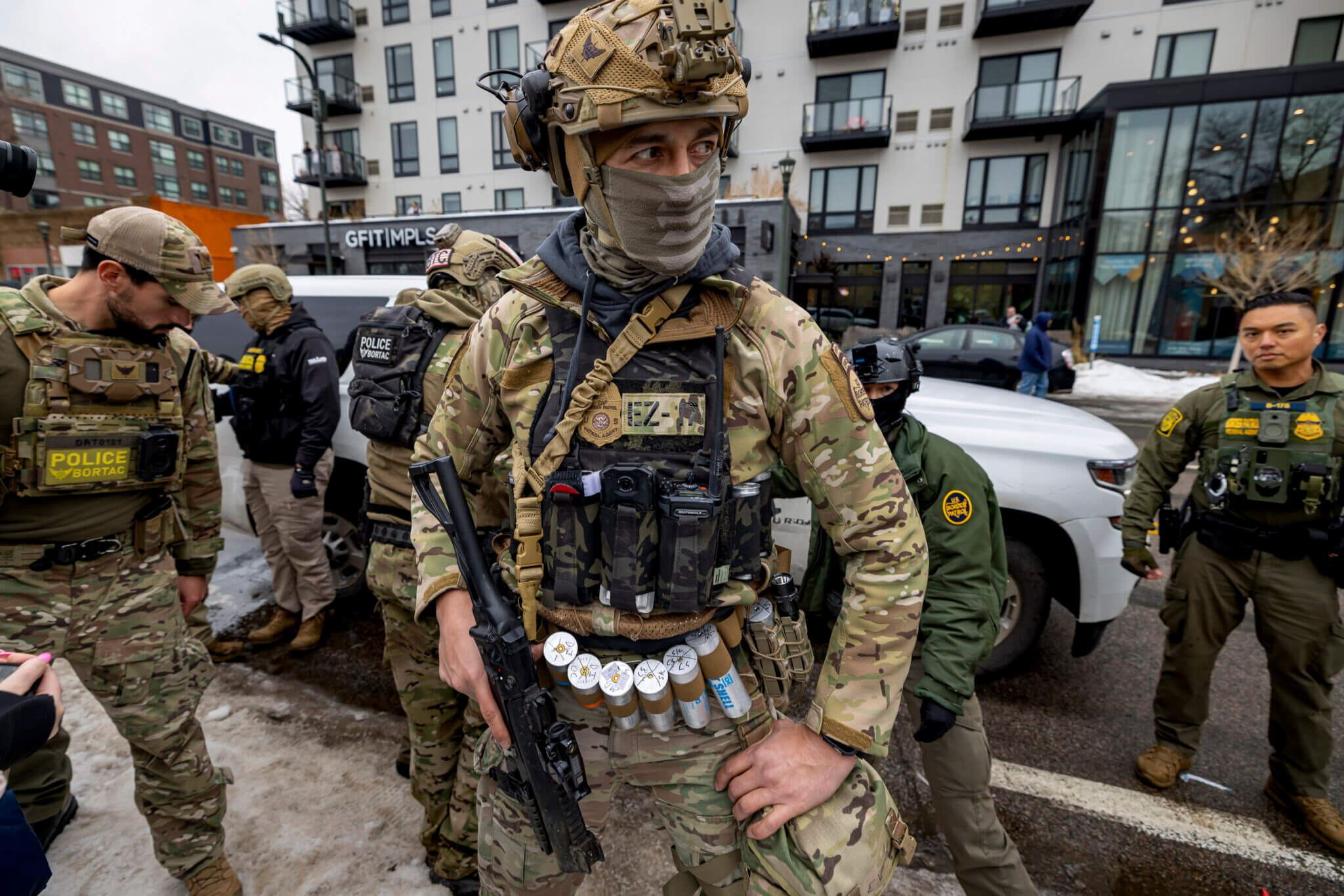
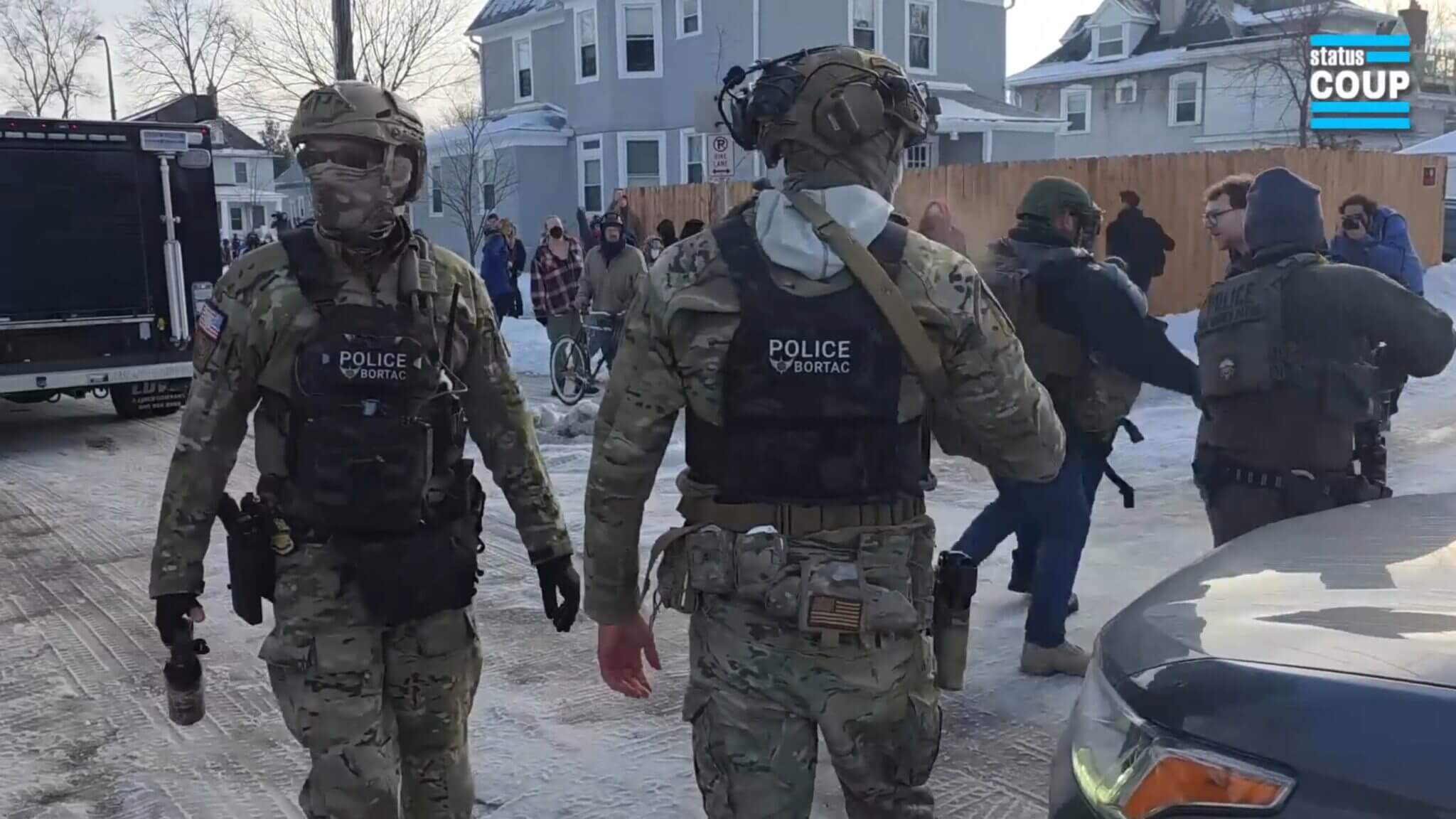
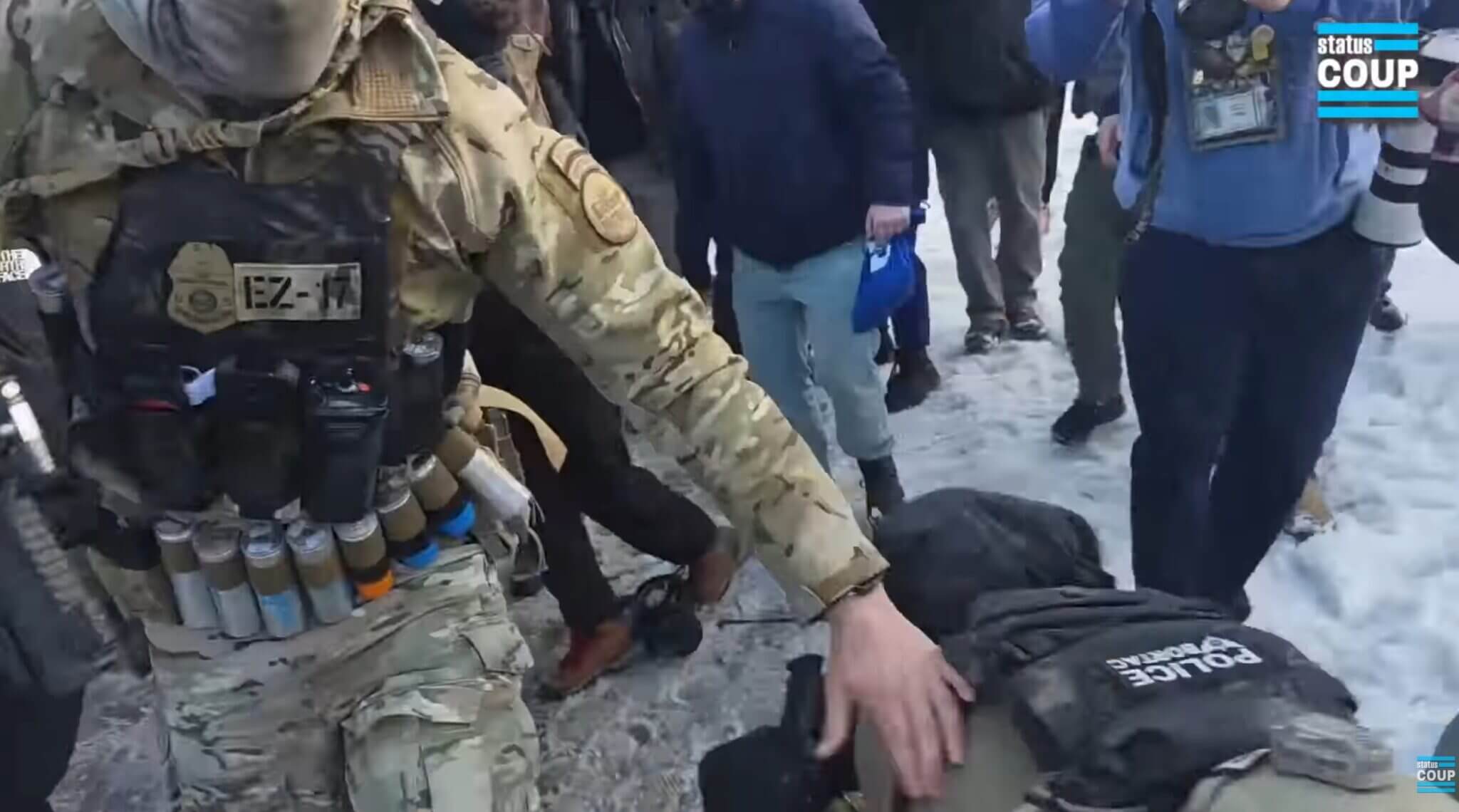
Another incident later emerged on video. An elite Border Patrol officer, wearing a mask but identifiable by the marking EZ-17 on his uniform, was seen moving along a street near the site of Good’s death and repeatedly using a less-lethal grenade launcher against protesters.
EZ-17 on the streets of Minneapolis on January 8.
Although so-called “less-lethal” weapons are not designed to kill, their misuse can cause serious injuries and even death. In California, one protester said he permanently lost vision in one eye after being struck by such a weapon during a demonstration on January 13. Video footage shows a Department of Homeland Security officer firing a PepperBall round at his face from close range, causing severe bleeding.
Last year, a judge in Illinois issued a court order limiting the use of force by federal agents, citing aggressive actions against peaceful protesters that she said “shock the conscience.” Despite this ruling, numerous cases of force and crowd-control weapons being used during immigration raids were reported in the following weeks, appearing to openly disregard the court’s decision.
Use-of-force experts note that most of the less-lethal shots fired by the agent identified as EZ-17 after his arrival at the scene on January 7—alongside Border Patrol commander Gregory Bovino—also likely violated internal U.S. Customs and Border Protection policies.
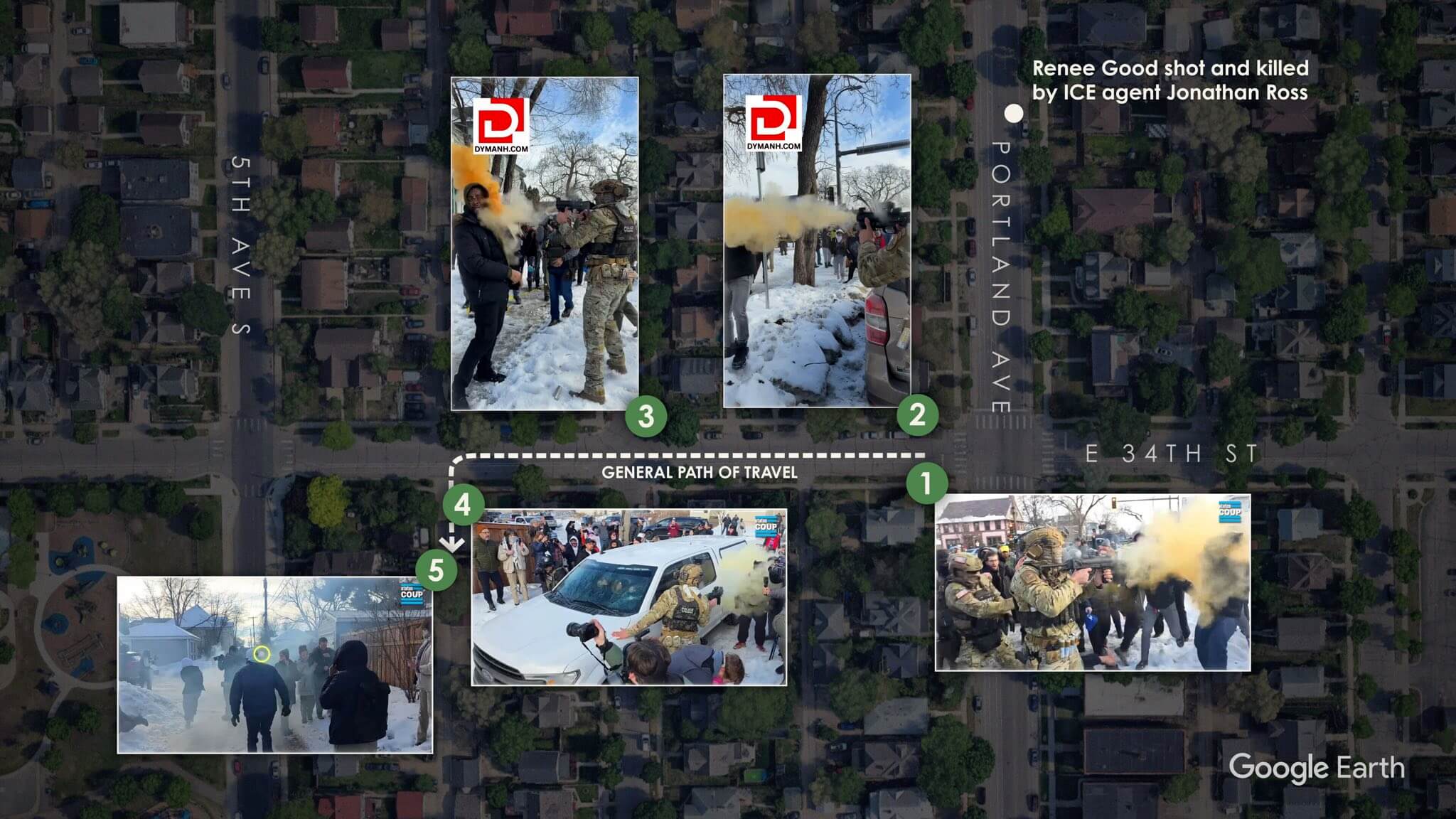
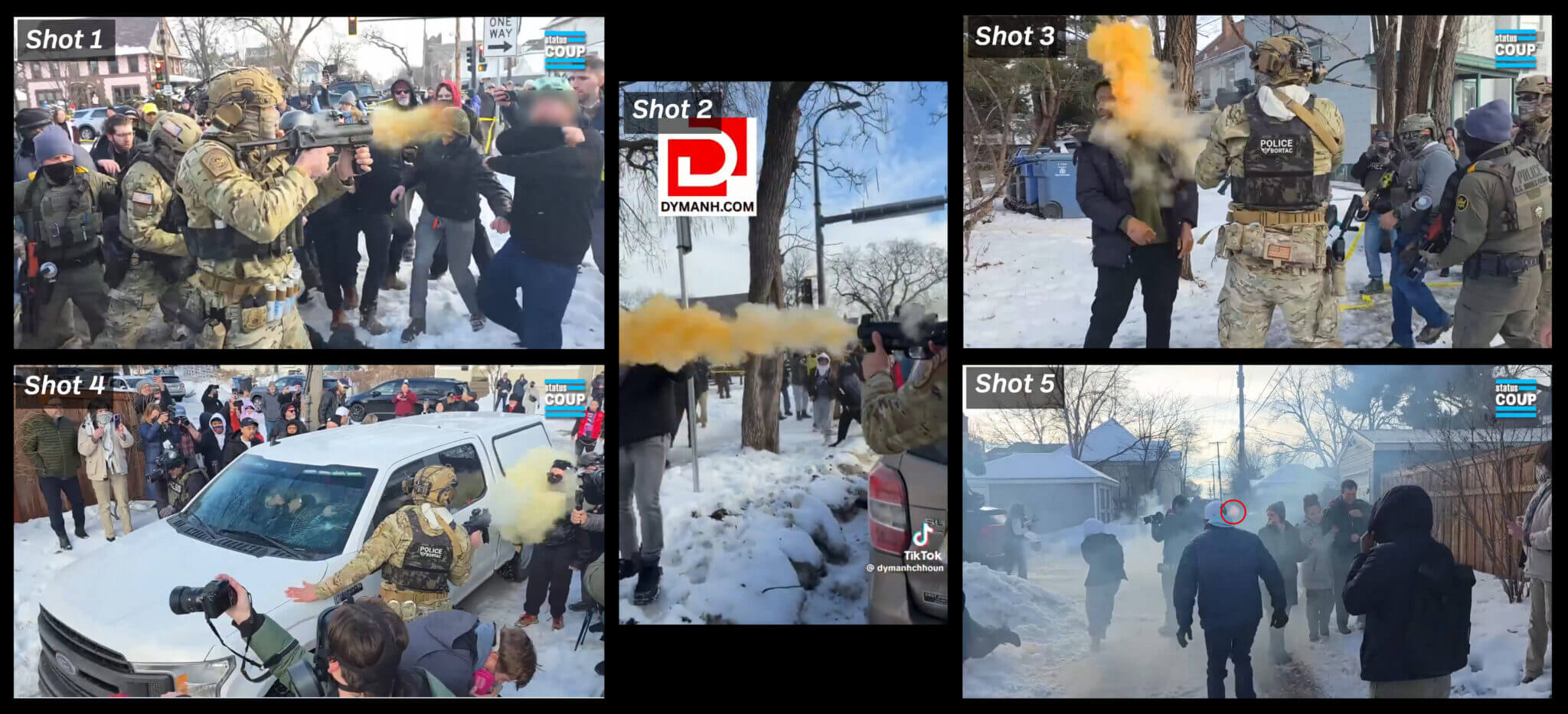
Video footage from news outlets and social media made it possible to reconstruct the full sequence of events and document all five shots fired by the agent.
EZ-17 fired five shots within five minutes near the site where Good was shot, shown in numbered order based on when they occurred, along with their approximate locations. The overall path of EZ-17’s movement is marked, as well as the location where Renée Good was killed.
Four of these shots appear to have been aimed directly at protesters’ faces from close range, while the fifth was fired from a distance into a crowd after tear gas had already been deployed. In a sixth clip, recorded at a different location later that same day, EZ-17 is also seen firing the same launcher at someone at head level.
Agent
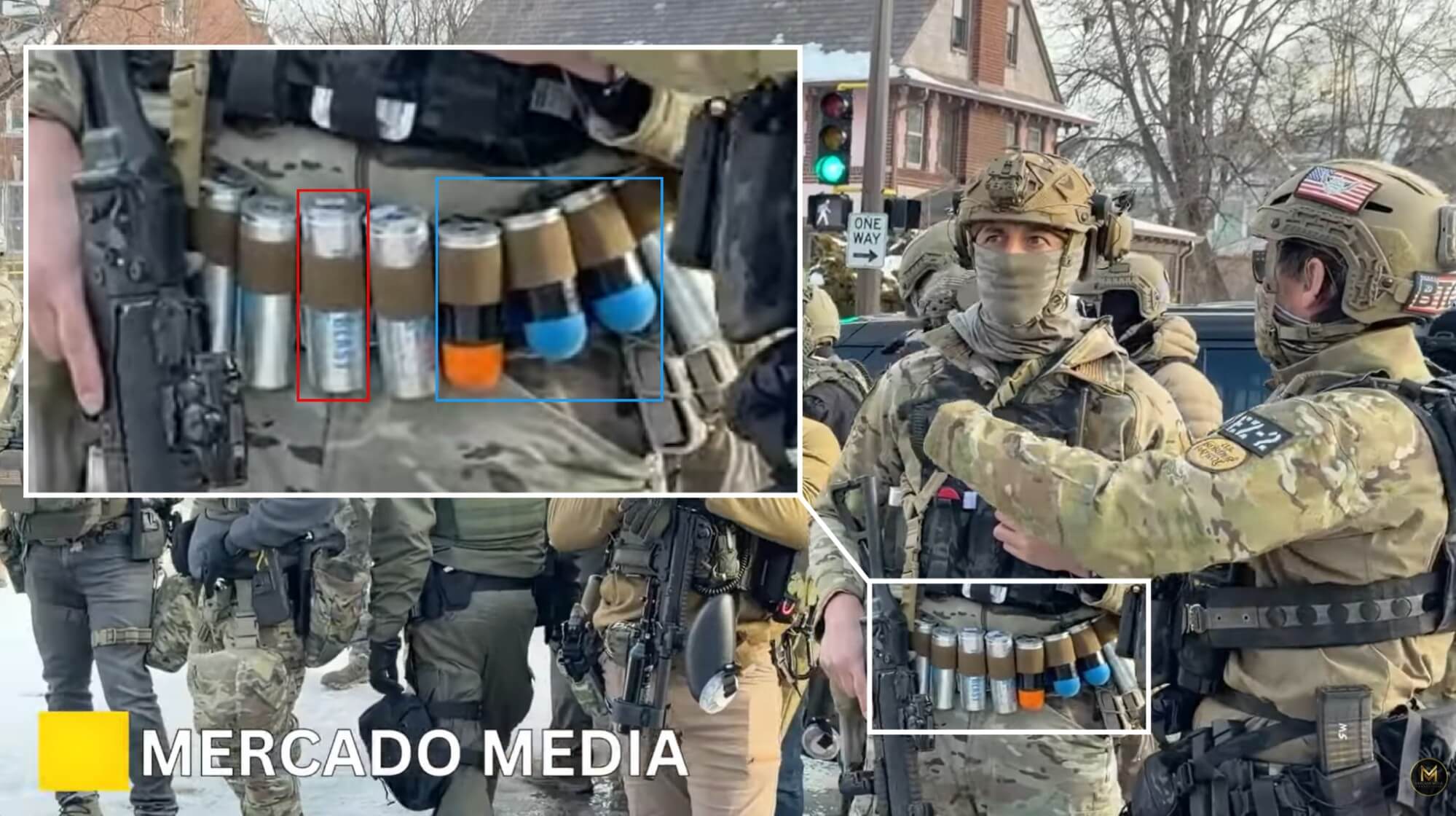
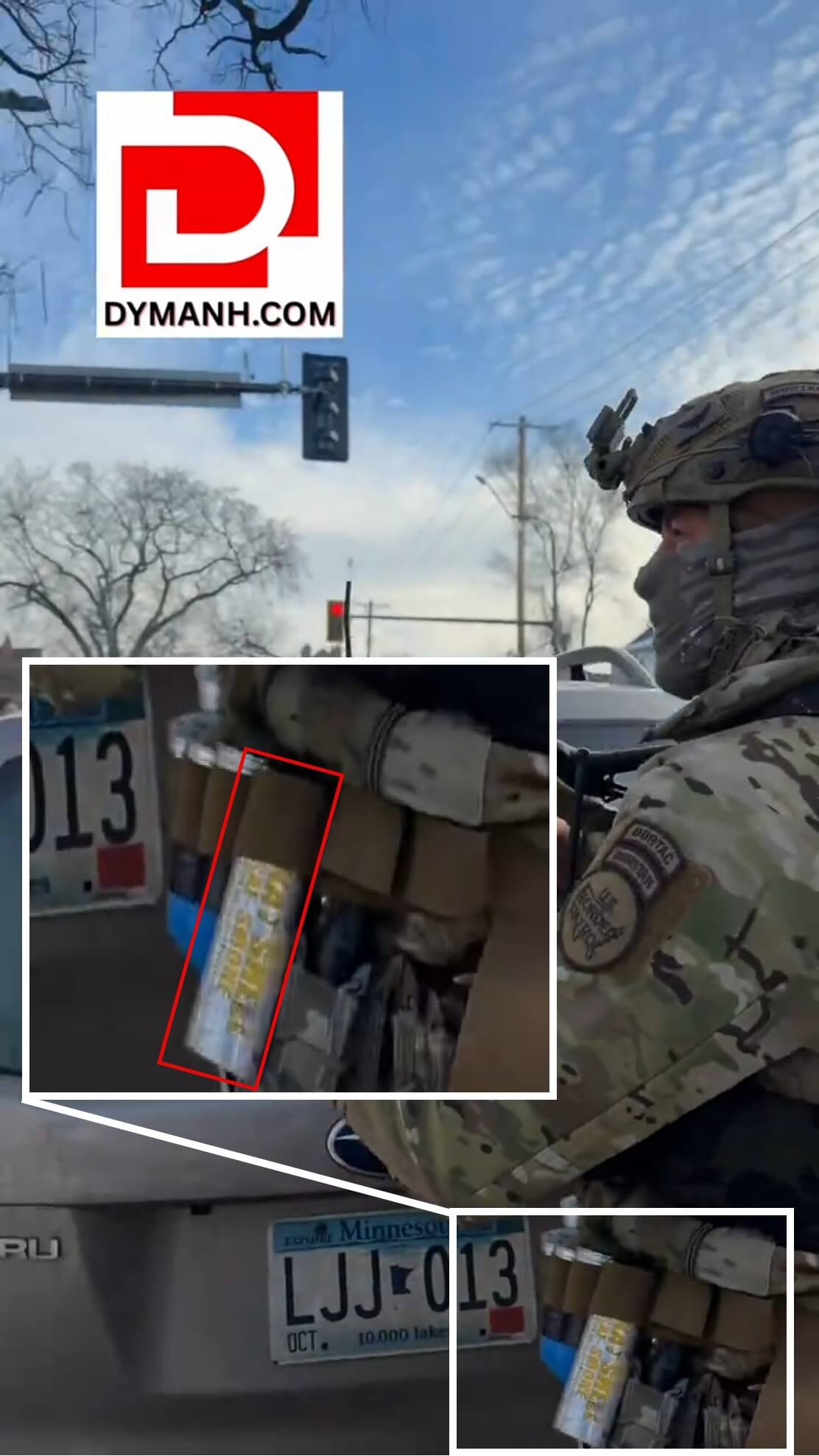
In video recorded by the independent news outlet Mercado Media, EZ-17 can be seen inside the taped-off crime scene perimeter, standing next to Bovino with eight 40-mm rounds on his belt.
EZ-17 with eight visible rounds on his belt, including 40-mm CS “Muzzle Blast” munitions (red box) and three direct-impact sponge-tipped rounds (blue box), approximately 30 minutes before his first shot.
Among them were three sponge-tipped impact rounds designed to cause “pain compliance” through direct blunt force, along with five cylindrical munitions that can be loaded with various payloads and chemical irritants. One of them is marked “BLAST” in blue, indicating a CS gas “Muzzle Blast” round—commonly known as tear gas. At least three additional 40-mm rounds can also be seen in his body armor.
In separate footage recorded by the independent news outlet Status Coup News, a continuous sequence captures all five shots—from the moment the agent left the crime scene at 5:02, shortly before the first shot, to the point when he departed in a truck with other agents at 9:23, immediately after the fifth shot.
On the back of EZ-17’s vest, it is visible that he belongs to the Border Patrol Tactical Unit (BORTAC) of U.S. Customs and Border Protection. BORTAC is a specialized, highly trained unit that, according to Customs and Border Protection, uses a selection process “modeled on elements of U.S. special operations forces selection courses.”
The patch on the back of EZ-17’s vest (center) shows that he belongs to BORTAC.
Members of BORTAC regularly accompanied Bovino as he led immigration raids under the Trump administration, including EZ-17 and EZ-2, another CBP agent who was frequently seen alongside EZ-17 in video footage from January 7. Both agents continued to accompany Bovino during raids in Minnesota in the days that followed.
EZ-17 fired five shots within five minutes near the site of the shooting of Good, numbered in the order in which they were fired.
First Shot
In video footage from Status Coup Media, EZ-17 and three other CBP agents, including EZ-2, are seen leaving the police-secured crime scene following Good’s death, pushing back protesters who are physically blocking their path. Snowballs are thrown at the CBP agents.
EZ-17 and EZ-2 force a man who is blocking their way to the ground. The video clearly shows EZ-17’s belt, with all eight rounds that were visible when he arrived at the scene still loaded at this point.
EZ-17’s belt is visible after he and EZ-2 force a man who was physically blocking them to the ground, just seconds before EZ-17 fires his first shot at 5:15.
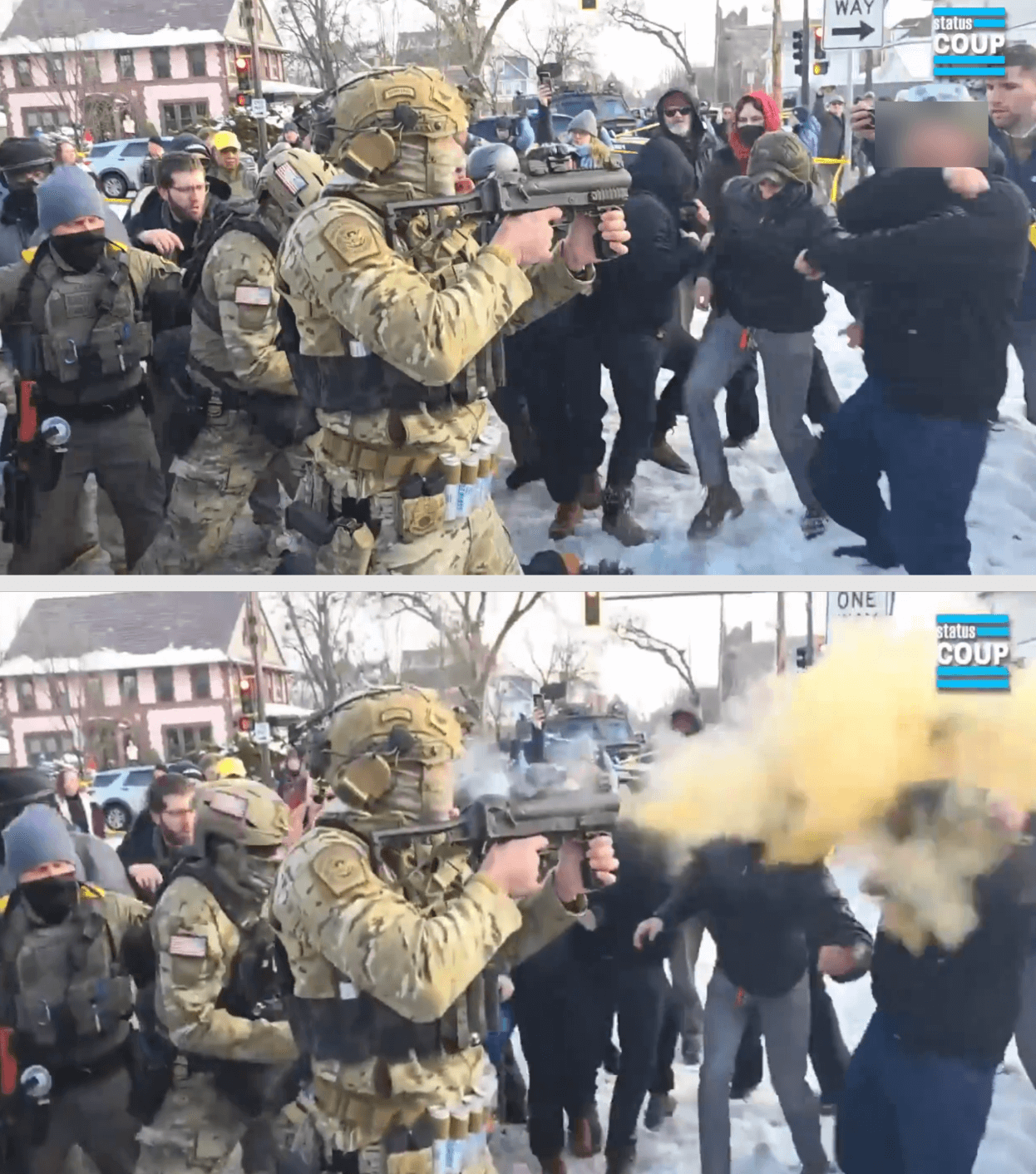
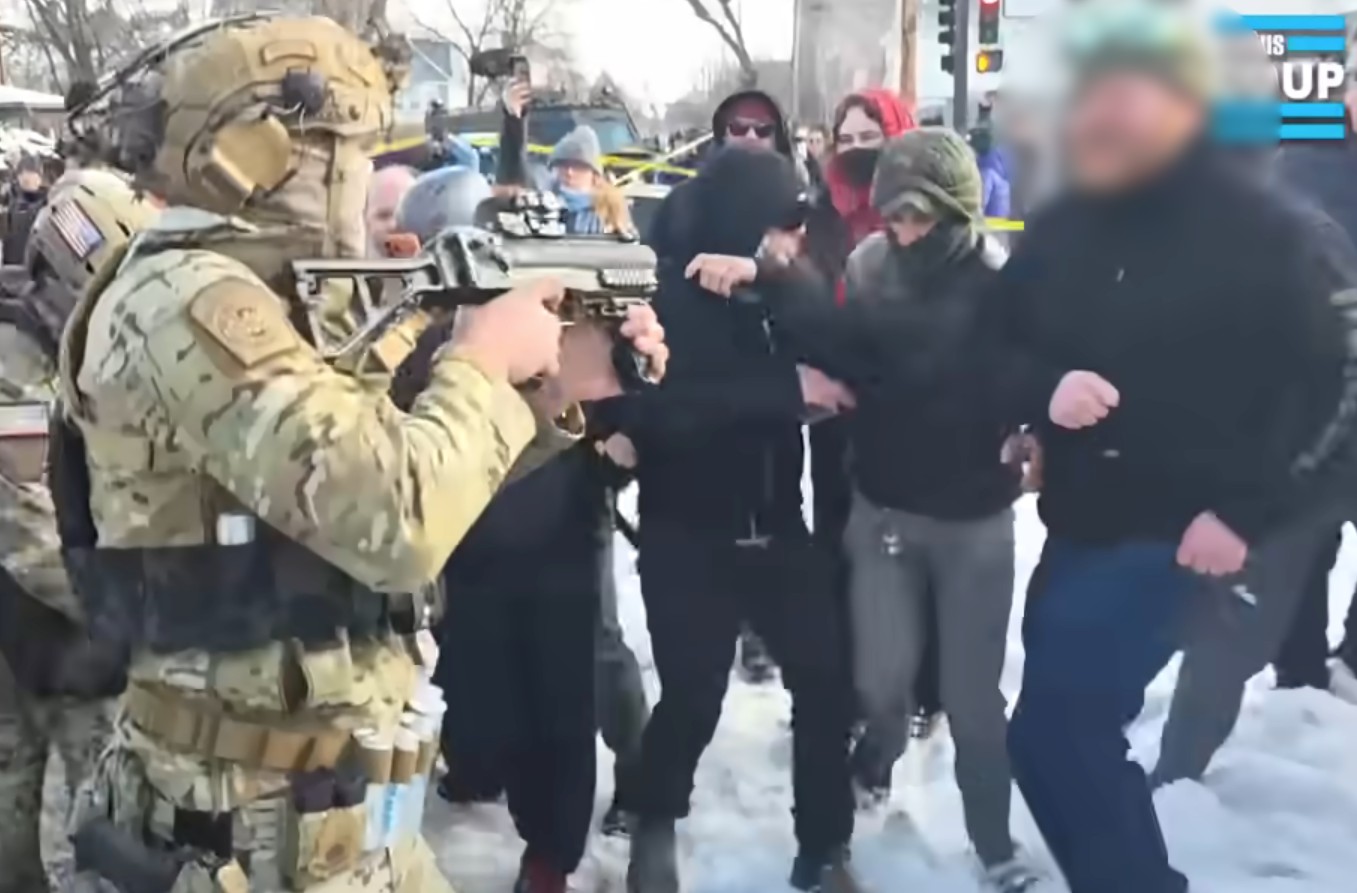
At first, EZ-17 aims his weapon at the man who has just been knocked to the ground. Moments later, he abruptly turns and aims at the face of another protester who, by all appearances, had not previously had any physical contact with the agents. As EZ-17 points the weapon at him, the man instinctively raises his hands to shield himself, and the agent then opens fire.
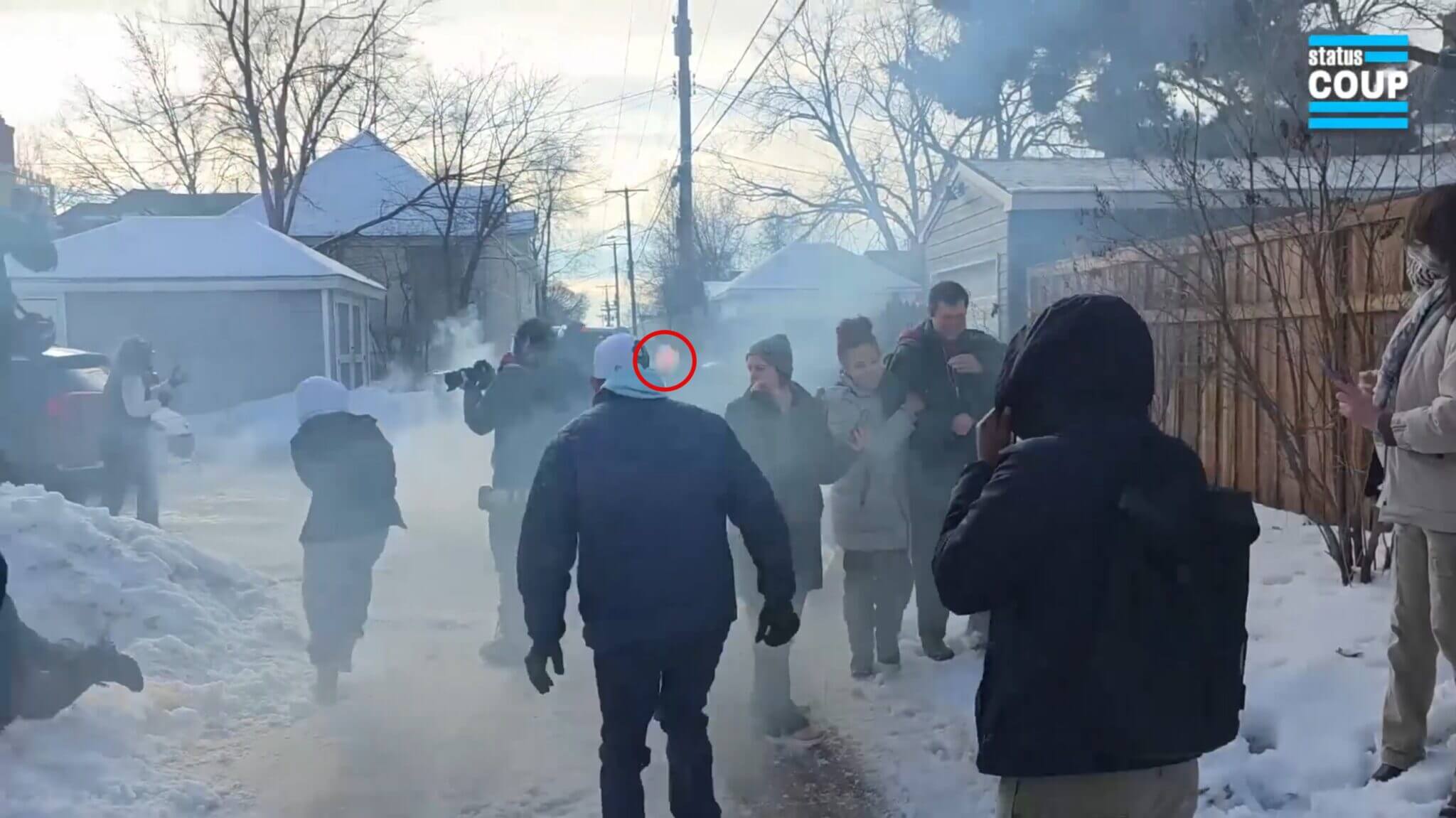
EZ-17 fires his first shot at 5:19.
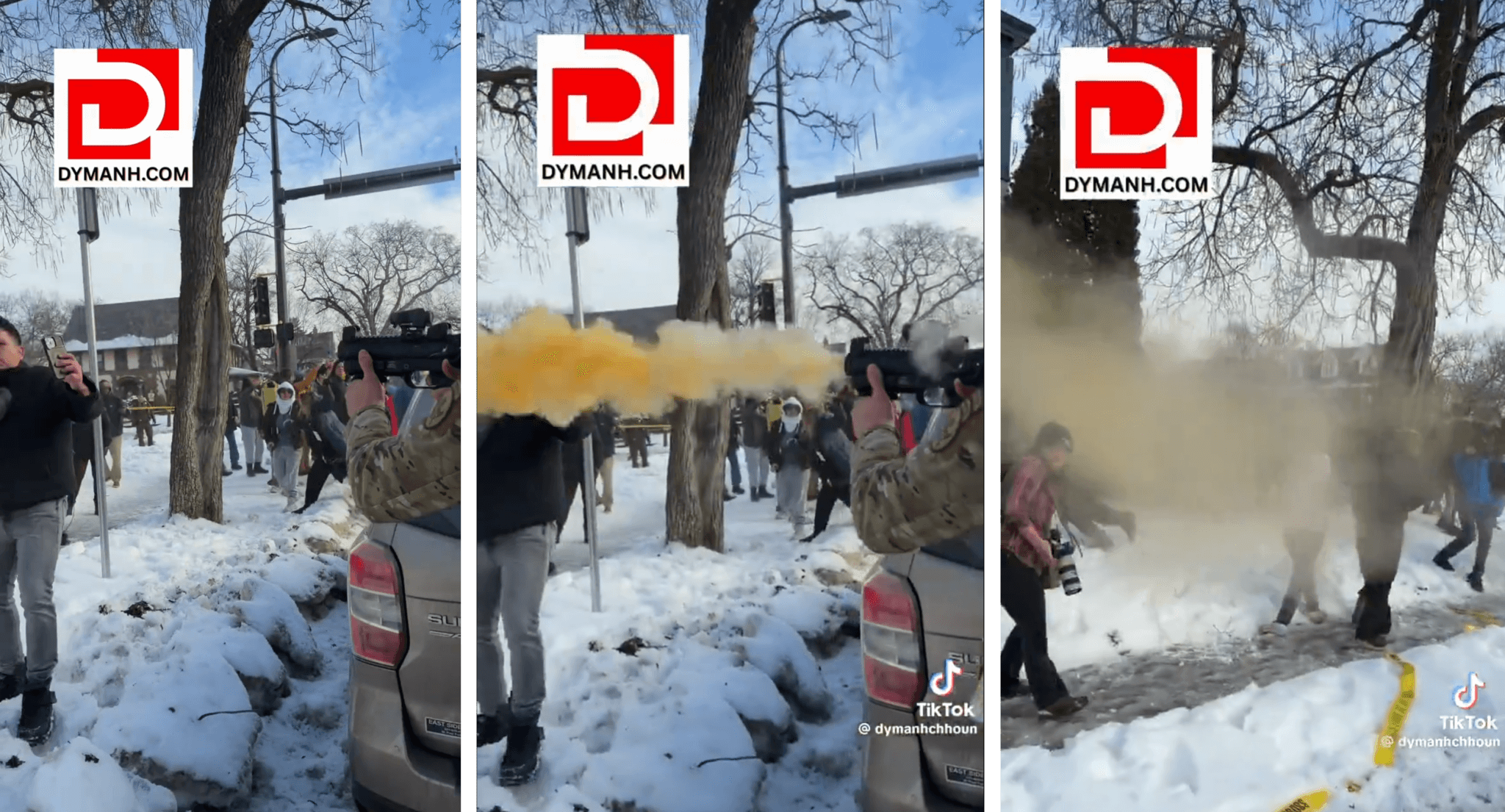
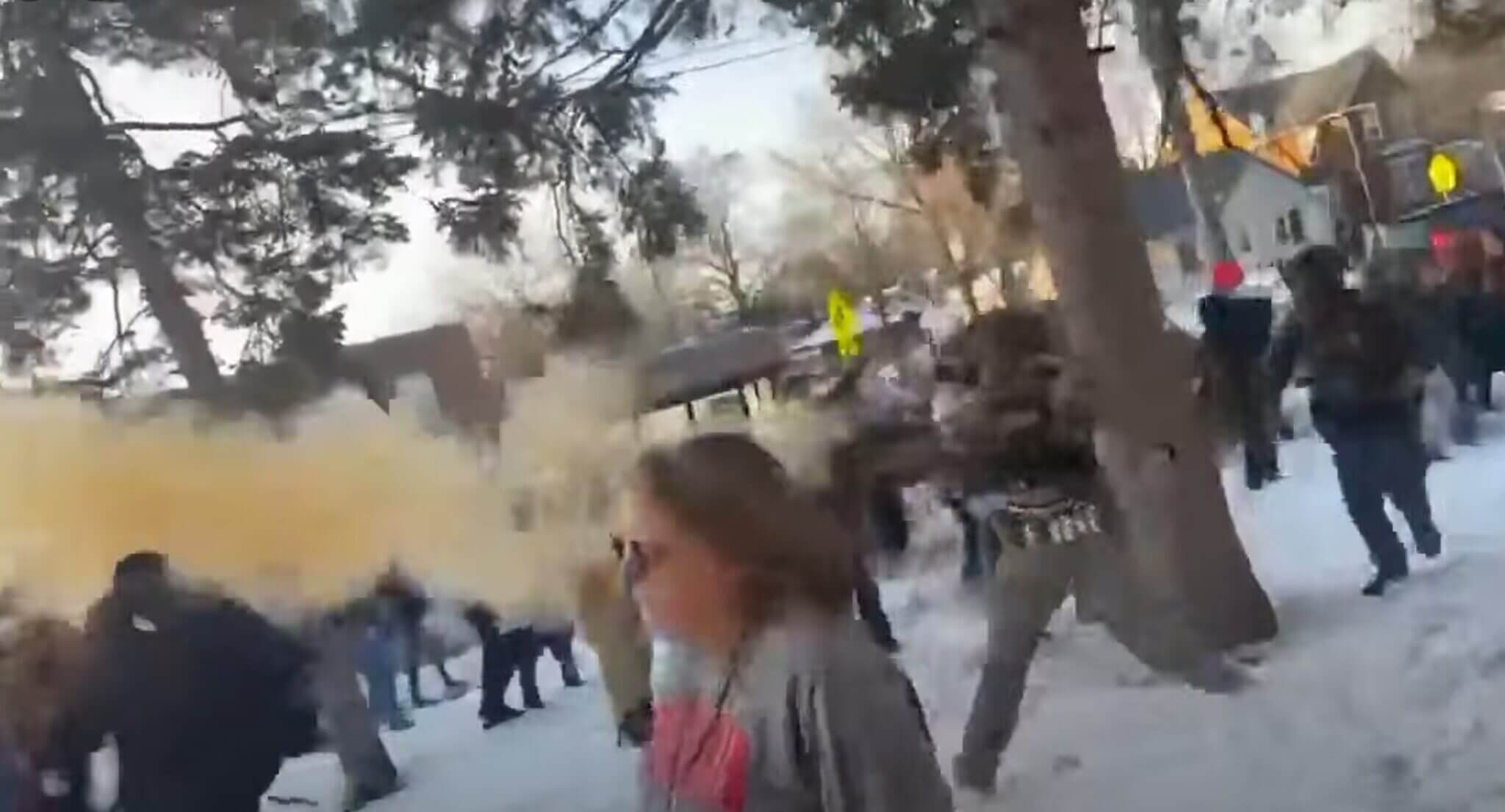
Immediately after the shot, a dense cloud of chemical irritant bursts from the barrel. The same type of dispersal is visible during the next three shots fired by EZ-17. Visually, it appears as an instant release of the substance directly into the area in front of the agent.
This matches the characteristics of 40-mm “Muzzle Blast” munitions, which can be seen on the agent’s belt. According to technical specifications, these rounds are designed to rapidly disperse a chemical agent at very close range—up to approximately nine meters from the person firing the weapon.
Second Shot
A few seconds after a snowball strikes EZ-17, he turns and fires at the face of a man who is filming in the direction from which the snowball was thrown. It is unclear whether this man was the intended target or if the shot was aimed at someone else in the crowd behind him.
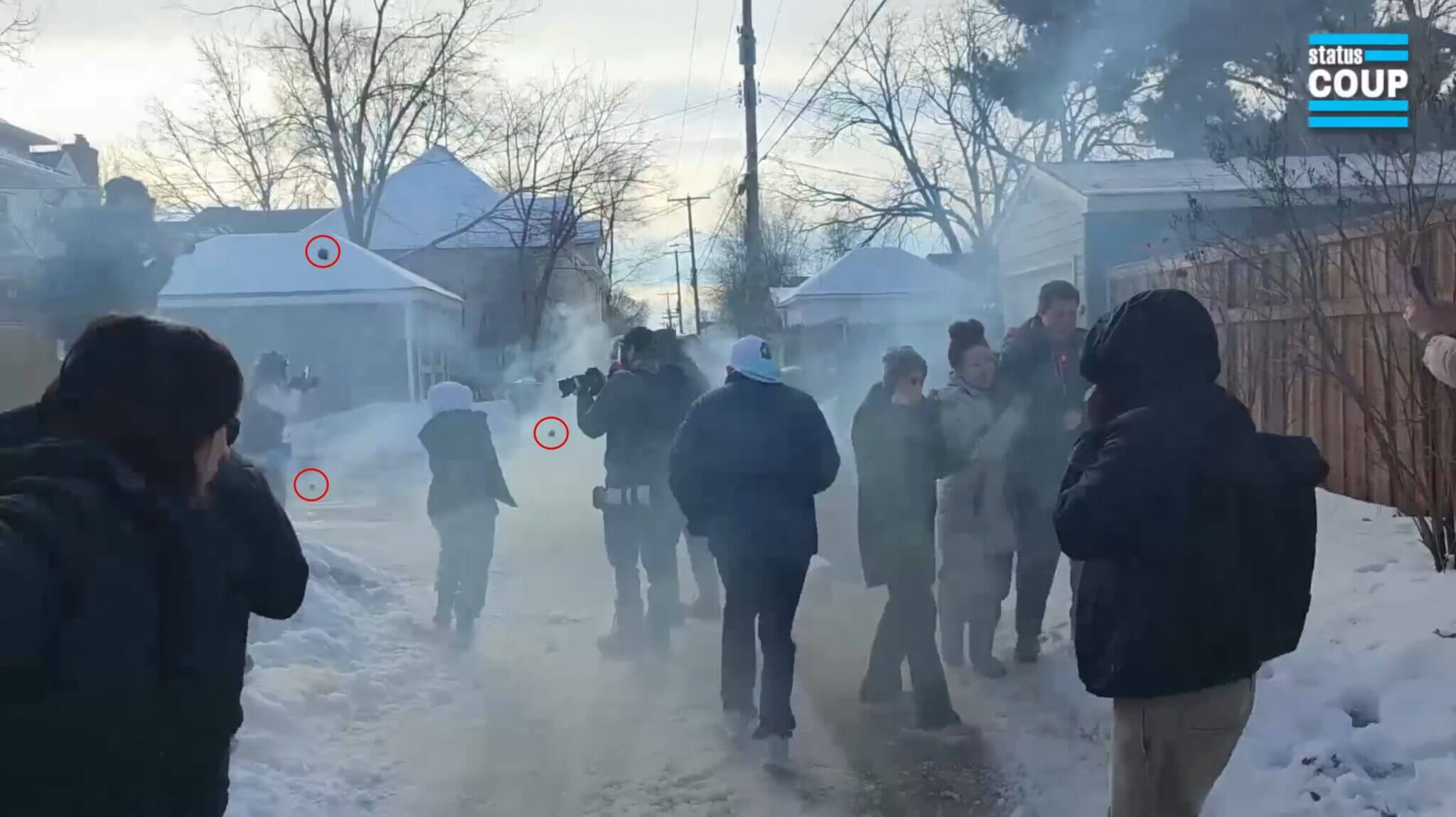
EZ-17 fires his second shot. The shot can be heard and partially seen at 5:37 in the Status Coup News video. Left: screenshot before the shot. Center and right: screenshots taken after the shot.
Third Shot
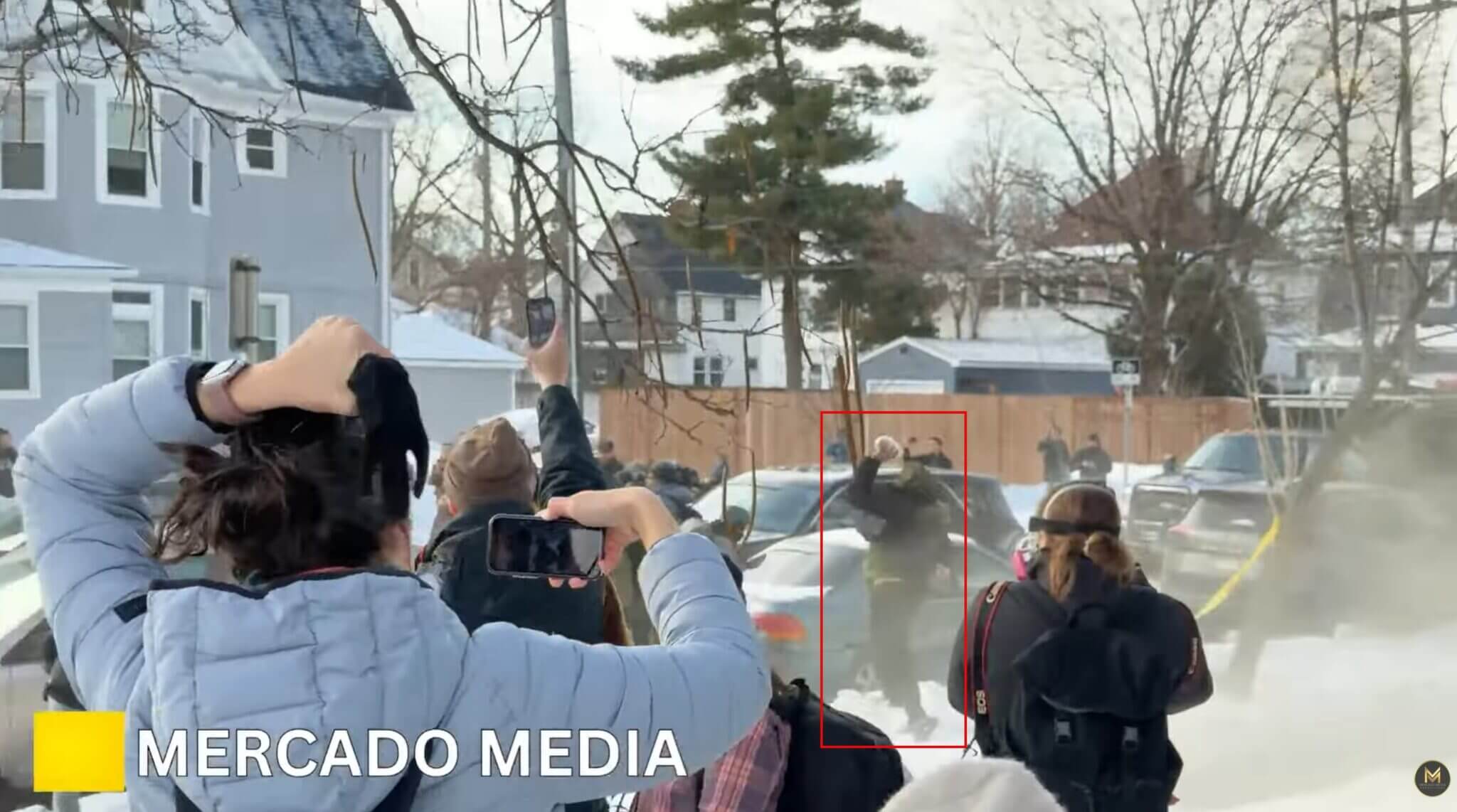
The third shot is fired at a man who is seen on video throwing a snowball that strikes EZ-2.
The man throws snowballs at Customs and Border Protection agents after the second shot.
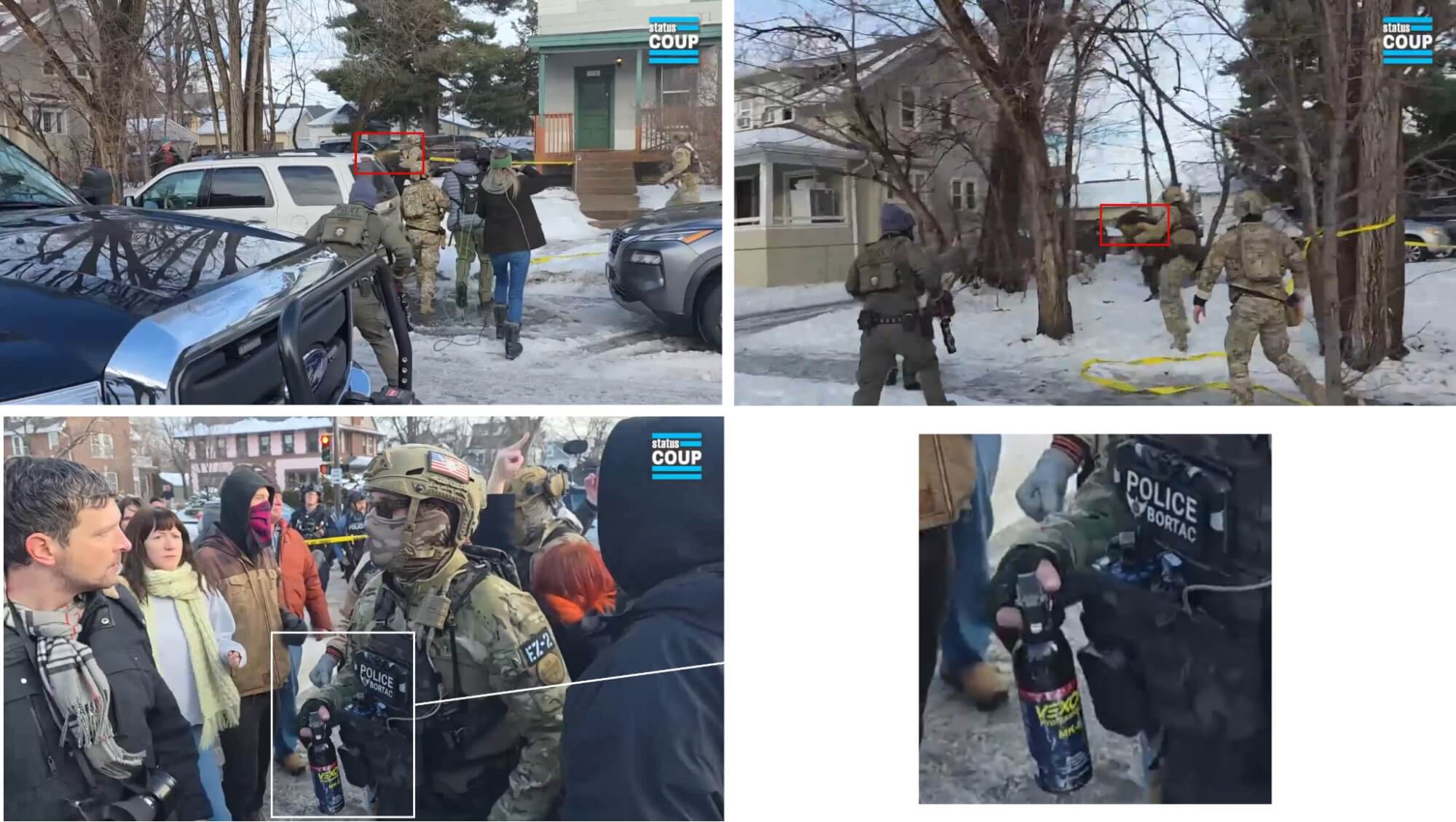
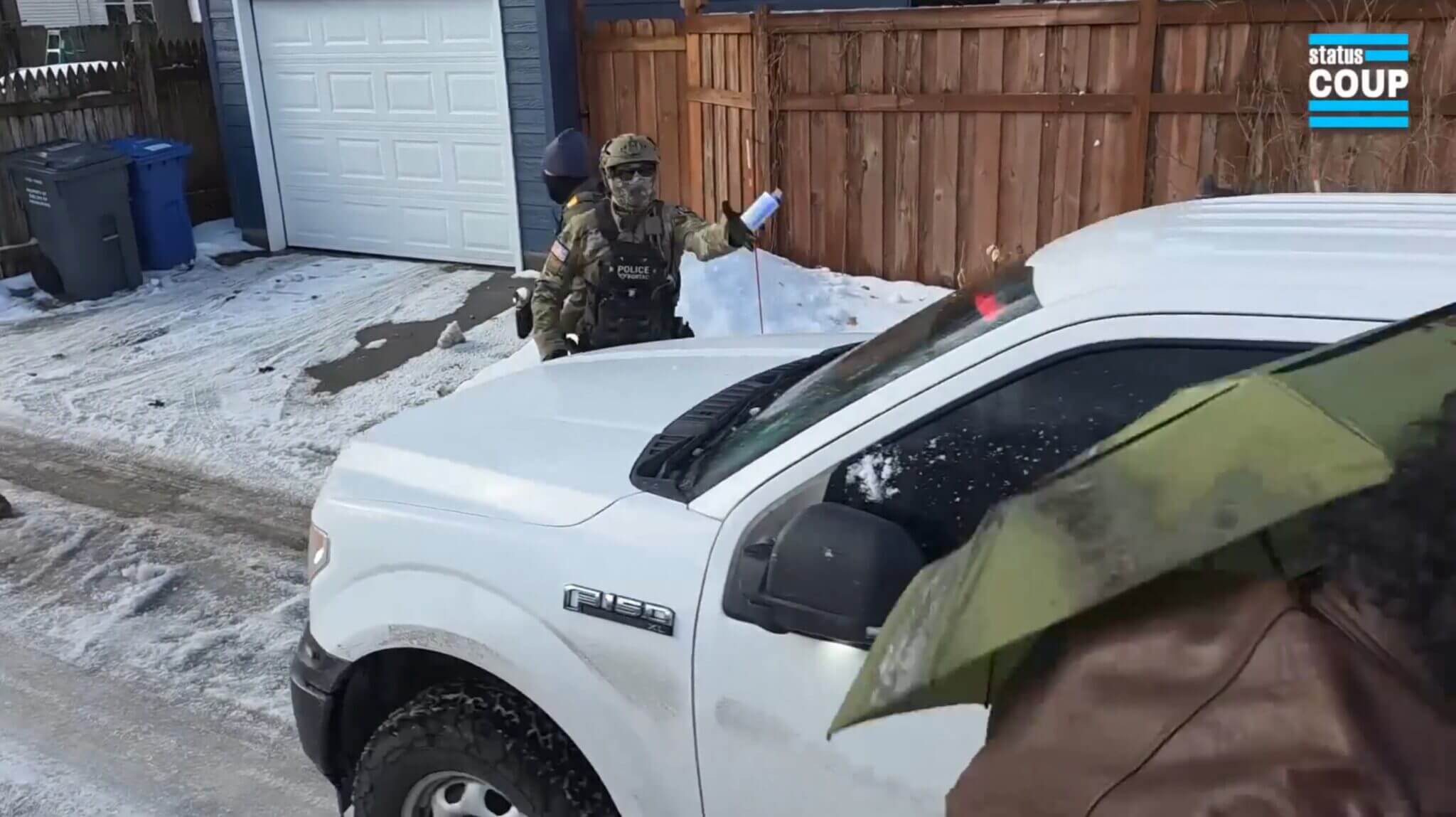
EZ-17 and EZ-2 pursue the man, with EZ-2 spraying him in the face with Oleoresin Capsicum (OC), also known as pepper spray or mace. As EZ-2 leaves the perimeter, he is carrying a canister labeled Vexor Professional.
Vexor exclusively manufactures various types of OC spray and does not list any chemical irritant sprays on its website that do not contain OC.
Top: EZ-2 is clearly seen spraying at least two bursts of OC spray at the man. Bottom: EZ-2 is earlier seen leaving the crime scene perimeter carrying a canister labeled “Vexor Professional.” Vexor manufactures various types of OC spray.
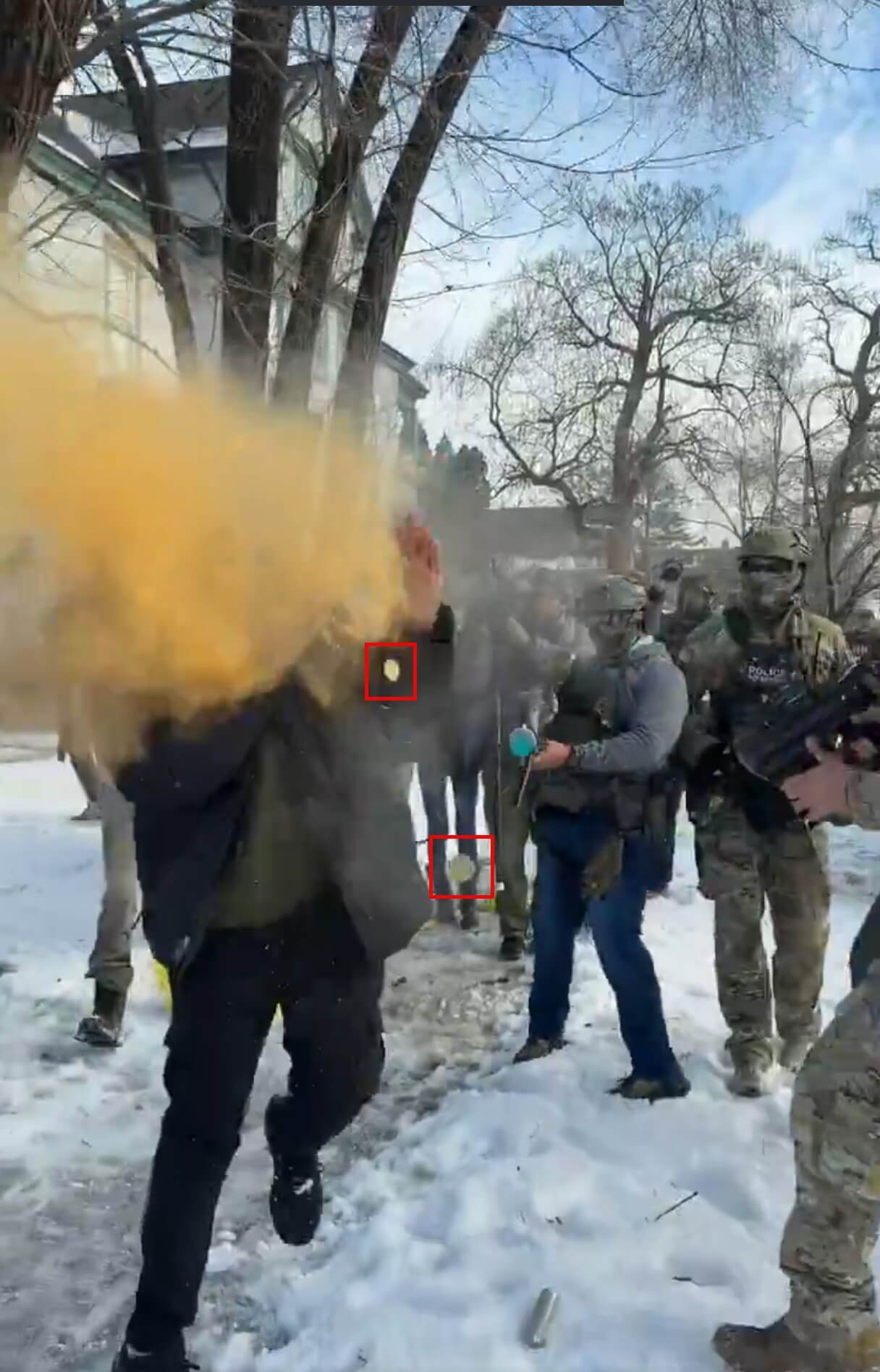
The man slowly approaches the agents, saying that he has just been struck with a baton. In response, EZ-17 pushes him back, then aims the weapon directly at his face and fires.
At this moment, components that had been holding the chemical irritant inside the 40-mm round before the shot can be seen striking the man. Immediately afterward, his face is engulfed in a cloud of smoke.
Seals from a 40-mm muzzle-blast munition.
Fourth Shot
After the third shot, a white CBP truck with no identifying markings turned off the street and attempted to drive through a narrow alley. At that point, protesters began physically blocking the vehicle, throwing snowballs and other objects. The windshield cracked, and the rear window was shattered.
EZ-17 and EZ-2 started pushing people out of the way in front of the truck in an effort to clear a path. During this, EZ-2 also used what appeared to be an OC pepper spray canister.
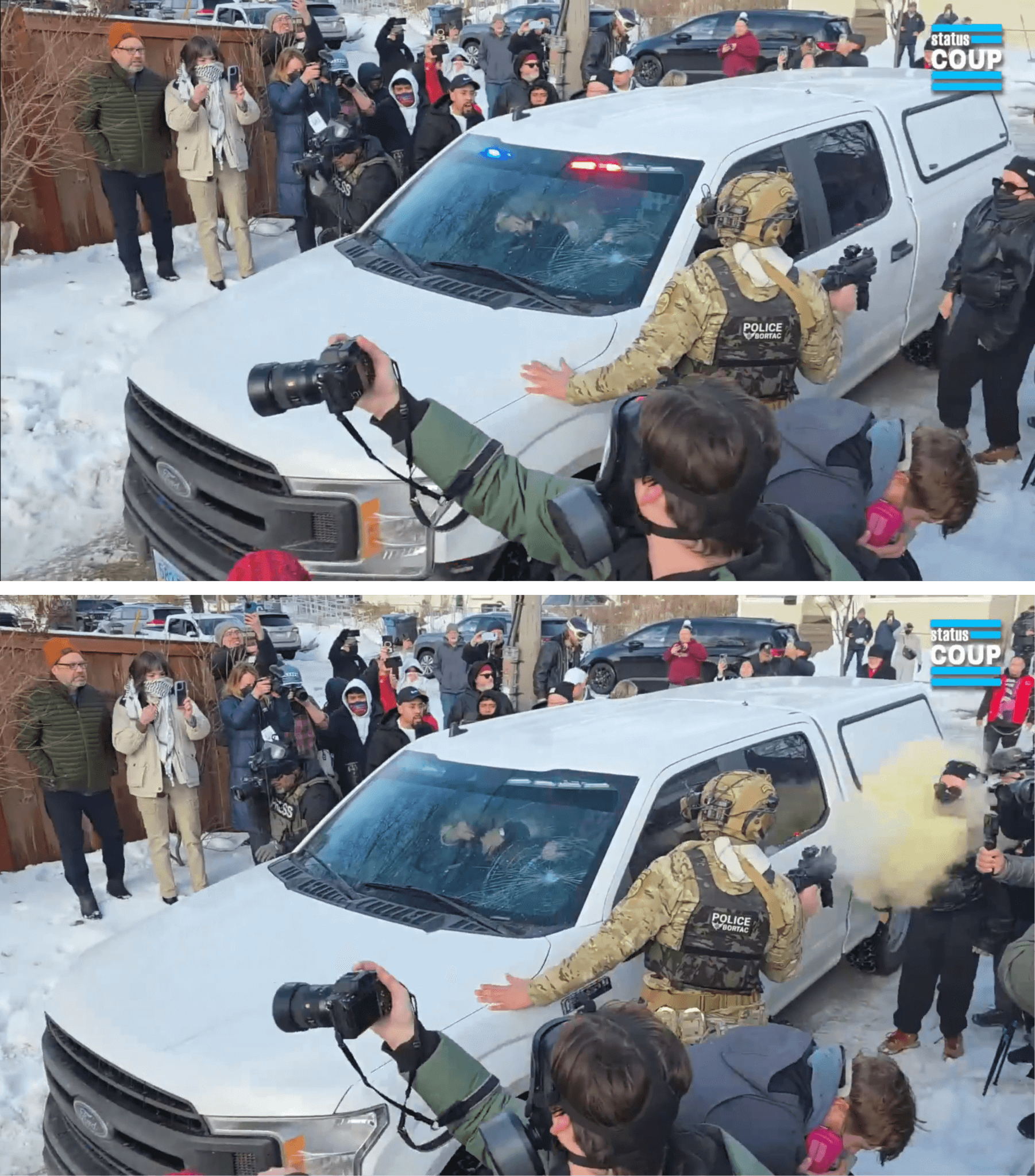
At 9:02, EZ-17 is seen firing his fourth shot at the person who was banging on the truck’s windows.
Rachel Moran, a professor at the University of St. Thomas School of Law who reviewed the video footage, said that of the six shots attributed to EZ-17, this one appears to be the most justified in the context of carrying out official duties—specifically, the effort to help evacuate the vehicle. According to her, the person at whom the shot was fired was still aggressively striking the vehicle at the time.
Fifth Shot
After EZ-17’s fourth shot, EZ-2 deploys a tear gas grenade, and the CBP truck drives down the alley, moving away from the protesters.
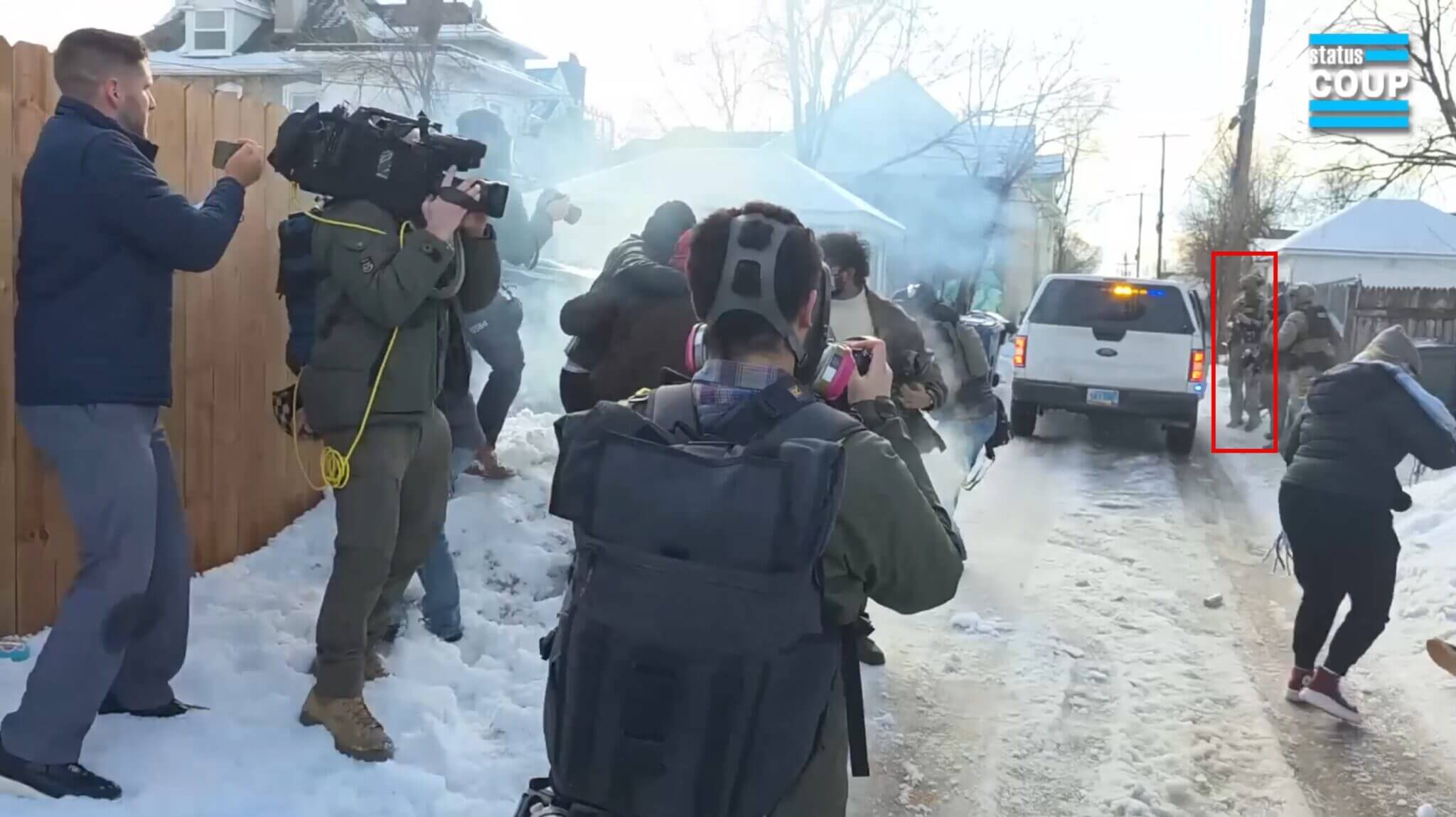
EZ-17 (in the red box) reloads the 40-mm launcher at 9:18.
The CBP agent with the PepperBall launcher appears to move to the other side of the truck, while EZ-2 seems to begin getting into the vehicle.
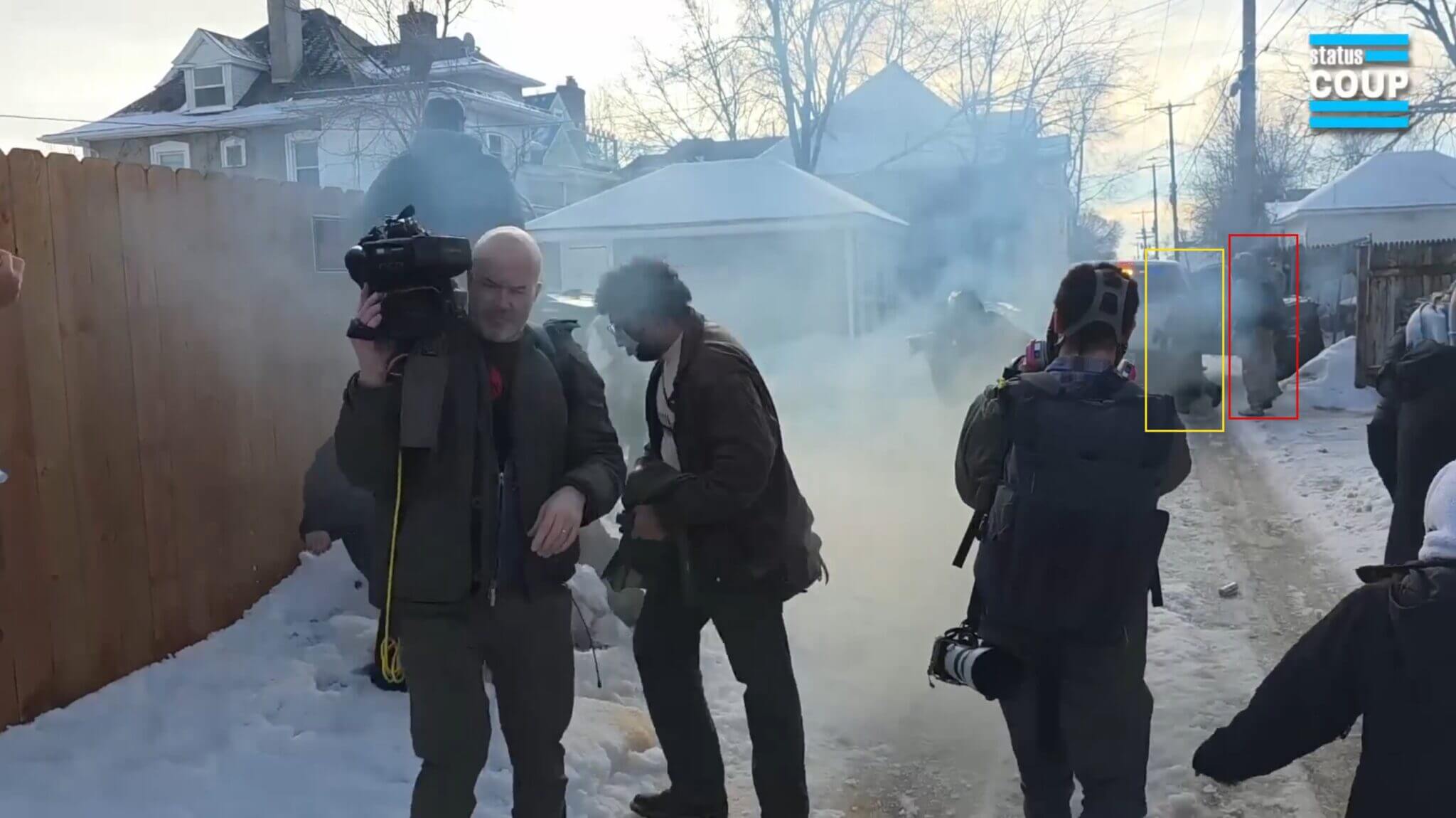
The CBP agent with a PepperBall launcher (yellow box) moves to the opposite side of the truck, while EZ-2 stands in front of EZ-17 (red box) at 9:20.
As soon as the truck’s rear right door closes, gas can be seen coming from the muzzle at the spot where EZ-17 was standing.
Visible gas emerges from the muzzle at 9:22.
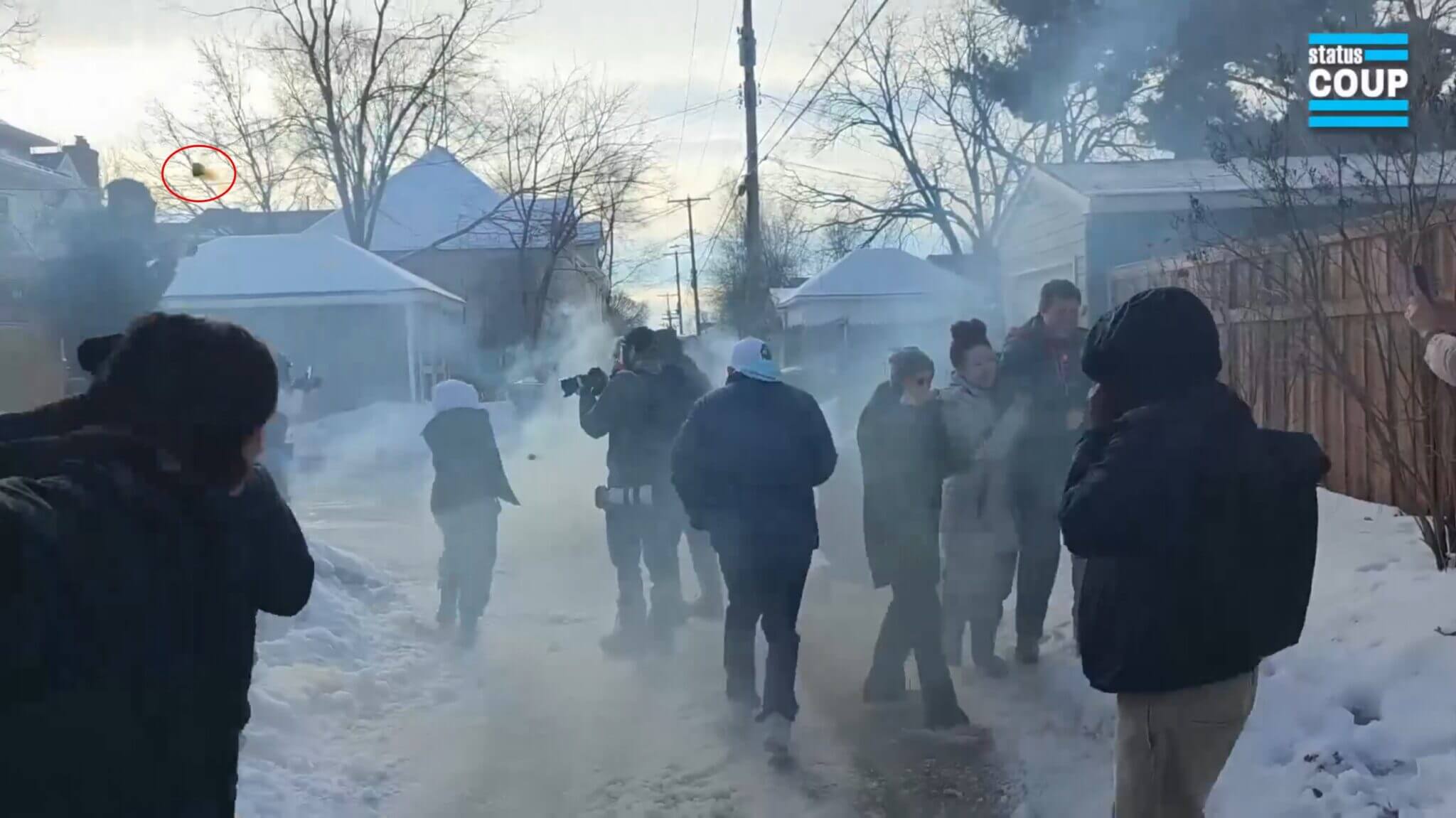
The fifth shot was likely fired with a “skip” shot, with the round aimed at the ground before ricocheting upward at close range. As a result, three visible projectiles were sent flying toward the crowd, narrowly missing people.
Although the footage appears blurred due to tear gas from a grenade previously deployed by EZ-2, EZ-17 appears to be the only agent who could have fired this shot. EZ-2 was not carrying a launcher, and PepperBall launchers—like the one held by another CBP agent—do not use ammunition capable of releasing multiple projectiles in a single shot.
Three distinct projectiles are visible after the muzzle gas at 9:22.
It was visible that the projectiles traveling through the air were releasing chemical irritant smoke from this final shot.
One projectile is clearly seen releasing chemical irritants while traveling through the air at 9:23.
Several of the projectiles appear consistent with a 40-mm “SKAT Shell” round produced by Defense Technology, which releases four separate submunitions upon firing, each dispersing chemical irritants. In one video, a SKAT round can be seen on EZ-17’s belt.
EZ-17’s belt before the second shot, with visible SKAT-SHELL SAF-SMOKE rounds to the right of the direct-impact munitions on his belt.
The footage shows EZ-17 once more firing his B&T GL06, apparently at head level—this time at someone who had thrown a snowball at a CBP agent.
EZ-17 after firing his B&T GL06 launcher at the face of a high school student.
“Punitive and unlawful”
Patrick Wilcken, a researcher specializing in military, security, and policing issues, said that although the situation shown in the video appeared tense—with verbal abuse, pushing, snowball throwing, and attempts to block a vehicle’s movement—there was no serious physical threat to the agents that would have justified the use of less-lethal weapons.
After reviewing all six shots fired by EZ-17, Wilcken said the agents’ actions—including pursuing fleeing protesters and, in some cases, firing at people who appeared to be trying to protect themselves—were punitive in nature and appeared unlawful.
U.S. Customs and Border Protection use-of-force policy allows 40-mm launchers to be used only against individuals engaged in active or assaultive resistance. Department of Homeland Security guidelines likewise stress that force may be used only when no effective and safe alternatives exist, and only to the extent that is objectively justified by the circumstances.
According to Wilcken, officers should resort to less-lethal weapons only when faced with serious physical violence that poses a real threat and cannot be stopped by other means. He emphasized that the use of force must be restrained and must not violate the right to peaceful assembly.
Rachel Moran, a professor at the University of St. Thomas School of Law, agreed that the justification for using such weapons depends directly on the level of threat posed by the individual being targeted. She noted that only the fourth shot—linked to an attempt to help evacuate a CBP vehicle—could be considered justified. The other shots, she said, were “at best questionable” based on the video evidence.
Moran pointed out, for example, that at the time of the third shot, the man was already fleeing, had his hands raised, and was holding nothing, meaning any threat had effectively dissipated. She described that shot as retaliation rather than self-defense. She offered a similar assessment of the incident near Roosevelt High School, where the person who threw a snowball was already retreating when EZ-17 opened fire.
Moran also said that if EZ-17 was indeed using a 40-mm B&T GL06 launcher, aiming directly at people’s faces would appear to violate Customs and Border Protection’s internal policy.
The weapon used by EZ-17 is visible as he points it at a protester.
U.S. Customs and Border Protection (CBP) use-of-force policy explicitly prohibits agents using launchers, including 40-mm launchers, from intentionally aiming at the head, neck, groin, spine, or female breasts. However, an analysis of the six shots fired by EZ-17 indicates that in five cases he likely aimed at the head area.
Travis Norton, a former police lieutenant and use-of-force consultant, explained that standard training and manufacturer guidelines for such launchers call for aiming at large muscle groups in the lower body. These guidelines specifically emphasize avoiding prohibited areas—the head, neck, chest, spine, and groin—in order to reduce the risk of serious injury.
According to Norton, 40-mm launchers are not intended for indiscriminate or area fire. Their use is limited to clearly identified individuals who are engaging in dangerous or violent behavior and who cannot be safely addressed by other means.
He also noted that ricochet or “skip” firing, which was used in the fifth shot, is generally not considered a standard or recommended practice in most law enforcement training programs. Because ground conditions, angles, and projectile behavior are unpredictable, such firing reduces accuracy and control and increases the risk of unintended injury to bystanders.
The information was taken from open-source reporting by Bellingcat
To provide the best experiences, we use technologies like cookies to store and/or access device information. Consenting to these technologies will allow us to process data such as browsing behavior or unique IDs on this site. Not consenting or withdrawing consent, may adversely affect certain features and functions.
Functional
Always active
The technical storage or access is strictly necessary for the legitimate purpose of enabling the use of a specific service explicitly requested by the subscriber or user, or for the sole purpose of carrying out the transmission of a communication over an electronic communications network.
Preferences
The technical storage or access is necessary for the legitimate purpose of storing preferences that are not requested by the subscriber or user.
Statistics
The technical storage or access that is used exclusively for statistical purposes.The technical storage or access that is used exclusively for anonymous statistical purposes. Without a subpoena, voluntary compliance on the part of your Internet Service Provider, or additional records from a third party, information stored or retrieved for this purpose alone cannot usually be used to identify you.
Marketing
The technical storage or access is required to create user profiles to send advertising, or to track the user on a website or across several websites for similar marketing purposes.