02.02.2026
14 min
617



Official reports keep leaning on the “self-defense” story, but the footage tells a completely different tale. We took a hard look at what actually happened on January 7 in Minneapolis, and the clips from people on the street tell a story that the police narrative just doesn’t cover. After a frame-by-frame breakdown, one thing is clear: the only thing in that woman’s hands was a cell phone, not a weapon.
We’ve walked through every single second of that day—from the moment they blocked her car to those final, fatal shots. It leaves you with a heavy question: how does a mother with nothing but a phone in her hand end up a victim of lethal force? And why is the official story so far off from what we can all see with our own eyes?
The best way to understand how the event played out is to map the movements of everyone involved. This is exactly what we did immediately following the January 7 incident.
Using eyewitness footage that surfaced online, we were able to precisely track the movements of the federal agents, including where Officer Ross was positioned as he moved down the street. The video also clearly shows the path of Renee Good’s car: its position before, during, and after the shots were fired. This kind of detailed reconstruction allows us to see the situation from an outside perspective and understand the dynamics of the movement that might be missed from a single, random angle.
The best way to understand what happened is to literally retrace every step taken by those involved on a map. This is exactly what we did in the immediate aftermath of January 7.
Thanks to eyewitness footage that surfaced online, we were able to precisely track the movements of the federal agents and pinpoint exactly where Officer Ross was at any given moment. The video also clearly shows the trajectory of Renee’s car: we can see its initial position, how it moved as the shots were fired, and where it finally came to a stop. Such a detailed reconstruction allows us to view the situation from the outside and grasp the logic of the movements that would be impossible to catch from a single, random angle.
We’ve also updated our animated map of the positions of agents and vehicles during the incident here with new footage published by @cnn.com that shows the shooter closer to a white SUV prior to the shootingbsky.app/profile/bell…
Another eyewitness video, later released by the Minnesota Reformer, provides a closer look at Ross’s movements right before the shooting.
The footage shows Ross filming Good with a phone in his left hand just before drawing his handgun from its holster with his right. About a second later, he fires the first shot through Good’s front window, followed by two more shots in quick succession.
A frame from the same video shows Ross walking past just seconds after the shooting. His phone screen is visible, showing the camera app still open.
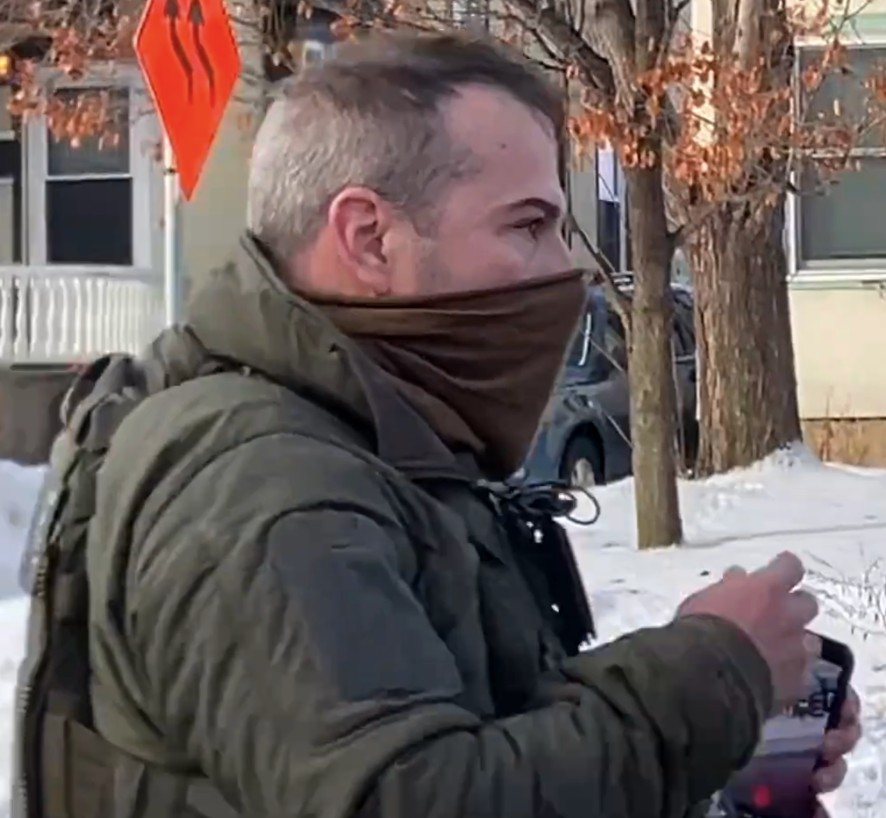
A few days after the tragedy, a recording surfaced online made by Officer Ross himself on his phone. By syncing it with other videos, it is possible to literally step into the agent’s shoes, though it is worth noting that the camera in his hand was offset, so the lens angle differs slightly from his actual line of sight.
The footage shows Renee backing up and turning right while the officer moves in the opposite direction. Because of how the phone was held, it is difficult to tell exactly how close the car came to him, as the camera was pointed away while the vehicle was in motion. Someone can be heard shouting “wow,” followed immediately by a series of gunshots.
Analysis of movement and angles. The street-level perspective sparked a lot of debate. To some, it looked like the car struck the officer, but a close-up analysis of the frames reveals that Ross managed to step aside just as he began to fire. Surveillance footage capturing the incident head-on only confirms this complex dynamic.
Political fallout and aftermath. The event instantly polarized the public. While protests broke out on the streets of Minneapolis and other cities, fierce debates raged at the highest levels of government. Officials in Washington labeled Renee a “domestic terrorist,” claiming she attempted to ram the agent. However, the city’s mayor dismissed these accusations as nonsense that is completely debunked by the available video evidence.
Despite the protests and doubts surrounding the legality of the agent’s actions, it was announced on January 12 that even more federal forces would be deployed to the state.