01.10.2024
7 min
907



The conflict between India and Pakistan has escalated due to a deepfake video that has spread rapidly on social networks and the media. This incident highlights the threat of disinformation in today’s digital world and raises concerns about regional security. Experts are calling for increased media literacy and the introduction of new technologies to combat fake news. In this article, you will learn how deepfake videos have contributed to the escalation of the conflict between India and Pakistan, why fake news is becoming increasingly dangerous, and what steps need to be taken to counter disinformation in the modern world.
India and Pakistan have been trading blows in the wake of a militant attack on tourists in Indian-administered Kashmir last month.
On May 7, India said it had launched missile strikes in Pakistan and Pakistan-administered Kashmir. Pakistan – which denies any involvement in the April attack on the tourists, most of whom were Indian – then claimed to have shot down Indian drones and jets.
Claims and counterclaims of ongoing strikes and attacks have been forthcoming from both sides. Some have been difficult to immediately and independently verify, creating a vacuum that has enabled the spread of disinformation.
For example, on May 8, a deepfake video of US President Donald Trump appearing to state that he would “destroy Pakistan” was quickly debunked by Indian fact-checkers. Its impact was therefore minimal.
However, the same cannot be said of another deepfake video spotted by Bellingcat and, by the time of publication, at least one Pakistani outlet.
The altered video had been shared on X (formerly Twitter) nearly 700,000 times at the time of publication and purports to show a General in the Pakistani army, Ahmed Sharif Chaudhry, saying that Pakistan had lost two of its aircraft.
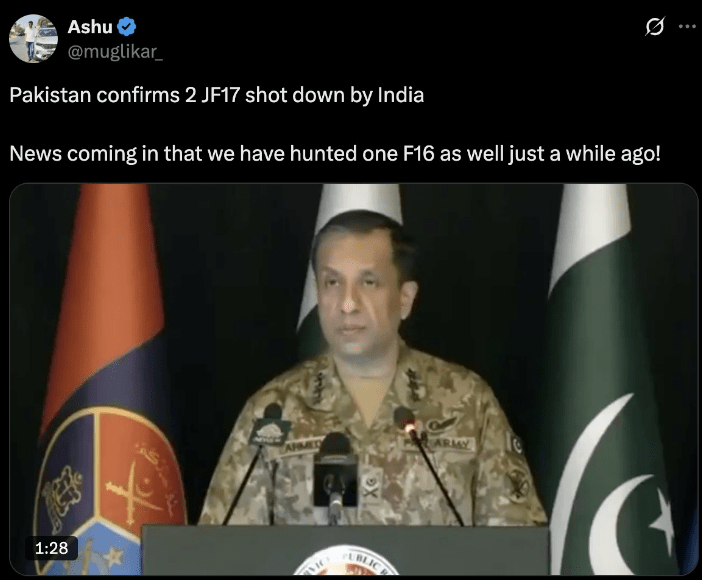
A Community Note was later added to the video on X detailing it as an “AI generated deepfake”.
However, several Indian media companies had already picked up and ran with the story, including large outlets like NDTV. Other established news media that featured quotes from the altered footage in their coverage include The Free Press Journal, The Statesman and Firstpost.
Bellingcat was able to debunk the video by finding another clip of the same press conference from last year. The video confirms that a different audio was added over the original footage, with Chaudhry’s lips appearing to sync with the altered audio.
The position of the microphones, Chaudhry’s position in relation to the flags, and his movements are identical. Both videos cut to the audience which is also the same.
You can see the video published on Facebook in 2025 here and the manipulated video published on X here.
Mohammed Zubair, co-founder of the Indian fact-checking organization Alt News, said that misinformation and false information are common on Indian social media platforms. He said that while it may be relatively easy for experienced fact-checkers to spot a deepfake, which uses an altered old video with manipulated audio, he expressed concern that ordinary users might simply click the “share” button due to the emotional impact of such content. Zubair noted that such content can appear very convincing, which is worrying.
NDTV, The Free Press Journal, The Statesman and Firstpost did not respond to requests for comment at the time of publication. NDTV and The Statesman later removed their content without explanation. Experts say such videos are a warning about the ongoing and growing threat of disinformation.
Rachel Moran, a senior fellow at the Center for an Informed Public at the University of Washington, said the speed with which such videos are created and distributed presents a new challenge for society. She emphasized that in times of crisis, the information space is already difficult to navigate, as it is difficult to quickly separate rumors from facts. The presence of high-quality fake videos only complicates this process, making it less reliable and distracting from important truthful information.