12.07.2026
2 min
244



Apple has filed a lawsuit against OpenAI, accusing the company of stealing its trade secrets as part of what it claims was a coordinated effort to accelerate the development of its own AI hardware.
According to the lawsuit, Apple uncovered what it describes as a coordinated scheme to obtain its confidential information involving current OpenAI employees who previously worked at Apple.
“Compelling evidence has recently emerged that individuals employed by OpenAI unlawfully obtained Apple’s secret and confidential information regarding our unreleased technologies, processes, and products,” an Apple spokesperson said.
One of the primary defendants is Chang Liu, who spent eight years at Apple as a senior electrical engineer and worked on some of the company’s most sensitive product development programs.
Apple alleges that after leaving the company, Liu retained access to his work laptop and exploited a previously unknown authentication flaw. According to the lawsuit, this allowed him to reconnect to Apple’s internal network shares and download confidential hardware-related files.
The company also claims that Liu coached a former Apple colleague before her interview with OpenAI by advising her to study topics related to unreleased Apple products.
Another defendant is Tang Tan, Apple’s former Vice President of Product Design for the iPhone and Apple Watch, who now serves as OpenAI’s Chief Hardware Officer.
Apple alleges that Tan used the company’s confidential information to recruit Apple employees to OpenAI. The lawsuit further claims that he encouraged candidates to bring prototypes, design documents, and other product development materials to interviews in order to gain access to even more proprietary information.
According to the complaint, these actions were not isolated incidents but part of a broader corporate strategy. Apple alleges that OpenAI instructed candidates to bring CAD files, design materials, prototypes, and disclose details about device architecture, component selection, system integration methods, engineering tools, and relationships with suppliers during interviews.
Apple also claims that OpenAI instructed newly hired employees on how to avoid internal scrutiny after leaving Apple.
The lawsuit further alleges that OpenAI approached one of Apple’s manufacturing partners and asked it to replicate a proprietary metal-processing technology while falsely claiming it had Apple’s authorization to do so.
Apple says it attempted to raise its concerns with OpenAI in February but never received a response. The company is now seeking unspecified damages, injunctive relief, and a court order preventing OpenAI from using its trade secrets.
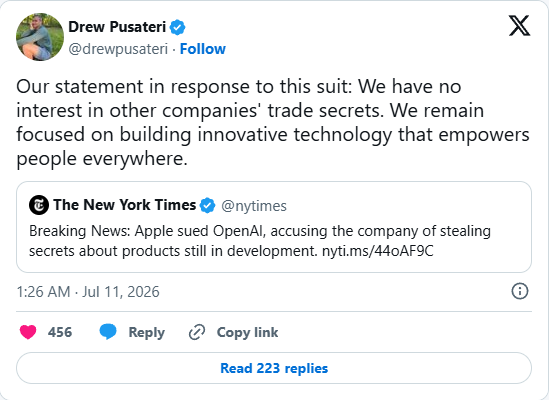
In response, OpenAI’s Head of Communications, Drew Pusateri, wrote on X that the company “has no interest in other companies’ trade secrets.”
The lawsuit marks a dramatic turn in the relationship between the two companies. Back in 2024, Apple and OpenAI announced a partnership that brought ChatGPT integration to the iPhone, iPad, and Mac. However, Apple later chose Google’s Gemini models to power the revamped version of Siri, which was unveiled last month.