

Cybersecurity researchers demonstrated a hack of the Volkswagen ID.4 electric vehicle that allowed them to access the cabin microphone, track the vehicle’s location, and control certain functions. By exploiting Bluetooth vulnerabilities, attackers could potentially read messages from a connected smartphone, activate the heating and windshield wipers, and open the sunroof. It took Volkswagen approximately 18 months to address the vulnerabilities.
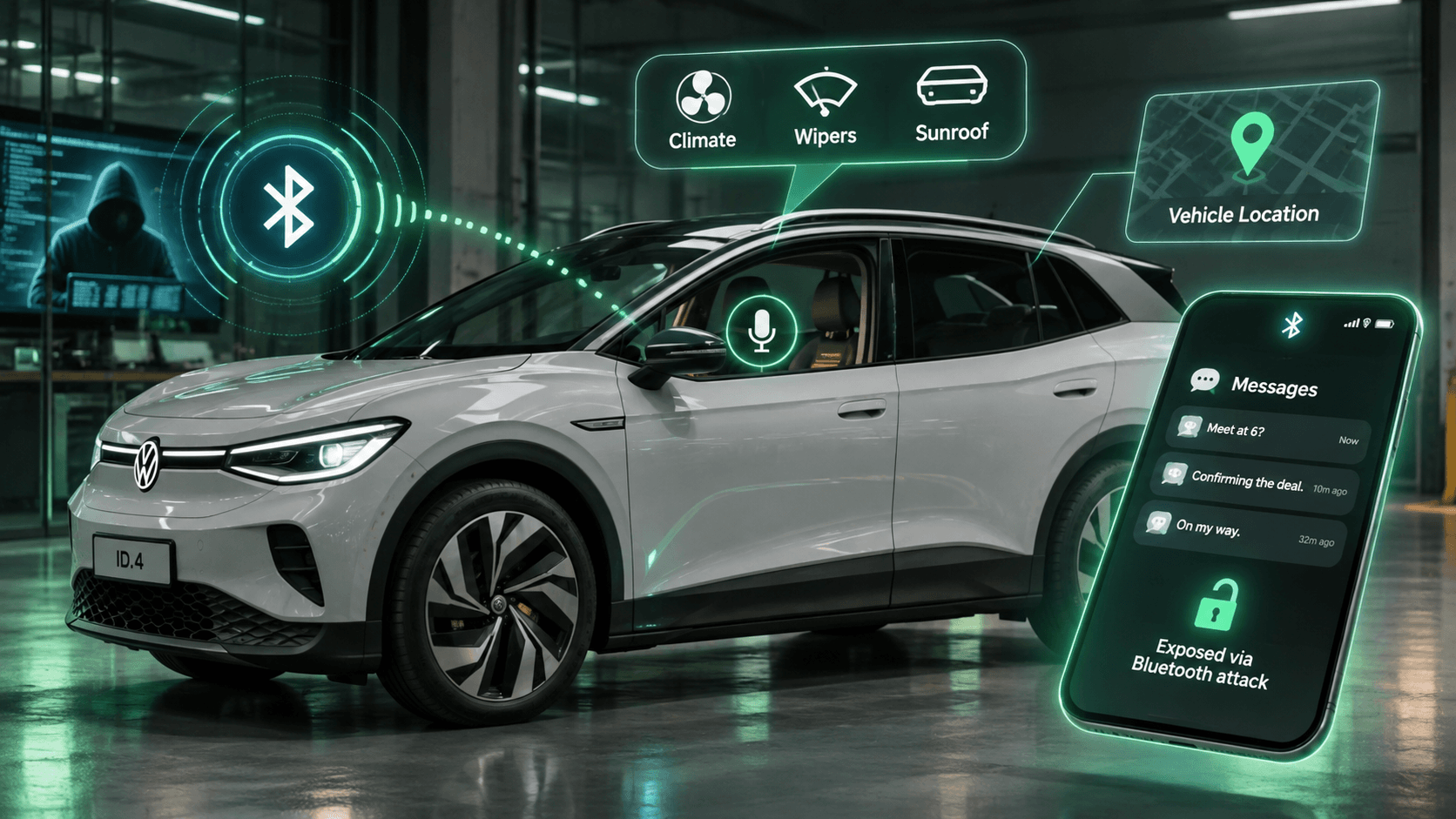
Specialists at PCA Cyber Security demonstrated an attack on a Volkswagen ID.4 electric vehicle in their laboratory in Budapest. During the experiment, researchers gained unauthorized access to the vehicle’s internal systems, highlighting how dangerous software vulnerabilities in modern cars can be.
After successfully gaining access, the team was able to remotely control certain functions of the electric vehicle. In particular, researchers adjusted the cabin heating settings, activated and deactivated the windshield wipers and sunroof, and played voice messages directly to passengers. To do this, they used text-to-speech technology, which allowed them to play prerecorded phrases through the vehicle’s audio system.
The researchers also managed to display the message “hacked by PCA” on the multimedia screen, confirming their ability to modify content shown by the infotainment system. However, the most serious risks involved the privacy of the driver and passengers.
According to The Times, the specialists gained access to text messages and contacts stored on a smartphone connected to the vehicle. They also recorded a conversation between the driver and a passenger using the microphone normally intended for communication with emergency services.
The team separately demonstrated its ability to determine the precise location of the Volkswagen ID.4, even while the vehicle was moving. This means a potential attacker could not only track the owner’s movements but also access private conversations and information from their phone.
The initial entry point was a Bluetooth software vulnerability discovered by PCA Cyber Security specialists in 2025. This flaw allowed the researchers to access the vehicle’s systems and begin escalating their privileges.
The situation was further complicated by the fact that one of the administrator accounts had no password. This allowed the specialists to expand their access privileges and then exploit two additional vulnerabilities to penetrate deeper into the vehicle’s systems.
However, the attack had important limitations. To initiate the hack, an attacker would need to be within Bluetooth range, for example, in a vehicle parked near the target. They would also need to establish a Bluetooth connection by tricking the vehicle or its driver into accepting a pairing request.
This means the demonstrated technique does not allow someone to access any Volkswagen ID.4 from anywhere in the world. Nevertheless, once an attacker successfully gains access, they could potentially obtain far greater control than a standard Bluetooth connection would normally permit.
According to the researchers, information about the Bluetooth vulnerability was shared with automakers after its discovery. However, Volkswagen had to be notified separately about the additional security flaws. It took approximately 18 months before the company began rolling out software updates to hundreds of thousands of vehicles across multiple countries.
Danila Parnishchev, Head of Security Assessment at PCA Cyber Security, criticized the lengthy remediation process. In his view, manufacturers should respond more quickly to vulnerability reports, especially as artificial intelligence continues to accelerate the discovery of software flaws.
Dray Agha, Senior Manager of Threat Response at Huntress, expressed a similar opinion. He emphasized that automotive cybersecurity should receive the same level of attention as vehicle mechanical safety, since delays in releasing security patches can create additional risks for drivers.
Volkswagen, for its part, told The Times that the safety of its customers and their vehicles had not been compromised. The company also confirmed that software updates were being distributed to affected vehicles.
The problem extends far beyond a single electric vehicle. Modern cars increasingly rely on software, wireless interfaces, smartphones, and over-the-air updates. While these technologies make it easier to introduce new features, they also create additional entry points for potential cyberattacks.
The scale of the problem is highlighted by PCA Cyber Security’s Global Automotive Threat Intelligence Report. According to the report, researchers discovered 345 new vulnerabilities in automotive systems during the second quarter of 2026 alone, a 30% increase compared to the previous quarter. The number of high-severity vulnerabilities rose from 75 to 161 during the same period.
This is not the first time researchers have demonstrated the ability to remotely interfere with vehicle operations. In November 2026, another team of specialists discovered flaws in the infrastructure of two automakers that allowed them to track vehicle locations, unlock doors, and start engines. In both cases, the manufacturers, whose names were not disclosed, resolved the issues approximately two hours after receiving the reports.
The Volkswagen ID.4 case demonstrates how an ordinary Bluetooth connection can become the starting point for a more sophisticated attack on a vehicle. If vulnerabilities allow attackers to gain administrator privileges, not only individual vehicle functions but also the owner’s privacy may be at risk. This makes timely software updates just as important for modern vehicles as regular mechanical maintenance.