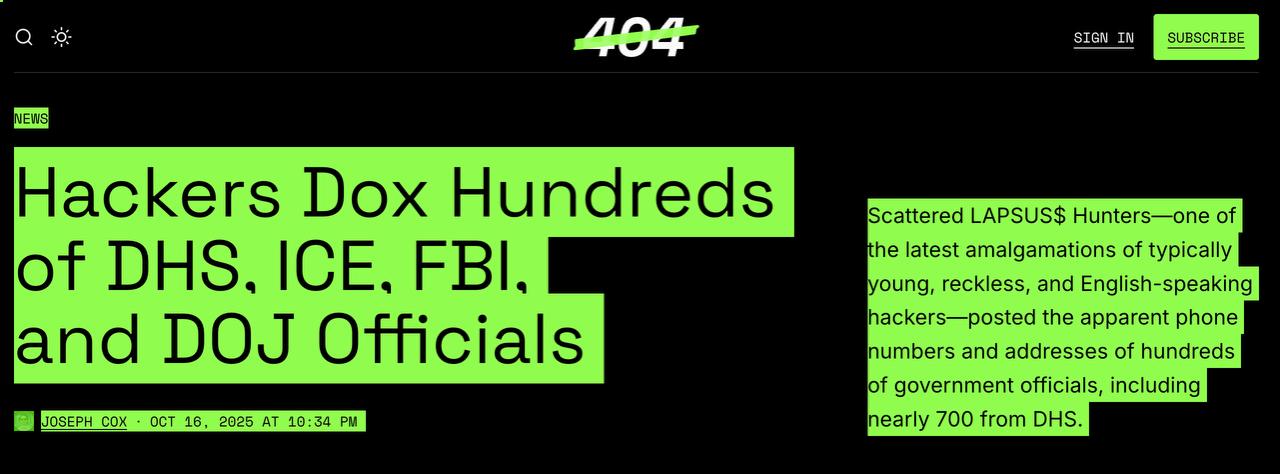
The United States has suffered one of the largest data breaches of law enforcement officials in recent years. The Com hacking group, affiliated with the Scattered LAPSUS$ Hunters community, has posted personal information of hundreds of government agents online, including those from the Department of Homeland Security (DHS), Immigration and Customs Enforcement (ICE), the FBI, and the Department of Justice (DOJ). According to 404 Media, the attack exposed approximately 680 profiles of DHS employees, 190 Justice Department officials, and 170 FBI employees. The data released includes names, work addresses, and in some cases, even home addresses.
The attack coincided with a period of heightened tension between federal agents and the public over a new wave of immigration crackdowns initiated by the Trump administration. ICE and DHS agents have been involved in arrests of protesters, sparking widespread public outcry and accusations of abuse of power. The messages posted on the Scattered LAPSUS$ Hunters Telegram channel were accompanied by sarcastic comments. One of them — *“I want my money, Mexico”* — referred to rumors that Mexican drug cartels allegedly pay for doxing American agents.
According to analytical data, the cartels could indeed have created a system of “rewards”:
$2,000 — for collecting information or photos of agents,
$5,000–10,000 — for attacks or kidnappings,
up to $50,000 — for the elimination of high-ranking officials.
Such statements have not yet been officially confirmed, but they raise serious concerns about the safety of federal employees. The leak has already become the subject of an investigation by the US Department of Homeland Security. The agency published a statement condemning “dangerous doxing attacks” and reported an increase in the number of attacks on agents by more than 1,000%.
In September, a federal grand jury indicted three women on charges of stalking an ICE officer, live-streaming his location, and leaking personal information. Other charges include threats to the agents’ families, including their wives and children, which makes the cyber campaign a real physical threat.
Cyber experts say the Com group is known for a number of politically motivated hacks and operates primarily through Telegram channels, connecting young hackers from various English-speaking countries. They have previously claimed to have targeted government agencies, including the NSA.
The incident was the first such large-scale doxing of U.S. law enforcement agencies and demonstrated that even the most highly secured government agencies can be vulnerable. It also underscored how dangerous the release of personal information can be in the context of political tensions and criminal interests.
Experts are calling on the authorities to urgently strengthen the protection of personal data and introduce additional security measures for employees working in high-risk areas.