
22.07.2026
4 min
215



A sex-tech company has brought a literal “vibe” to vibe coding after finding an unusual way to use OpenAI’s Codex Micro keyboard.
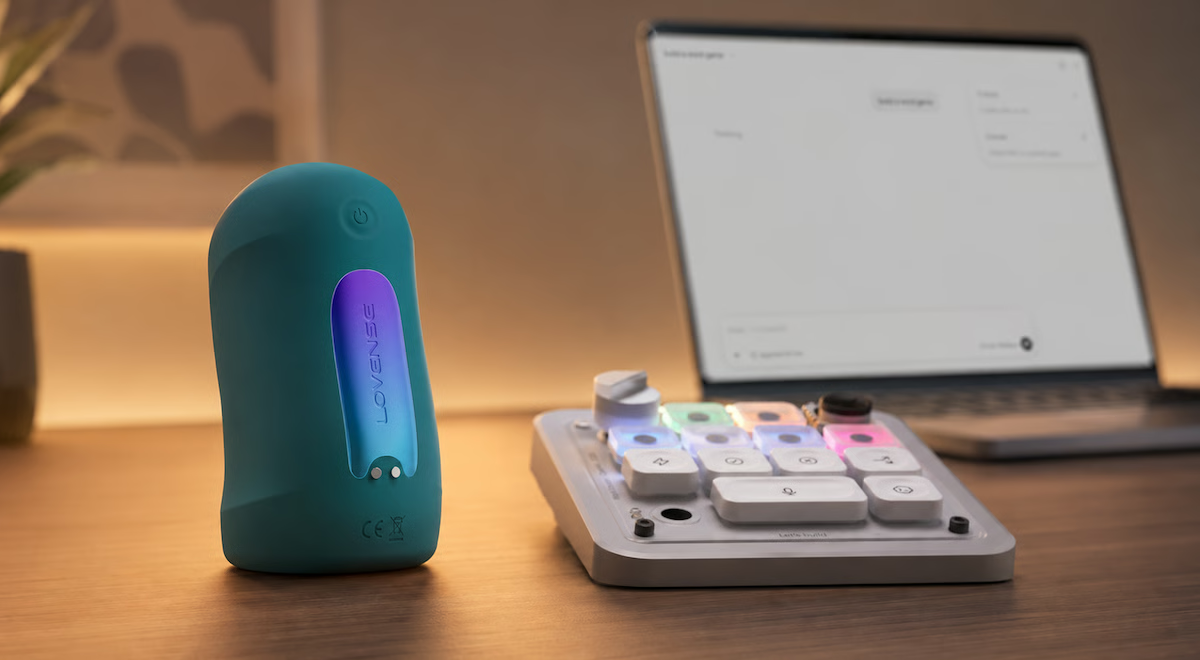
One of the developers at Singapore-based Lovense gained access to OpenAI’s new keyboard designed specifically for coding. Codex Micro helps developers manage multiple AI agents using programmable keys and dedicated software.
The keyboard was priced at $230, but the entire batch sold out within 12 hours. Resellers are now listing the device on eBay for as much as $1,850. Meanwhile, a Lovense developer found an entirely unexpected use for Codex Micro by connecting it to a sex toy.
The developer created an experimental project that connects Codex Micro directly to one of Lovense’s sex toys. The device in question is one of the company’s latest products, the Gush 2 Motion, which the manufacturer describes as a wearable vibrating and oscillating penis massager with a motion sensor.
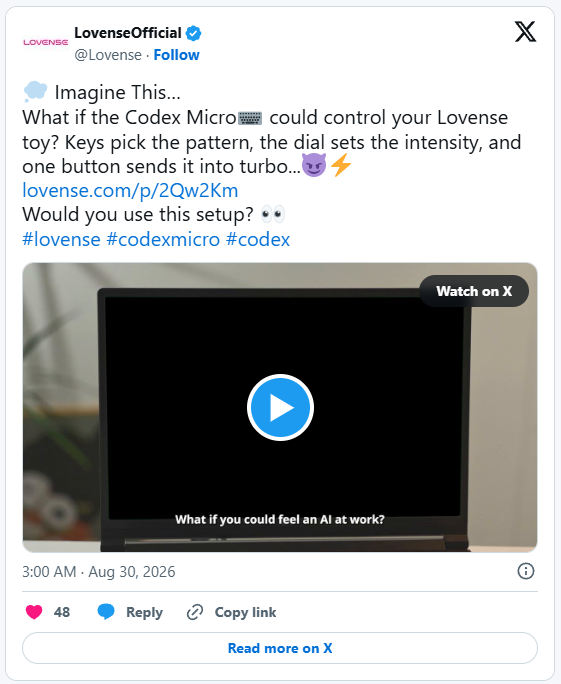
Lovense is known for app-controlled intimate devices, but this time the developer decided to hand control over to OpenAI. To make it work, they built a small local bridge between the Codex app server and Lovense’s public API. The project was named TokenPulse.
The prototype measures the speed and volume of Codex’s streaming responses in real time. The more data the system generates, the faster and more intensely the device vibrates. If generation slows down, the vibrations weaken or stop entirely.
The prototype gives the signals from Sam Altman’s company’s programmable keyboard a physical form. The AI agent keys indicate whether a task is running or completed and show when agents are waiting for input, processing information, or encountering an error.
The connection between the two devices creates a unified workflow and synchronizes their operation. At the start of a run, the device vibrates at a low intensity. As Codex generates its response, the streaming output adjusts the strength and pace of the vibrations. Once the task is complete, the system delivers a short final pulse.
Codex Micro also features a dial that normally adjusts the AI agents’ reasoning level. In this prototype, it controls vibration intensity. The programmable keys act as shortcuts, while the APPR key activates a rhythmic vibration pattern inspired by Kegel exercises.
Although the project has an obvious intimate angle, Lovense says the experiment is not solely about sex. The company sees it as a way for developers to experience the progress of their workflows through an additional sensory channel.
“Adding physical vibration to the output stream is not as strange as it may seem. It is another feedback channel, providing tactile confirmation that your AI is working, thinking, and producing results,” Lovense said.
The company believes that coding has always been a kind of “dopamine game” and that developers already have a strong sensory connection to their work.
“Developers use laptops covered in stickers, install custom keycaps, and choose mechanical switches calibrated to precise actuation forces. Writing code already has a deeply sensory component.”
In this way, vibe coding, the process of creating software with the help of artificial intelligence, has taken on a literal meaning. TokenPulse currently remains an unfinished experimental Lovense prototype and is not an official feature of OpenAI or Codex Micro.