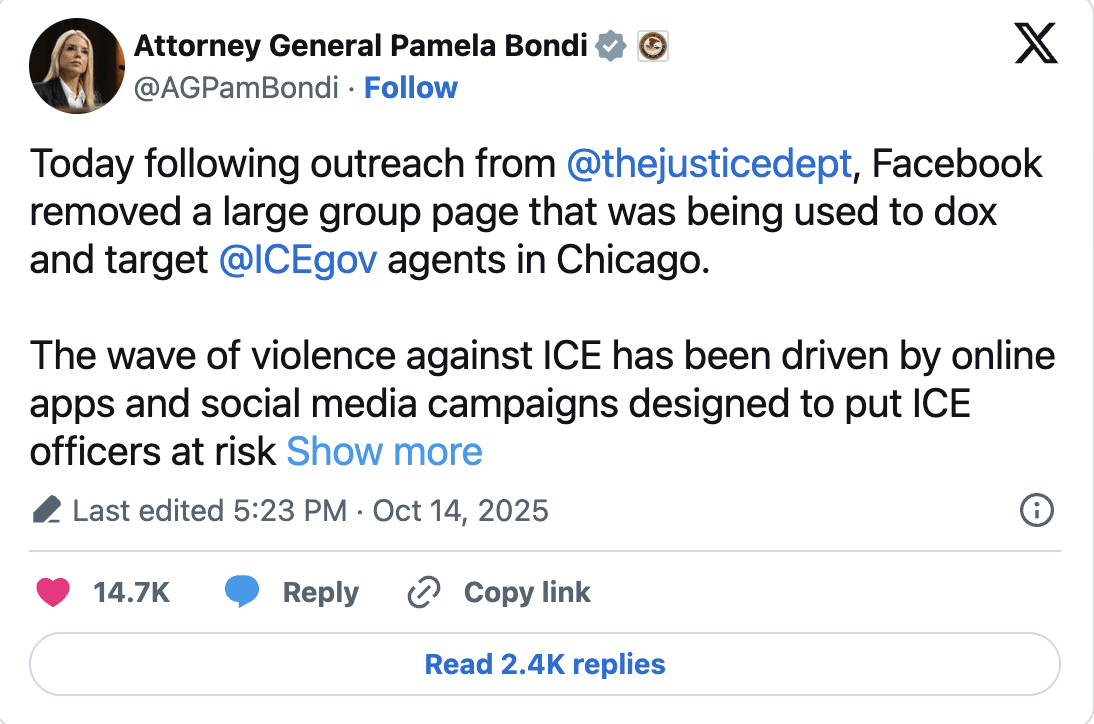
The U.S. Department of Justice said Meta complied with its request and removed a Facebook page that the department said was being used to harass Immigration and Customs Enforcement (ICE) agents in Chicago. According to Reuters, the Facebook page, which the Justice Department said was part of a “doxxing” campaign — the publication of personal information about ICE agents — was removed for violating its “coordinated harm” policy. Attorney General Pam Bondi said in a post on the platform that the page targeted about 200 ICE agents deployed to Chicago as part of the Trump administration’s immigration policies. Meta confirmed the page had been removed but did not disclose its contents. The Justice Department similarly provided no further details, and reporters were unable to review it. Meanwhile, Apple and Google have previously removed apps that allowed them to track the movements of ICE agents after pressure from the Trump administration, which threatened to investigate the developers of such services.

ICE remains a central element of Trump’s immigration policy, and its agents have repeatedly conducted mass raids. Human rights activists accuse the agency of violating free speech and migrant rights, while supporters of the administration say protests against ICE often escalate into harassment of employees.
Meta and other technology companies are trying to improve relations with the White House after Trump’s re-election in 2024. The company donated $1 million to his inaugural fund and discontinued fact-checking and diversity programs. Meta also agreed to pay $25 million to settle a lawsuit related to the blocking of Trump’s accounts after the events of January 6, 2021.
At the local level, the city of Chicago and the governor of Illinois have spoken out against ICE’s activities: Mayor Brandon Johnson signed an order prohibiting agents from using municipal facilities for operations, and businesses are putting up signs warning that their area is “off-limits” to ICE.
The removal of the Facebook page demonstrates how technology corporations are increasingly responding to political requests from the authorities in the United States. The balance between security, free speech, and political influence remains a difficult issue, especially when it comes to sensitive topics such as immigration, social media monitoring, and the relationship between tech giants and the government.