

01.08.2024
2 min
1426



Finnish companies Nokia and ICEYE have reached an agreement with Ukraine’s Ministry of Defense to cooperate on developing an independent satellite communications system. The initiative comes amid reports of restrictions on the Starshield military satellite service, which, according to Ukrainian officials, have complicated drone operations and air defense activities.
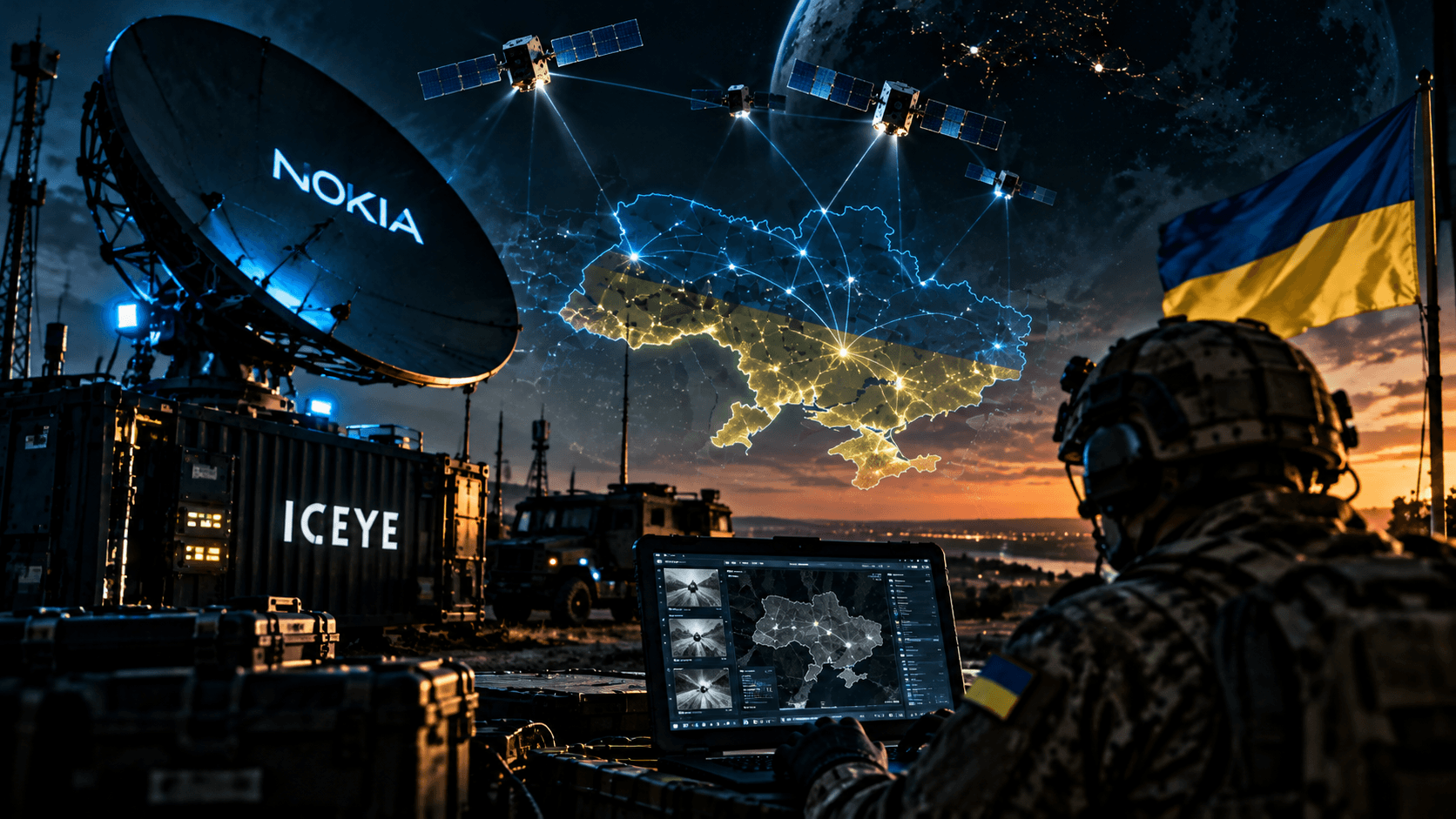
On October 22, 2026, Finnish companies Nokia and ICEYE announced the signing of a letter of intent with Ukraine’s Ministry of Defense. The document outlines plans to explore cooperation in the space sector, particularly the development of a secure satellite communications system that Ukraine would be able to control independently. The agreement was announced during the Finnish Prime Minister’s visit to Ukraine.
Earlier in October, Nokia and ICEYE announced a partnership to develop high-speed broadband satellite communications systems operating in low Earth orbit (LEO). The technology is primarily intended for government agencies and is designed to provide stable, secure communications for defense operations, border security, emergency services, and disaster response.
A key feature of the proposed system is that countries would be able to own and independently control their satellites, ground infrastructure, and terminals. This approach aims to reduce dependence on external providers that could change access conditions or restrict the use of communications services.
Ukrainian President Volodymyr Zelenskyy emphasized that modern warfare has demonstrated the importance of reliable communications for national security. According to him, countries must have communications capabilities under their own control, and the agreement with Nokia and ICEYE represents an important step in that direction. He also thanked Finland for its continued support of Ukraine and its contribution to strengthening Europe’s long-term security.
ICEYE CEO and co-founder Rafal Modrzewski also emphasized the importance of independent communications:
“Ukraine needs secure, independent, and high-performance satellite communications systems that it can control. We have a proven track record of rapidly delivering sovereign projects that will help build these capabilities. ICEYE has proudly supported Ukraine since 2022, and we remain committed to that support.”
Nokia representative Mikko Hautala noted that satellite networks are particularly important when ground-based communications infrastructure is damaged or unavailable. In his view, the ability to independently manage such systems would help Ukraine maintain resilient communications even under difficult conditions.
However, the signed document does not yet mean that deployment of a fully operational satellite network has begun. The parties have only agreed to explore potential cooperation, and no specific launch dates or technical specifications for the Ukrainian system have been announced.
The agreement with the Finnish companies came just days after Ukrainian officials reported problems with Starshield, the military version of SpaceX’s Starlink satellite service. According to them, terminals stopped functioning properly when moving at speeds of approximately 160 km/h or higher, creating difficulties for certain military operations.
Ukrainian officials claim that the restrictions affected the operation of strike drones and air defense systems used to intercept Russian drones. This potentially increases risks for both military personnel and civilians during Russian attacks.
The question of who introduced the restrictions remains disputed. US President Donald Trump’s administration and SpaceX owner Elon Musk have denied responsibility for the situation, blaming each other. Meanwhile, media reports citing anonymous sources claim that Musk himself made the decision to slow down Starshield service.
According to The Wall Street Journal, Trump personally called Musk on October 23 and asked him to lift the restrictions affecting Ukraine. Following the conversation, some Ukrainian military personnel reported improvements in satellite internet speeds within certain units. However, there has been no comprehensive official confirmation that all terminals have returned to normal operation.
This is not the first time Starlink’s operation has sparked controversy during the war in Ukraine. According to media reports, in 2022 Musk ordered satellite connectivity to be restricted near Russian-occupied Crimea while Ukrainian forces were conducting operations aimed at reclaiming territory seized by Russia.
The latest restrictions have drawn criticism even from individuals associated with Musk’s businesses. SpaceX investor Ross Gerber told CNN that he was disgusted by the decision, describing it as strategically catastrophic and appalling from a humanitarian perspective. In his view, the situation demonstrated that Starlink cannot be considered an entirely reliable foundation for national security.
The problems with Starlink have reignited discussions about European countries’ and Canada’s dependence on American satellite technologies. For Ukraine, this issue is particularly important because Starlink remains one of the primary communications tools on the battlefield, while European partners help finance its use by Ukrainian forces.
There is currently no full replacement for Starlink. SpaceX’s network consists of more than 10,000 satellites in low Earth orbit, giving it a significant advantage in terms of coverage and the number of available terminals. Nevertheless, European companies and government agencies are gradually developing their own solutions to reduce dependence on a single provider.
On October 19, major European telecommunications operators Deutsche Telekom, Orange, Telefónica, and Vodafone announced plans to explore the creation of a joint venture for the use of radio spectrum. The initiative focuses on developing satellite mobile communications through direct-to-device technology, which allows ordinary mobile devices to connect directly to satellites.
Meanwhile, the European Union is negotiating accelerated access for Ukraine to the secure GOVSATCOM satellite communications system, which began operations in January 2026. The program is designed to provide secure, encrypted communications for government institutions and military organizations and is expected to become one of the foundations of Europe’s technological independence.
Another major EU project is Infrastructure for Resilience, Interconnectivity and Security by Satellite (IRIS²). The program involves developing a multi-orbit satellite system consisting of 290 spacecraft, with the first phase of deployment expected by 2029. It is intended to provide government agencies, the defense sector, and other users with secure communications under European control.
Canada is also developing its own alternative. Canadian company Telesat plans to launch its Lightspeed low Earth orbit broadband network in early 2028. According to company representatives, its capabilities could also be made available to the armed forces of allied nations, including Ukraine.
The agreement between Nokia, ICEYE, and Ukraine’s Ministry of Defense is therefore part of a broader trend toward developing independent satellite communications capabilities. Although none of the emerging projects can fully replace Starlink yet, building sovereign infrastructure could gradually reduce Ukraine’s dependence on decisions made by individual private companies and provide greater control over critically important military communications.