
23.07.2025
2 min
733



Swiss company Proton, known for its focus on privacy, has introduced a new product — Lumo. It is an artificial intelligence that does not store conversations, does not use queries to train models and does not have hidden algorithms. Everything is built on open source, and data is encrypted from the moment of input.
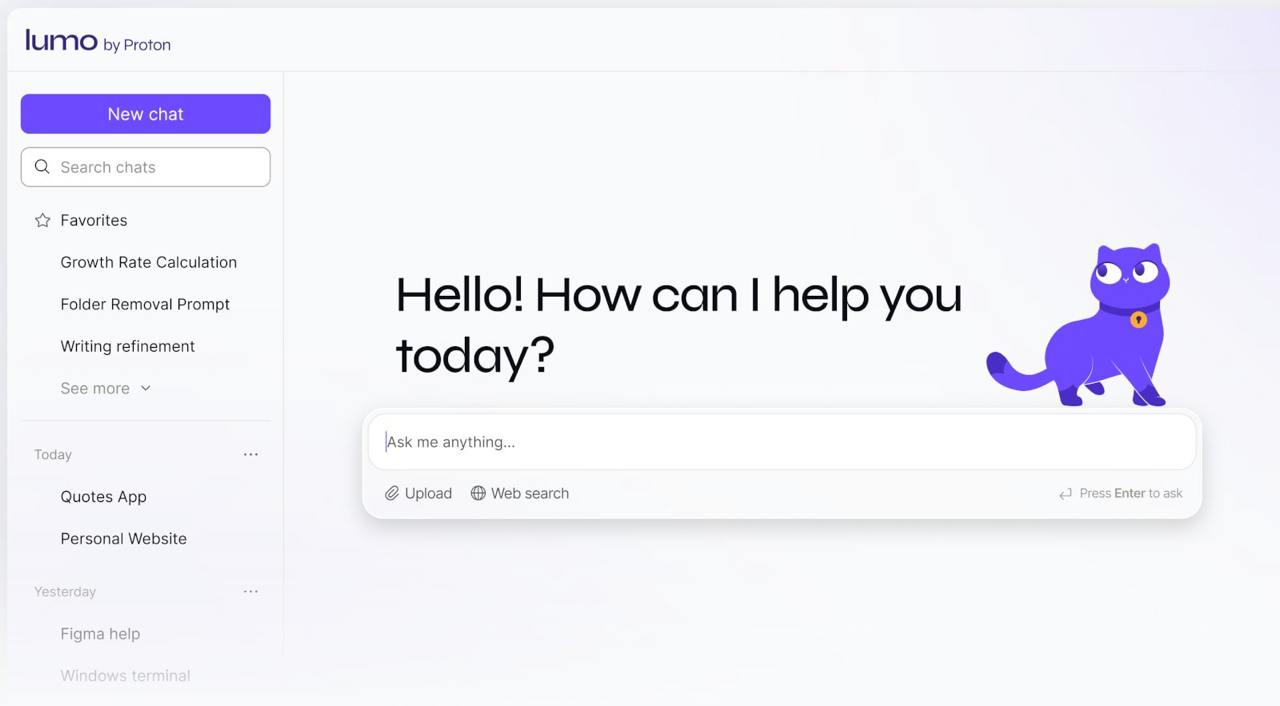
Lumo is Proton’s answer to the market of “omni-seeing” AI assistants. Unlike its competitors, it:
Lumo’s interface resembles ChatGPT or Claude, but behind the facade — a different philosophy. By default, there is no online search, data is deleted immediately after the session. Files can be downloaded directly from Proton Drive, storing them in a European jurisdiction where GDPR applies.
The service works on desktop and mobile (iOS, Android) and is available in three modes:
At launch, Lumo supports 5 languages: English, French, German, Spanish and Italian.
Proton is the Swiss company behind Proton Mail, Proton VPN and Proton Drive. In 2024, it became a non-profit organization, betting on protecting privacy instead of profit.
Lumo logically continues this strategy. The developers abandoned centralized servers, opaque code and metadata collection – all the weaknesses on which other AI products are built. The key principle of Lumo is “we don’t see, we don’t store, we don’t use”. It’s an attempt to reinvent AI as a service, with people at the center, not data. Proton has taken a step towards making AI a tool for personal assistance, not an all-seeing algorithm.
Transparent architecture, open source, and local encryption are not marketing buzzwords, but the standard for a new generation of ethical AI solutions. If other companies don’t follow suit, Lumo will be the alternative chosen by users for whom privacy is more than just a buzzword.