08.07.2026
3 min
223



People are calling on Tesla to punish a driver who fell asleep behind the wheel. But almost no one is talking about the apparent failure of the vehicle’s driver attention monitoring system.
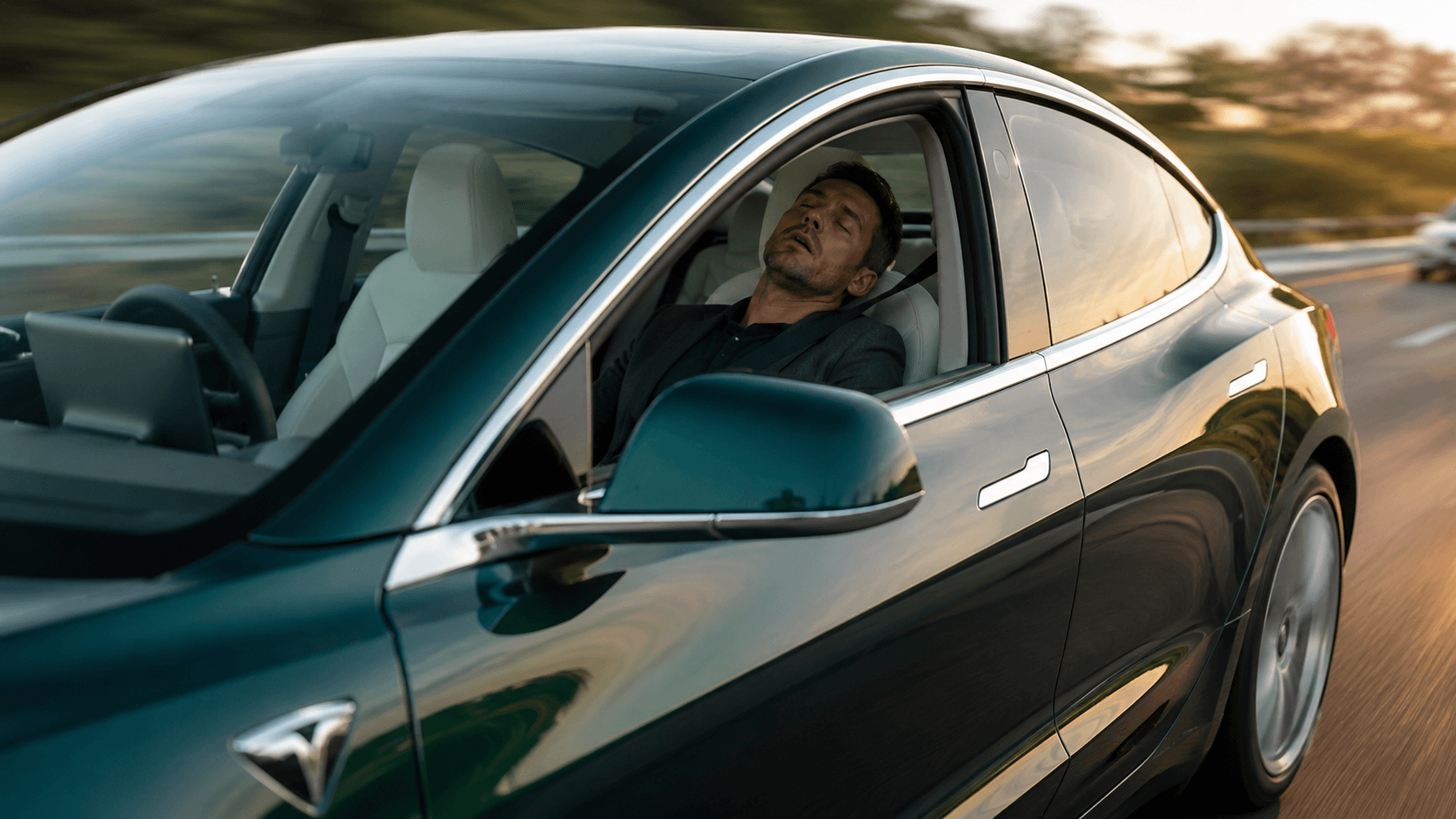
A viral video showing a sleeping Tesla driver has sparked widespread outrage on X. While most users are calling for the driver to be punished, far fewer are questioning why Tesla’s driver attention monitoring system failed to respond to such a dangerous situation.
The footage shows the driver slumped over as the vehicle travels at around 100 km/h on the Trans-Canada Highway in British Columbia, Canada. At first, it appeared the driver might have been experiencing a medical emergency, but it later became clear that he had simply fallen asleep behind the wheel.
The situation was made even more alarming by the fact that two children were also asleep inside the vehicle. At the time of the incident, the Tesla was operating with Full Self-Driving (Supervised) enabled.
The person who shared the video urged Tesla to identify the owner through the vehicle’s license plate and permanently revoke access to FSD.
“Run this plate and permanently ban this car and the owner of their FSD subscription and/or purchase.”
Many users supported the call, arguing that the driver should no longer be allowed to use the system because of such reckless behavior. However, relatively few questioned why Tesla itself failed to detect that the driver was no longer paying attention.
Despite its name, Full Self-Driving (Supervised) is not a fully autonomous system. Tesla states that drivers must continuously monitor the road and be prepared to take control at any moment. The company explicitly says the feature is designed to operate only under the driver’s active supervision.
To enforce this, Tesla relies on a driver attention monitoring system. An interior camera mounted above the rearview mirror tracks the driver’s gaze. If the driver looks away from the road for too long, the vehicle is supposed to issue warnings and eventually disable FSD if the driver fails to respond.
The company also uses a steering wheel monitoring system that detects whether the driver is actively holding the wheel by measuring changes in steering torque.
In 2024, Tesla updated its monitoring system after numerous owners complained that they received distraction warnings simply for wearing sunglasses while using FSD. The update was intended to resolve that issue and allow the system to function properly even when drivers wore sunglasses.
It remains unclear why the system failed to detect the sleeping driver in this case. One theory is that the vehicle’s AI was unable to accurately assess the driver’s condition because his eyes were closed.
Another theory circulating online suggests the driver may have been using a device that applies force to the steering wheel, allowing the manual monitoring system to be bypassed. However, there is currently no evidence that such a device was used in this incident.