
13.05.2026
4 min
399



Unencrypted signals exchanged between Wi-Fi-connected devices and routers can be used to create radio images of people and identify them within seconds.
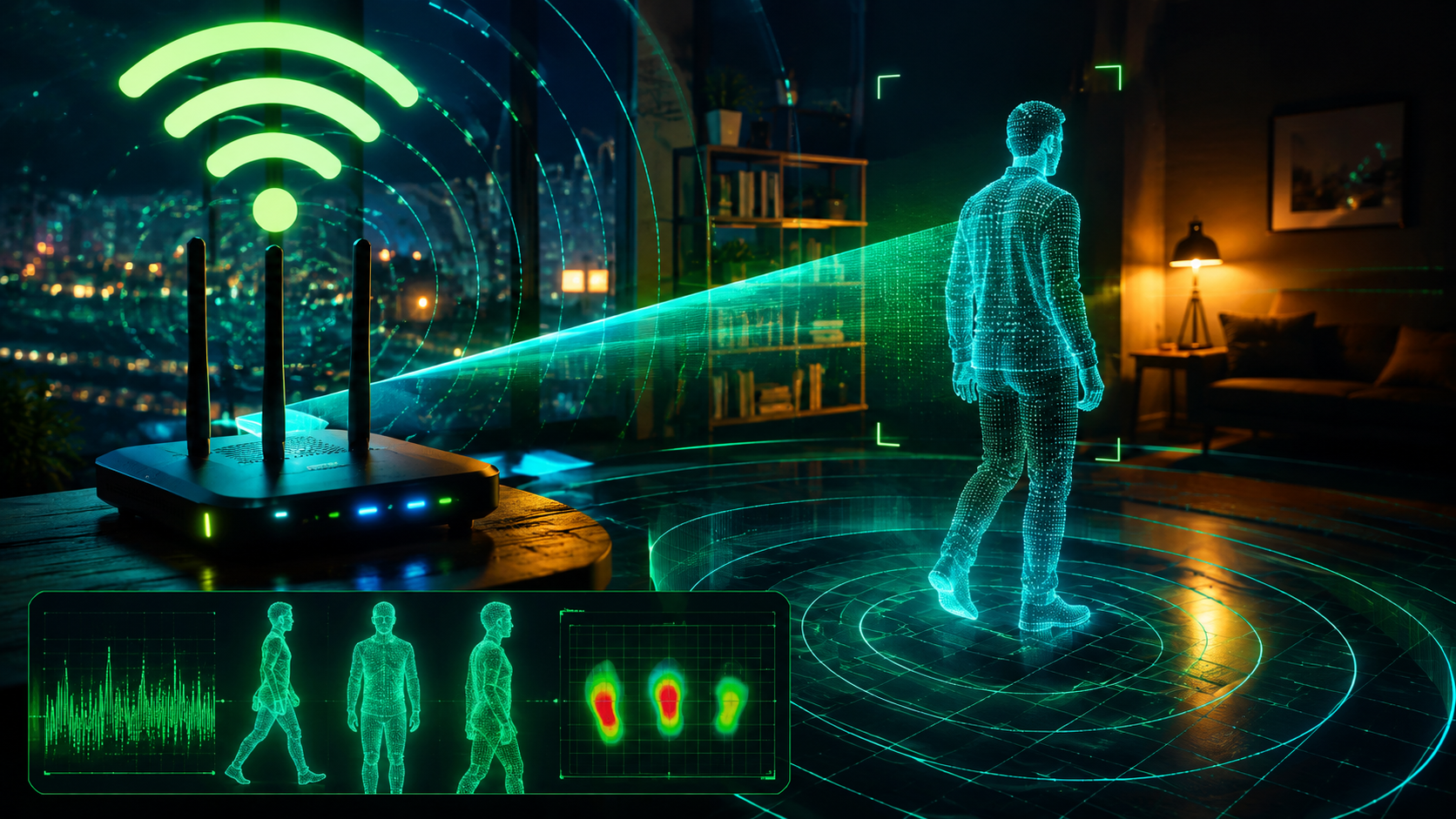
If you thought putting a sticker over your laptop camera guaranteed your privacy, think again. A new study by researchers at Germany’s Karlsruhe Institute of Technology (KIT) shows how ordinary Wi-Fi networks can be turned into powerful surveillance tools capable of identifying people without cameras or specialized sensors.
The new identification method relies on wireless local area network (WLAN) technology. Wi-Fi is a type of WLAN widely used in homes and provides internet connectivity in offices, cafés, and other public places.
Wi-Fi-connected devices regularly send data to routers to optimize communication. This information, known as Beamforming Feedback Information (BFI), is transmitted without encryption.
By analyzing this data, the system can create images of people from different angles and reconstruct their surroundings. The resulting information can then be used to identify individuals.
“It works in a similar way to a conventional camera, with the only difference being that in our case, radio waves are used for recognition instead of light waves,” Professor Thorsten Strufe of KASTEL, the Institute of Information Security and Dependability at KIT, explained in a press release.
According to the researchers, once the machine learning model has been trained to recognize specific individuals, the identification process takes only a few seconds.
During the study, the method was tested on 197 local students, although the researchers had usable data from only 161 participants. The system identified them with nearly 100% accuracy regardless of differences in their gait, such as whether they were carrying a backpack or walking quickly.
“If you regularly walk past a café where a Wi-Fi network is operating, you could be identified there without noticing and later recognized, for example, by government agencies or companies.”
Julian Todt of KASTEL
However, it is important to note that the tests involved preselected participants who were already known to the system rather than completely random passersby. The number of participants was also relatively small.
Participants were also asked not to wear baggy clothing, skirts, dresses, or high-heeled shoes to ensure that nothing interfered with recording their gait.
As a result, the system could potentially be less accurate in real-world environments such as large organizations or smart cities.
Despite these limitations, the study raises important questions about how ordinary Wi-Fi infrastructure could be used to monitor people.
The researchers note that the method analyzes radio waves traveling through the surrounding space. This means a person does not need to carry a Wi-Fi-enabled device, such as a smartphone or smartwatch, to become a target of this type of surveillance.
Even turning off your own device would not necessarily prevent the system from working.
“It is enough for other Wi-Fi devices around you to remain active,” Strufe explained.
The researchers warn that the technology could be abused in countries governed by authoritarian regimes. They are therefore calling for safeguards and privacy protections to be incorporated into the upcoming IEEE 802.11bf Wi-Fi standard.