07.11.2024
1 min
1005



Deepfakes are becoming increasingly popular, raising serious ethical and legal questions. Of particular concern is the use of deepfakes to create pornographic content without the consent of the individuals depicted. A recent investigation has uncovered links between a popular website called MrDeepFakes, which specializes in pornographic deepfakes, and several technology companies. In particular, the website actively promotes Deepswap AI and Candy.ai, apps that allow users to create realistic deepfakes photos and videos using artificial intelligence.

DISCLAIMER: This article discusses non-consensual sexual content from the outset.
The graphic images show a woman who claims to be an investigative journalist from Germany. She is shown naked and shackled.
“At first I was shocked and ashamed, even though I knew the photos were fake,” said Schlosser, who believes she may have been targeted because of her reporting on sexual violence against women.
“But then I thought: no, I can’t just stay silent, I have to fight back.”
She decided to track down the person who posted the fake photos on a deepfake pornographic website. “At first I felt the same as many other victims: like it was useless, like you were powerless,” she admitted. “But in the end it turned out that it wasn’t.”

The journalist, like a growing number of women, has fallen victim to deepfake technology, which uses artificial intelligence to create fake images and videos of a sexual nature without consent. It’s not just actresses, musicians and politicians who are being targeted by such manipulation.
Now, such material can be created using just a single photo, and it’s not just celebrities who are being targeted. Many people who are not public figures have been victims of such abuse, including in the UK, the US and South Korea.
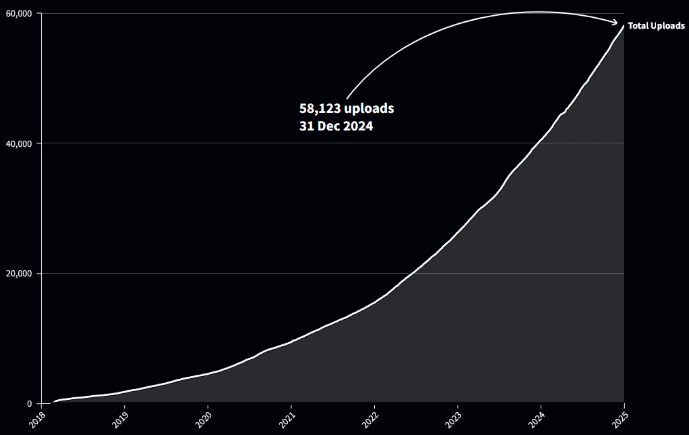
One of the most popular platforms where this type of content is distributed is a website that hosts tens of thousands of deepfake videos and images. The resource has hundreds of thousands of members and millions of visitors every month.
According to analysis by independent researchers, the materials on this site have been viewed almost two billion times. In particular, one of the albums containing controversial images remained publicly available for almost two years.
The website does not provide any information about its owners, and its administrators appear to be deliberately hiding their identities. Since its launch, the site has changed hosting providers several times, moving to different countries.
Financial transactions also suggest an attempt to avoid revealing the true owners. Premium access can only be purchased with cryptocurrency through a system that generates a unique address for each transaction, making it difficult to identify the ultimate beneficiaries. PayPal payments are also occasionally available, but payments are made through multiple accounts registered in unverified names.

While the identity of the website’s owners remains unknown, some details provide clues. Two independent apps, in particular, that are heavily advertised on the platform, allow us to trace their origins.
One is linked to a Chinese fintech company with global operations and a listing on the Hong Kong Stock Exchange. The other is owned by a Malta-registered company headed by the co-founder of a major Australian platform specializing in pet services.
Deepswap AI is a permanent fixture in the top menu of this website. It’s a tool that allows users to create realistic deepfake photos and videos for a monthly subscription fee of $9.99.
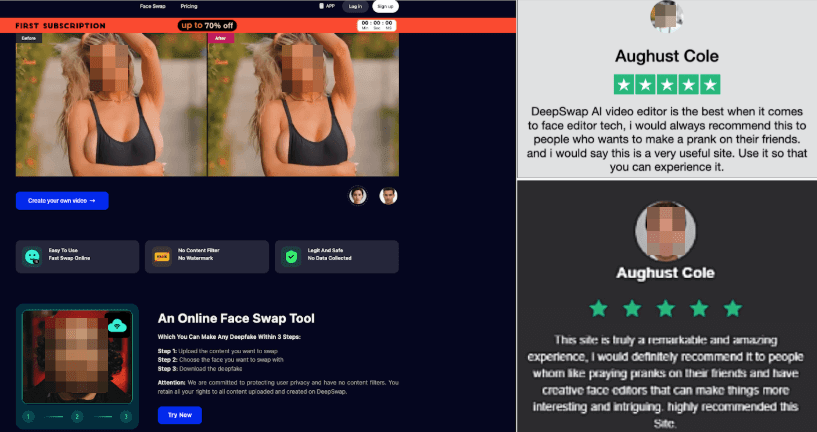
Pop-up ads for this app feature images and videos with provocative captions that encourage people to create deepfake photos of anyone in seconds. The service’s official website states that it is “reimagining the face swap industry,” and five-star reviews allegedly left by different users contain the same names, although accompanied by different profile photos, which may indicate the artificial formation of a positive reputation.
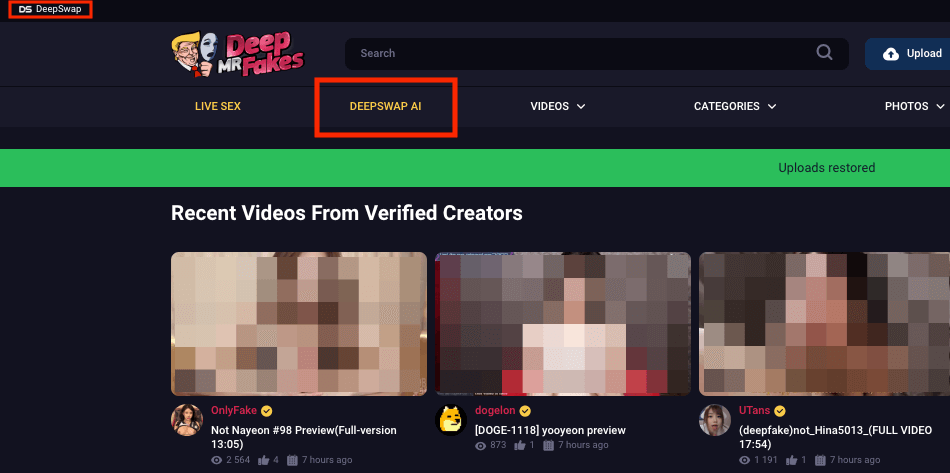
This website does not provide any public information about the individuals or companies behind it. However, the privacy policy states that the app is hosted in Hong Kong.
A search for “Hong Kong” on the website reveals a page with company details, including contact information. The legal entity behind the project is registered as Deep Creation Limited and is located in a high-rise building in central Hong Kong.
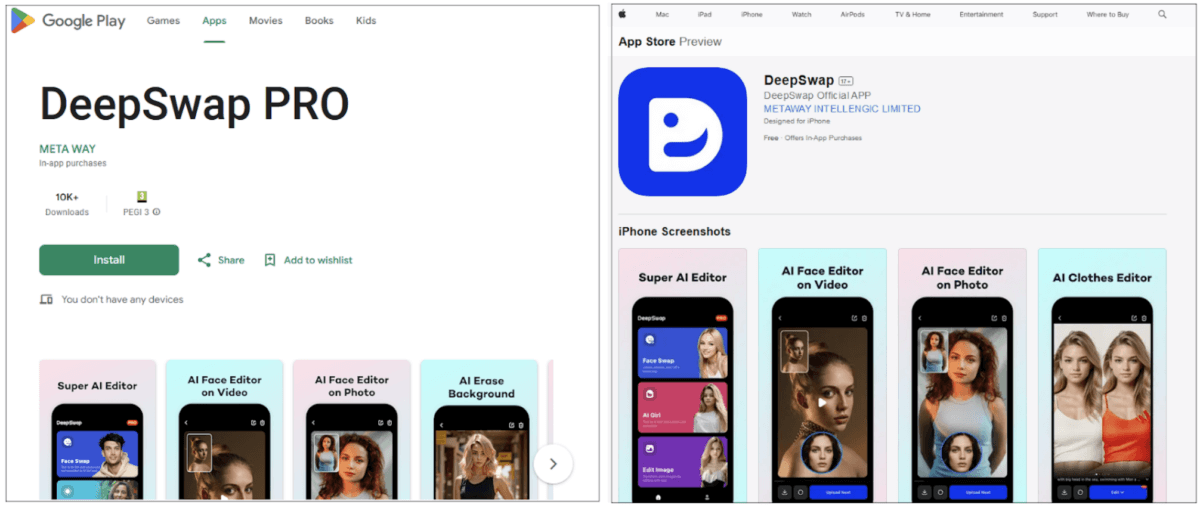
The Deepswap website contained links to apps available on Google Play and the Apple Store. Until recently, the DeepSwap PRO app was heavily promoted on the Google Play store and had been downloaded over 10,000 times.
However, when asked about the app, a Google spokesperson said it had been suspended and was no longer available. The developer was identified as Meta Way.
Deepswap is also no longer available on the Apple Store. Instead, the service’s website now links to another app that is billed as an AI-powered “personalized clothing gallery.”
Archives show that a previous version of the app had the full developer name Metaway Intellengic Limited, a company registered in Hong Kong.
The Hong Kong Companies Registry is open to the public and provides access to corporate information for a reasonable fee, including details of directors and shareholders.
A search of this registry shows that the sole director of Metaway Intellengic is Mr. Zhang, a resident of Shenzhen, a city adjacent to Hong Kong.
Metaway Intellengic is 100% owned by Deep Creation Limited, which is in turn owned by Virtual Evolution Limited, a company registered in the British Virgin Islands. Mr. Zhang is also a director of Deep Creation Limited and signed the registration documents for the Deepswap-related application on behalf of Virtual Evolution Limited, which is listed as a “founding member” of the service, according to Hong Kong registration records.
Further searches for information on these three companies revealed several references in documents related to Shenzhen Xinguodu Technology Co., Ltd. (Nexgo), a company based in Shenzhen. Nexgo is a publicly traded technology corporation that specializes in developing payment devices, including card readers.
At first glance, Nexgo doesn’t seem like a company that would be associated with the creation or distribution of deepfake content. It is listed on the Hong Kong Stock Exchange and operates globally, with subsidiaries in Brazil, Dubai, and India.
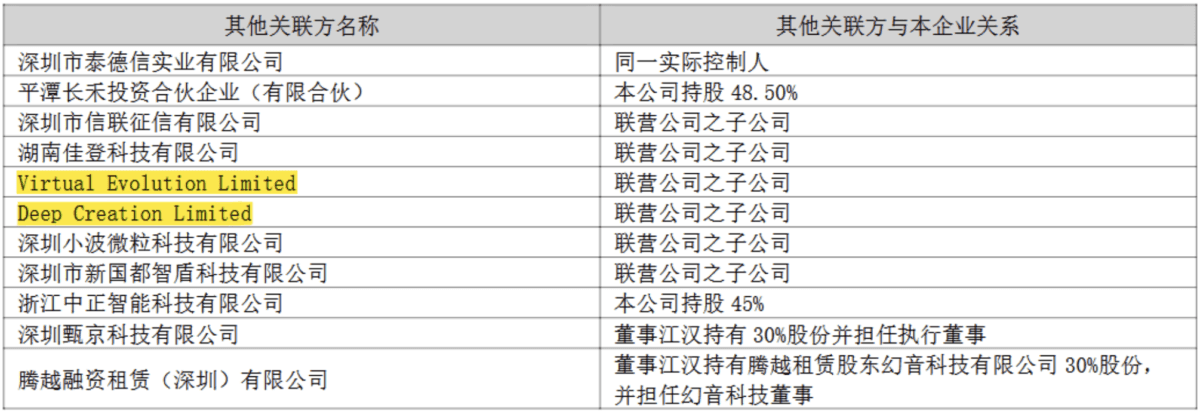
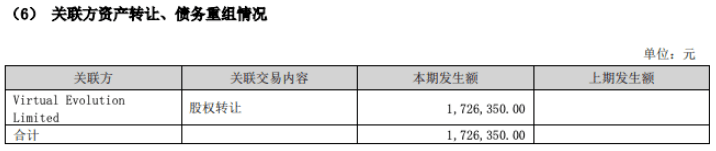
Nexgo’s financial statements for 2023 and the first half of 2024 refer to Deep Creation Limited and Virtual Evolution Limited as “subsidiaries of associated companies.” The 2023 annual report also shows a share transfer worth 1,726,350 Chinese yuan (approximately $238,000) between Nexgo and Virtual Evolution Limited, although the direction of the transfer is unclear.
Kenton Thibault, a senior fellow on China at the Atlantic Council’s Digital Forensics Lab in Washington, D.C., says Chinese companies that engage in “questionable activities” often use this type of corporate structure.
“Typically, the parent company has a long list of subsidiaries registered in Hong Kong, because the legal system there is different from mainland China,” she explained. “To maintain anonymity, there are six to seven layers of intermediary structures between the parent company and the ultimate firm that does the actual business. This is typical for companies operating in the ‘gray zone.’”
Pop-up ads at the bottom of the website also promoted the Candy.ai app, accompanied by crude slogans like “Create your own AI girlfriend.”
The official Candy.ai website claims that the service allows users to create their own “artificial girlfriend,” a concept that is gaining popularity with the development of generative artificial intelligence.
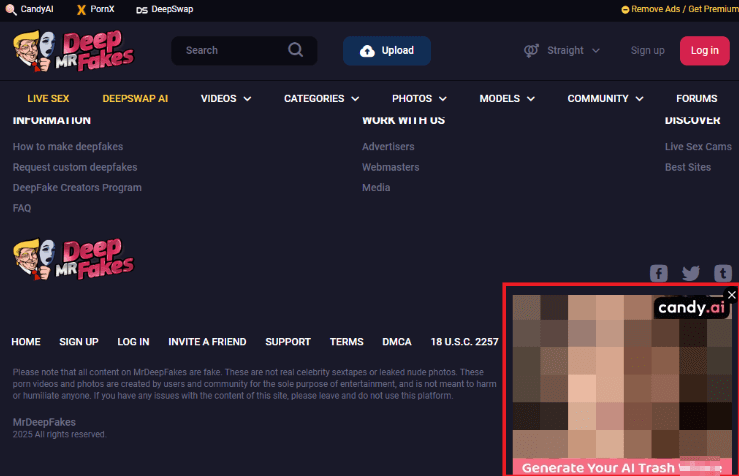
The inclusion of Candy.ai in the website’s promotional materials appears to be fairly recent. Archived versions of the site from December 17, 2024, do not contain any mention of the web app, while three days later a link to its website appeared at the top of the page. This suggests that Candy.ai began advertising on the platform around mid-December.
According to Candy.ai’s terms of service, the service is owned by EverAI Limited, a company registered in Malta. The company’s website does not list any management, but according to its LinkedIn profile and job postings, EverAI’s CEO is Alexis Soulopoulos.
Soulopoulos was previously the co-founder of Mad Paws, an Australian public company that offers an app and online platform for pet owners looking to take care of their pets. However, according to The Australian Financial Review, he is no longer working in the sector, and according to LinkedIn, he has been at the helm of EverAI for just over a year.

Following inquiries about Candy.ai’s ads last week, the app’s link was removed from the website.
An EverAI spokesperson said the company “does not condone or promote the creation of deepfakes.” The platform has moderation mechanisms in place to prevent the creation of such content, he said, and users who attempt to violate the company’s policies are subject to sanctions.
He also explained that Candy.ai’s ads on the deepfakes site were part of an affiliate program:
“The online marketing ecosystem is complex, and some affiliate webmasters own over 100 websites where they can place our ads.”
The spokesperson said that after discovering the ads on the platform that did not comply with the company’s policies, the cooperation was terminated. In addition, EverAI has banned the further use of its advertising materials on the platform.
Affiliate marketing works on a reward scheme for attracting new customers, often in the form of a percentage of sales or subscriptions. The Candy.ai program allowed affiliates to receive up to 40% commission on each subscription payment or purchase of digital tokens.
A similar scheme is used by giants such as Amazon and eBay, and is also common in the gambling industry. In 2017, the UK’s Advertising Standards Authority (ASA) investigated complaints against several companies for unethical affiliate promotion. In one of its decisions, the ASA stated that the company is liable for the actions of affiliates because it is the beneficiary of the marketing materials.

Over the past year, a series of investigations have uncovered websites and apps that not only enable the creation of such content, but also profit from the technology. These platforms range from small startups in California to a Vietnamese AI-powered “art” site used to generate child sexual abuse material. They have also uncovered a global organization behind several large AI companies, including Clothoff, Undress, and Nudify.
Government approaches to the problem of deepfakes vary significantly:
The European Union does not yet have specific laws prohibiting deepfakes, but in February 2024 it announced plans to criminalize the “sharing of intimate images without consent”, including deepfakes.
The United Kingdom passed new laws in 2024 targeting creators of sexually explicit deepfakes. However, sites like MrDeepFakes remain accessible via VPNs and proxies despite being blocked in the UK.
These platforms not only remain active, but also openly advertise artificial intelligence applications that have ties to legitimate companies.