

31.05.2023
7 min
2647



What happens to your anonymity if the state shuts down the internet? We break down why conventional VPNs and Tor won’t save you from surveillance and how to bypass total state control.

What is the funniest thing about our perception of cybersecurity today? We all take for granted the many technologies we use to help protect us, which rely upon a pretty thin thread. We pay for VPN subscriptions, download the Tor browser, create I2P bridges, and become our own cyberpunk hackers. We feel as though we are safely ensconced “inside” our own personal secure house. But, the layers of encryption, and the sophisticated routing systems that provide us with anonymity, can only do so while there is a physical cable that connects your country to the rest of the world.
Let’s be paranoid for just a moment, and consider an eventuality that has moved from being a science fiction dystopia, to being a grim reality in some countries. A government makes the decision to disconnect their citizens from the global web. The switch is flipped, and instead of the limitless ocean of the Internet, a citizen is now confined to a closed internal intranet (a so called “splinter-net”). Every server, provider, router exists exclusively inside the country and is under the control of a single entity.
How does your anonymity fare in this new environment? Will Tor save you? The short answer is NO. It will dissolve into a pumpkin. To better understand the long answer, we need to peer beneath the hood of network technology, and see how surveillance really works, and how mathematics attempts to counteract the efforts of those who seek to surveil.
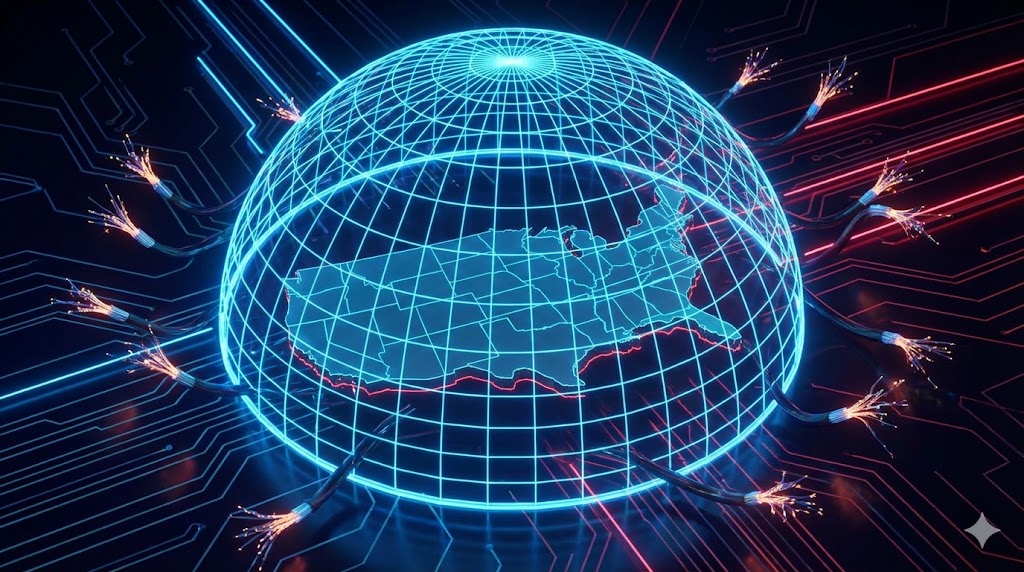
To get a better idea about the scope of the issue, we need to explain how some of the most well-known anonymous networks function with respect to their security. Anonymous networks primarily rely on the federation system for the bulk of their protection.
The federation system may appear complex, but in reality it is based on a simple distrust of governments in other countries. In order for you to connect to a site via Tor, your request does not go directly to the site. Instead, your request is put into multiple layers of encryption (referred to as onion routing) and begins to bounce around server nodes. For example, you are in Kyiv. First, your traffic goes to a server in Germany (the first layer of encryption is removed). Then it travels to a server in Brazil (the second layer is removed), and finally, it reaches an exit node in Japan. So what makes this work? The fact that the German government, Brazilian intelligence service, and Japanese Internet Service Providers do not have a common interest. They also do not log anything. Therefore, the Japanese person has no way of knowing who you are, nor where the original request originated, and the German person has no way of knowing where the request is going.
Cryptography refers to the power of federation—i.e., the number of separate, politically disinterested states in your chain. The more hostile countries are towards each other, the safer it is for you to be connected to this network.
However, what happens if a country blocks the network? If so, the federation power immediately drops to one. Even if you were to build a Tor-equivalent using only internal servers within your own country, the physical location of all these servers would remain in the same geographic area, and therefore, the same jurisdiction. And if the authorities of your country (in uniform) were to pay a visit to the providers (or if all the traffic was already routed through state-owned equipment by default), the authorities would be able to obtain access to all the nodes at the same time.

This is where things get interesting. When you block a network, a typical Internet Service Provider can turn into a monster, and this concept is called the Global Observer in Information Security Theory.
An ordinary hacker may only be able to intercept traffic at the local coffee shop. However, the Global Observer has God Mode capabilities. It sees everything on the network at one time. The Global Observer does not need to decrypt your files to see what you are writing. All it needs to do is analyze the metadata. Timing Attacks (looking at the timing and volume of data) are the primary method the Global Observer uses to attack a network.
Let’s take this example. You have to send a 5-Megabyte file to a friend while keeping it completely anonymous. You have encrypted the file with the most reliable internal encryption available. You then send it through three different dummy internal servers. The Global Observer analyzes the network and here is what it sees:
User A’s computer sent a 5MB packet to the first server at 15:05:01.
The first server bounced a 5MB packet to the second server at 15:05:02.
The second server bounced a 5MB packet to User B’s computer at 15:05:04.
That’s it. Your file was still never seen by anyone else, however the fact that “A” and “B” were communicating was now proven without a doubt.
Immediately after reading the above, some will say: “Okay, I’ll just create a bunch of junk traffic! My computer will constantly send false packets of various sizes to cover my tracks.”
It sounds like a great idea, but it will not fool the Global Observer. Eventually, analytical algorithms (Yes, the Intelligence Agencies’ AI) will identify your true communications from the noise of the “junk traffic.” They will find patterns in your communications habits and remove the “junk” so they can ultimately de-anonymize you.
You do not need to use any tricks to beat the Global Observer, you need to use pure, unadulterated, brutal mathematics.

A closed border forces you to live in a world of mathematical paradoxes and at least some of the concepts in the realm of network theory will withstand the Global Observer, i.e., architecture based on theorems about anonymity. The author of the original article describes three primary ways to achieve this.
1. DC-Networks – The Dining Cryptographers Problem This is a very elegant mathematical model developed in the early 1980s. Let’s assume we have three users (A, B, and C). They are connected to each other and want to enable A to send a single bit of information to the network in a way that neither an outside observer, nor the other two users, can identify which user has been sending the data.
This can be achieved using the XOR (Exclusive Or) logical operation. Each user generates and agrees upon a random number (key) between them. As soon as a user wants to send a real bit of information he overlays his key with the information using XOR and transmits the resulting value in the network. The other users do the same thing with their zeroed keys.
At the end, each of the received values is added together. The magic of mathematics lies in the fact that the network obtains the correct value, but due to the properties of the operation used, identifying the source of the value is theoretically impossible. Even if the user B intends to reveal the identity of the sender, he cannot determine whether the signal originated from either A or C.
2. Queue-Based Networks (The Absolute White Noise Principle) Recall the timing attack described above, where the observer measures the time and size of the transmitted file? Queue-based networks resolve this issue in a radical manner.
Suppose that all the devices in such a network act as metronomes. In addition to sending data into the network each device is also required to send a data packet of a constant size every second (or millisecond), strictly on time. For instance, when you type text and then send an article, your computer divides the text into fixed-size blocks and sends them in the time intervals of one second. However, what happens if you take a break and go get yourself a cup of tea? Your computer continues to send packets of exactly the same size every second, but now instead of meaningful text they contain absolutely useless, randomly generated white noise.
From the point of view of the global observer the entire Internet in the country appears to him as a solid wall of noise. All the devices in the country are continuously transmitting and receiving something. There are no peaks, there are no pauses. It is impossible to analyze such traffic; it simply resembles TV static.
3. Iterative Networks (Increasing Entropy) In iterative networks the hot potato method is used. Instead of sending the message directly to your friend, you first encrypt it using the public keys of several arbitrary nodes in the network. Then you forward the request and initially the probability that you are the sender equals 100%. But as soon as an intermediate node receives the packet and relays it to another node in the network, the entropy starts growing. At each subsequent bounce of the packet the probability of being the source becomes lower. After the message has made 50 jumps, finding the originator of the message is almost hopeless.
So, What Does It All Boil Down To?
If the government decides to shut down the global (external) Internet access, the first things that will likely go out-of-service will be classic VPNs and Tor. There is no way to design the architecture of a VPN or Tor so as to resist an enemy which has total control over all the infrastructure inside the country.
But there is still some hope! While it is possible to mathematically prove and guarantee anonymity within a completely closed network, it is also possible to create anonymity using DC-networks and networks that have pre-set timing.
There is however one huge, fatal BUT. The cost of creating networks with theoretically provable anonymity is a significant reduction in their usability.
DC-networks and other similar types of networks are very slow. Because each device on the network needs to generate massive amounts of white noise to avoid being identifiable by others, sync their keys with neighboring devices, and jump around through many layers of packet routing to stay anonymous, the bandwidth of these networks will drop to the same speeds as the dial-up modem speeds of the early 1990s.
You will not be able to watch your favorite video in HD, nor will you be able to rapidly scroll through your photo feeds. A simple text message may take seconds to transmit, and downloading a picture may take anywhere from a few seconds to several minutes. Your ping times will be astronomical.
These technologies were not made for entertainment. They are emergency tools for digital survival. In the event the Internet-Titanic sinks due to state control, these networks are the digital life-boats. And although these networks are difficult to use, when the time comes for you to send a text file to someone without the risk of going to jail, the speed at which you can send that text file will be much less important than how fast you can scroll through your memes.

Це якщо залишити інтеренет швидким. А якщо ще його і сповільнити то з цими алгоритмами можливо юзати максимум для пересилання тексту)) хоча краще ніж нічого