The war in Sudan is increasingly spreading from the battlefield to social media feeds. Fast-paced video clips, viral posts and algorithm-driven recommendations for trending stories have created a new environment where war is now a product to be consumed quickly through digital bites. This article will look at how popularity on-line works during a time of war, how some people’s faces are used as symbols of conflict, and the role that platforms play in making their visibility possible.
Viral Child Soldiers on TikTok
TikTok users have viewed videos of child soldiers tied to the opposite warring parties in Sudan more than millions of times.
A study revealed these “lion cubs” have become popular among the opposing factions that have been engaged in a struggle for control of the country since 2023.
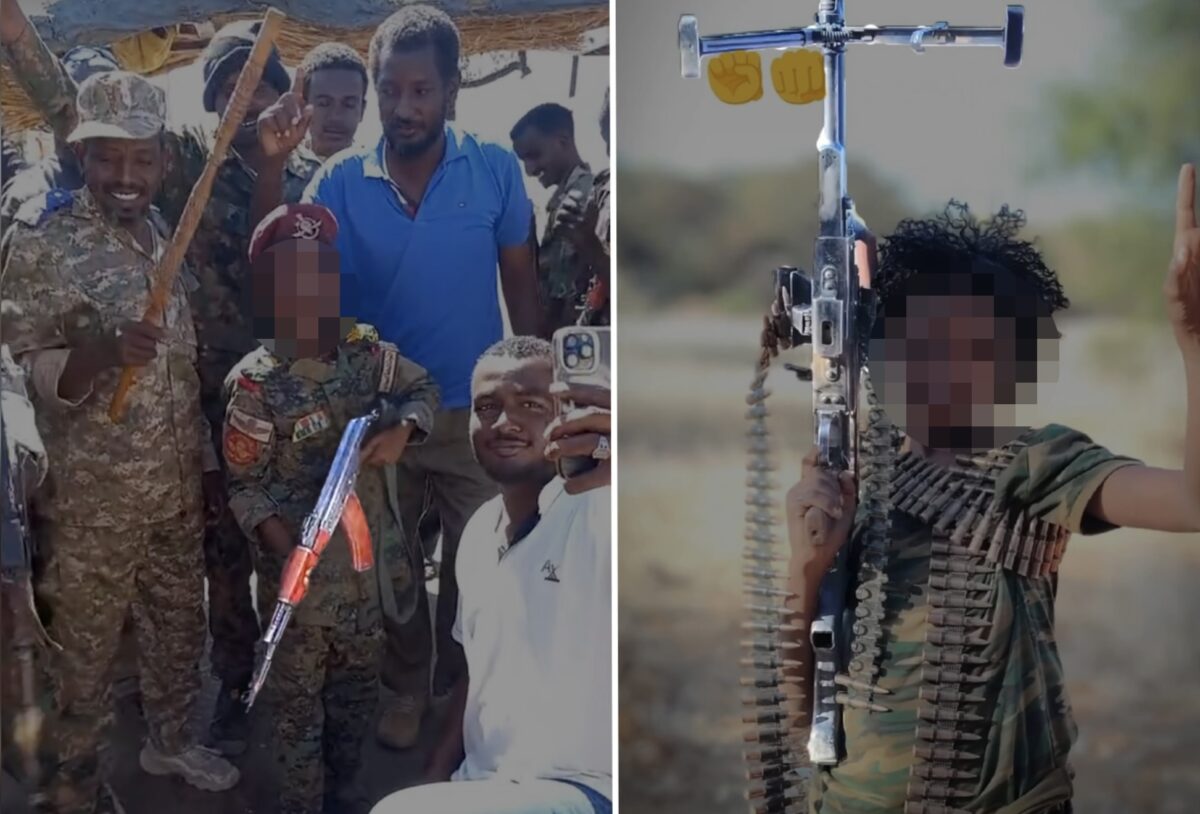
The majority of the videos reviewed were filmed of the children wearing military garb with fighters and higher-ranking officials from both sides of the conflict — the Rapid Support Forces (RSF) and the Sudanese Armed Forces (SAF). These children were shown celebrating battles that took place, giving inspirational speeches, and delivering threats of violence. Some of the children seen filming were visibly carrying weapons.
Experts studying child soldiers claim the high visibility and appeal of these videos — portraying the use of violence as typical, worthy of praise, and something to aspire to — will likely lead to the recruitment of many more young people into the conflict.
Twelve TikTok accounts that were sharing highly viewed videos of child soldiers using TikTok’s internal reporting process were flagged. Following over 48 hours of no response from TikTok, we sent an email to TikTok asking it to provide comments and including links to the reported content. We did this so TikTok could be given another chance to look at and delete the accounts, thereby reducing the potential for more exposure.
After receiving our inquiry, TikTok deleted seven of the accounts that had been flagged. The remaining active accounts continued to post more than a dozen videos of child soldiers — content that violated TikTok’s policy prohibiting the exploitation and militarization of children (Update: After this story was published, TikTok deleted the remaining active accounts).
According to the Paris Principles, a document to which Sudan is a party, a child soldier is defined as anyone who is under the age of 18 years old who is “recruited or used by an armed force or armed group in any capacity,” regardless of whether they engage directly in hostilities.
Two of the most well-known “lion cubs” representing each side of the ongoing civil war were targeted by journalists in order to illustrate how the content is spread and made popular on social media — primarily through TikTok — in spite of the platform having restrictions in place regarding content associated with the exploitation and militarization of children.
In certain situations, children have filmed themselves near areas where there is currently active combat — including at least one time, next to the bodies of recently deceased people. Other instances include them performing choreographed dances along with senior commanders and political figures. Armed groups and their supporters celebrate the children as heroes, and their content is reshares by hundreds of TikTok accounts, some of whom have millions of followers.
“People Say I’m Going to Die”: A Child Soldier of the Republican Security Forces
Several TikTok videos featuring a “lion cub” affiliated with the Republican Security Forces — appearing to be a young teenager — were geolocated by Bellingcat that appear to be celebrating the capture of the 22nd Infantry Division base of the SAF in Babanusa, a city located in West Kordofan, in early December 2025.
Millions of views were recorded by the videos posted on TikTok by accounts affiliated with the Republican Security Forces, which included footage of the child moving about the ground in the aftermath of the takeover. By mid-January, 2026, the child’s TikTok account had grown to tens of thousands of followers, and his recent posts had attracted hundreds of thousands of views.
In a TikTok video published on January 1, 2026, on the child’s account, he responds to comments on social media stating: “I see people on [social] media saying that I’m going to die. A person who dies has simply paid their debt.” Before TikTok deleted the child’s account in response to an inquiry by Bellingcat, the video had been viewed more than 1.6 million times.
On December 1, 2025, after a protracted siege, security forces captured the 22nd Infantry Division base in Babanusa, securing control of the last remaining SAF stronghold in West Kordofan.
In a video posted by a pro-RSF TikTok account in early December, the child is seen near the northern entrance of the SAF base, holding an assault rifle and celebrating alongside adult RSF fighters.
In a second TikTok video, he can be seen roughly 100 metres away, running toward the main entrance of the base amid the sound of gunfire, chanting “Allahu Akbar” and claiming that the 22nd Infantry Division of the SAF had been captured.
In a third, particularly graphic TikTok video, the child films himself among a group of nearly ten bodies scattered across the ground inside the SAF base.
Графічні зображення тіл. Цифрові мітки надані для того, щоб показати, як ми зіставили положення тіл, видимих на відео, із супутниковим зображенням.
Images of Bodies Visible in Video; Digital Markers Added to Show How We Matched Satellite Imagery of Bodies Found With Those Shown in Video
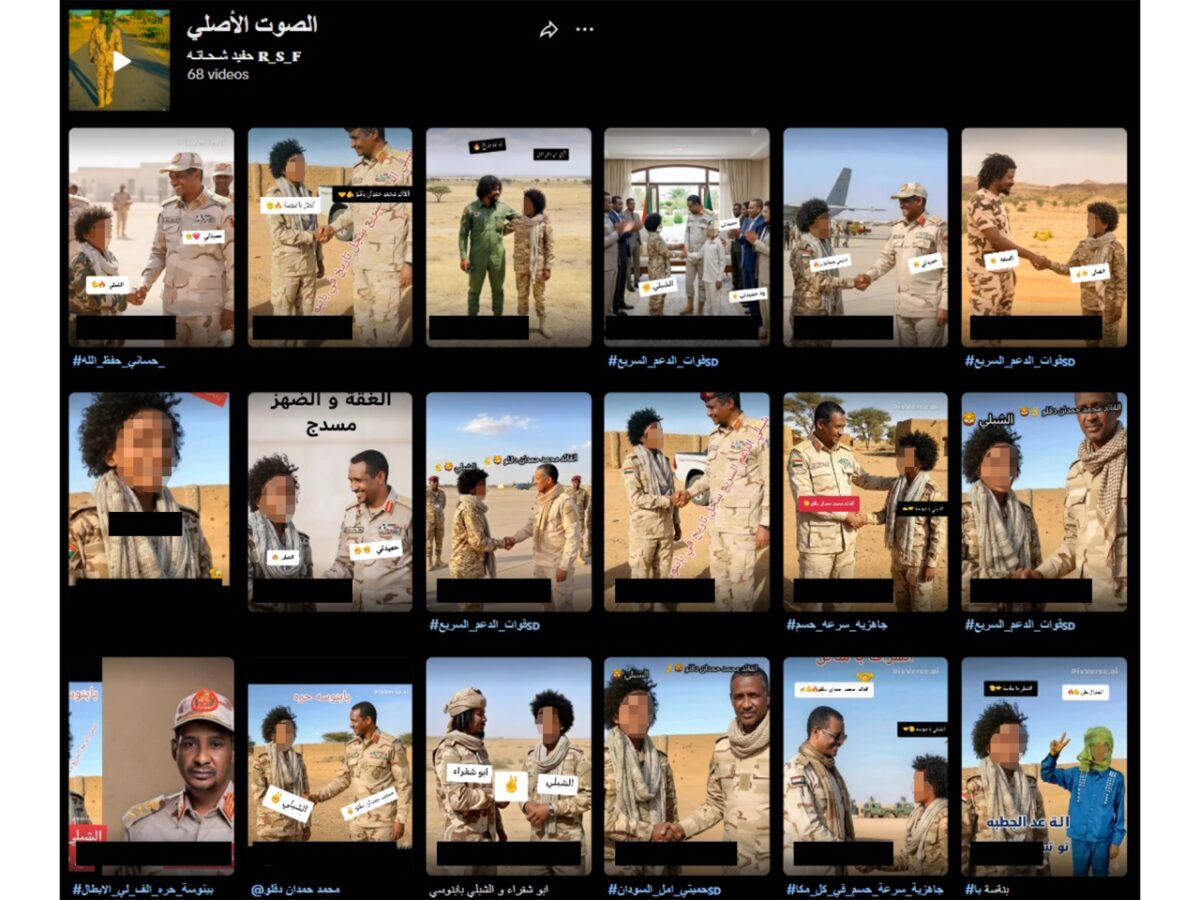
The second video (the one where the kid is running) has had over 2 million views before it was taken down from Tik Tok. The audio from this video has been used in 200 other videos on the app to increase it’s reach in networks that support the RSF. A 10-15 second clip of the same audio has also been shown in over 70 other videos. Many of these videos are AI generated, and can be identified as such by their animation and obvious errors with the soldiers’ uniforms, patches and flags. In addition, many of these Tik Tok posts showed the children running with senior RSF officials, including Hemetti, who is the head of the RSF and an officer named Abu Lulu. On February 19, 2017, the US Department of the Treasury placed sanctions against Abu Lulu for his involvement in the RSF taking control of the city of El Fasher.
A screenshot showing AI-generated TikTok posts featuring the “lion cub” alongside prominent RSF figures, including Hemeti and Abu Lulu, as well as an audio clip of the child’s voice.
On the same day that Babanusa was seized, “Lion Cub” (a name associated with the Republican Security Force) can again be seen in a TikTok video featuring what appears to be captured SAF soldiers who are being mocked by the lion cub while he chants support for the Republican Security Force. This video has received dozens of supportive comments, most of which seem to come from members of the RSF.
A video dated December 5 shows RSF fighters celebrating as they carry a lion cub (who is wearing a white t-shirt), the lion cub is sitting atop the shoulders of RSF commander Saleh Al-Fouti. Two very well-liked pro-RSF TikTok accounts, which have a combined 1.4 million followers, also re-posted the video; each account included the caption, “Commander Colonel Saleh Al-Fouti honors the hero Al-Shibli [the lion cub]”.
As reported by Al-Jazeera News Network, the lion cub was described by Al-Fouti as a “hero” and he credited the child’s presence on the battlefield (during the first entry into the 22nd Infantry Division SAF base) for the RSF’s success. Al-Fouti repeatedly referred to the child as the “lion cub”, stating “I see the whole world talking about this lion cub”. He went on to say that the RSF never recruits children or asks them to participate in battles; however, he did claim that the RSF occasionally has minors join their ranks, but only when they volunteer, with no prior knowledge or approval. In addition, Al-Fouti claimed that these minors typically fight along side adult combatants.
Saleh Al-Fouti’s role as a commander in the RSF is confirmed through a video produced by the RSF that documented the operation in which Babanusa was taken over. Prior to the RSF taking control of Babanusa, Saleh Al-Fouti was mentioned in a 2023 report from the UN Joint Human Rights Office in Sudan, in which testimony accused forces under his command of intentionally killing civilians in Nyala based on their tribe or ethnicity. According to reports, Al-Fouti was later promoted to Major General after the RSF took control of Babanusa, according to various social media posts. The RSF “lion cub” celebrated the promotion with a TikTok video published on January 10, 2026.
In response to the situation, El-Basha Tebeig, a media spokesperson and an advisor to RSF leadership, stated that the Rapid Support Forces have a dedicated human rights unit that works within the military structure of the RSF. Furthermore, Tebeig stated that the RSF adheres to international humanitarian law and the Geneva Conventions, which prohibits the use of children in armed conflicts. Tebeig further stated that RSF commander Saleh Al-Fouti issued standing orders prohibiting participation of anyone under the age of 18 in military operations.
When asked by Al-Jazeera News Network to explain why the child was sitting on the shoulders of RSF commander Saleh Al-Fouti, Tebeig responded: “The child was present with his father during the celebration of the liberation of the 22nd Division in Babanusa, and it is entirely normal for children and women to attend such celebrations and take part in the celebratory mood.” Tebeig also stated that the accusations of the RSF utilizing child soldiers is simply a tactic used by hostile political forces to harm the reputation of the RSF. Tebeig reiterated that the RSF remains committed to not utilize children in armed conflict.
The “Lion Cub” Shibli: A SAF Child Soldier On Social Media
Bellingcat was able to identify the social media presence of a child soldier for the SAF, with over 700,000 followers on TikTok. This social media account included the term Shibli (شبلي) meaning lion cub; the account description refers to it as the “official account,” and invites advertisers to contact the account holder regarding potential advertising opportunities. The Shibli child appears to be less than the “lion cub” for the RSF.
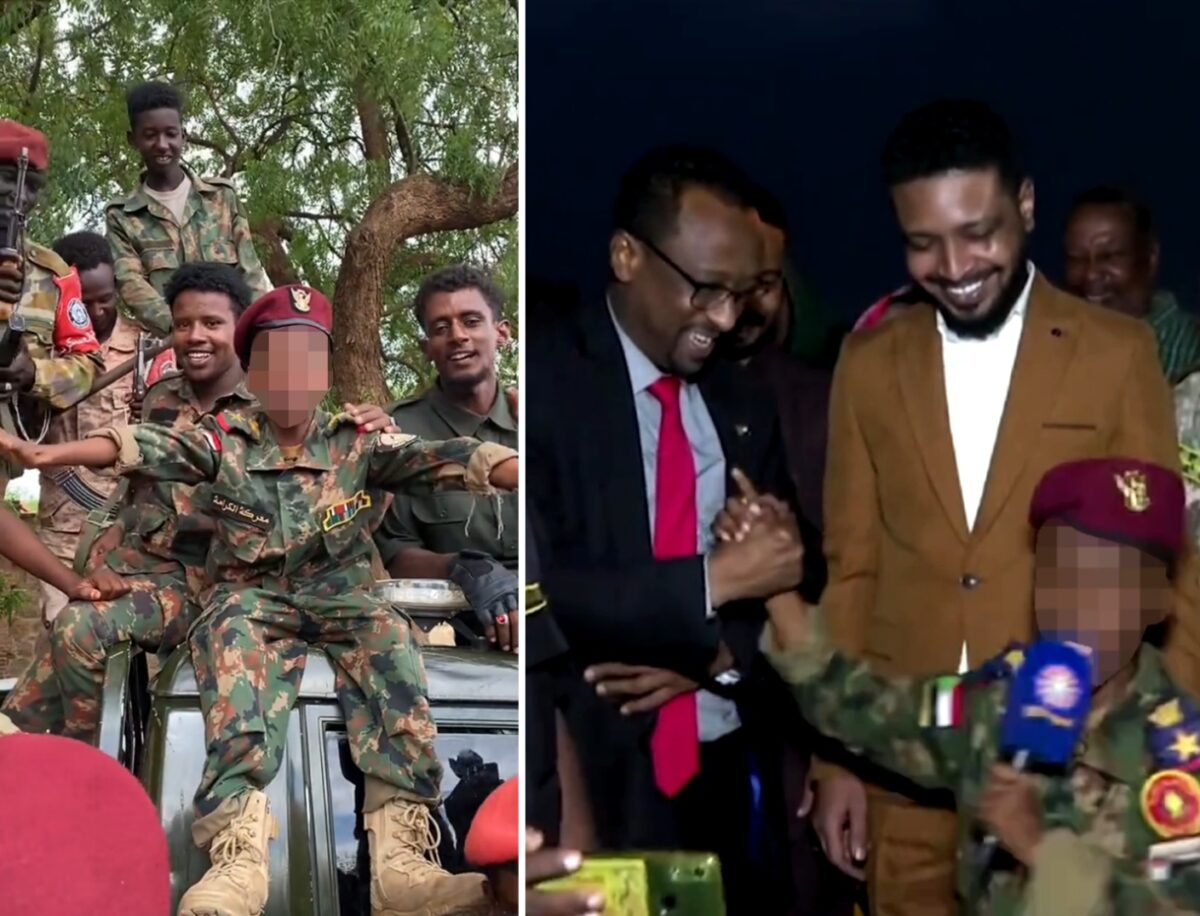
While the videos from the Shibli account are not visually close to the front lines of conflict like those from the RSF child’s account, they seem to be staged for visual appeal. Videos of the child wearing an SAF uniform, complete with SAF insignia on the beret, the flag of Sudan, and SAF camouflage, while standing beside SAF soldiers and high ranking SAF officers in ceremonial or public capacities have been viewed millions of times.
One of the videos showed the child reciting a poem ridiculing RSF head Hemeti that had almost nine million viewers before being taken off line. Another video that had over four million viewers displayed him delivering a speech declaring Sudan’s unity from atop a podium, flanked by SAF soldiers.
Left: A TikTok video with 1.3 million views showing the child standing alongside armed soldiers, issuing threats against the Rapid Support Forces. Right: The child holding hands with Khaled Al-Aiser, Sudan’s Minister of Culture and Information.
The “lion cub” has also appeared alongside senior members of the Sudanese government. One TikTok video that has received over seven million views shows him standing with Khaled Al-Aiser, the Sudanese Minister of Information, as they both declare:
“Our time doesn’t permit us to engage in war or to join the army. But, we want to go on the frontlines, carry DShK and Goryunov machine guns, and drive a battle tank… We may be young children, but when we are angry, we are like an eruption from a volcano, we kill every traitor and coward.”
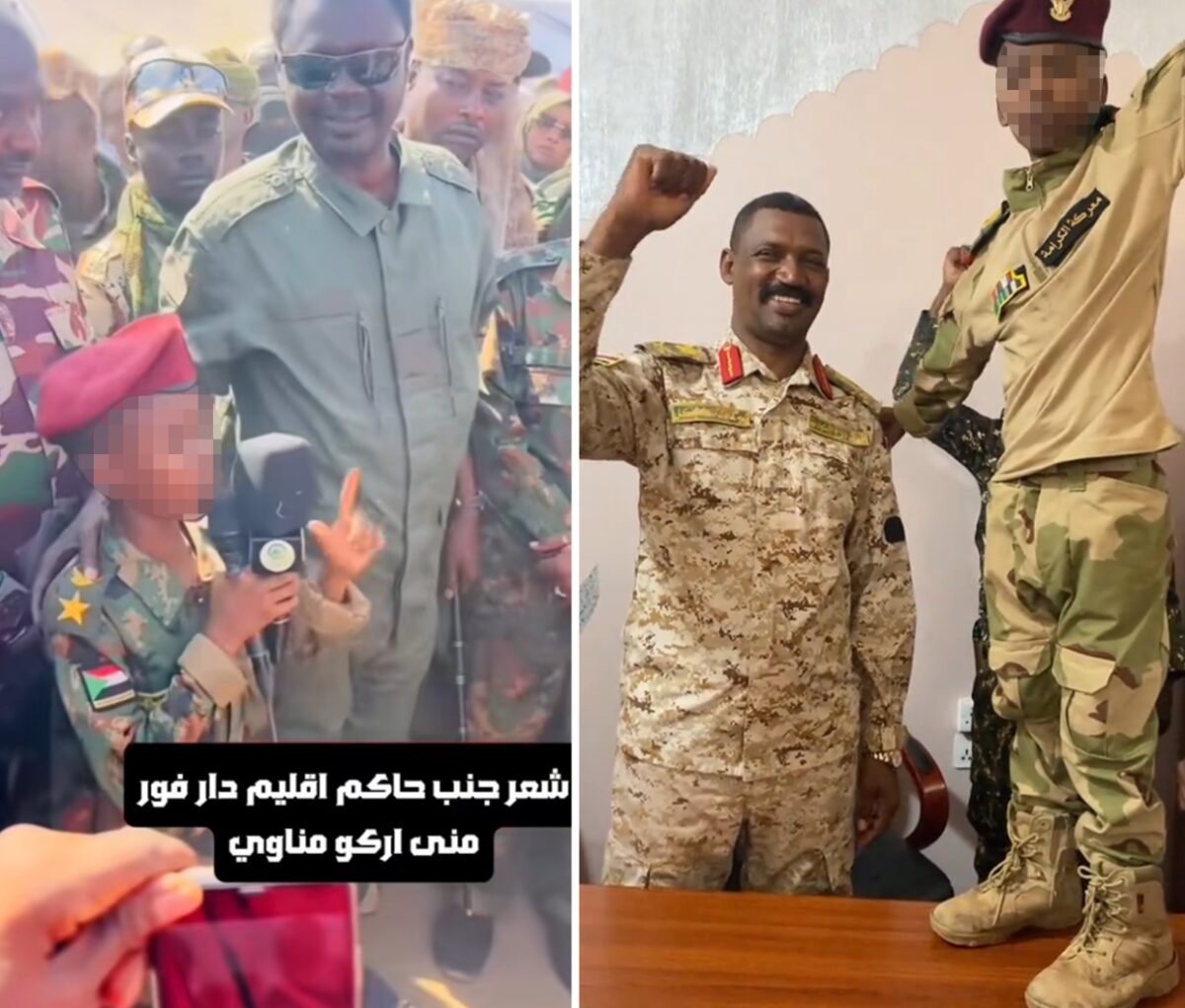
He is also shown in a TikTok video with Minni Minawi, the head of the largest faction of the Sudan Liberation Army and the current governor of Darfur, whom he praises in poetry. He is also shown standing beside Major General Abu Agla Keikel, a former RSF commander who deserted to the SAF and is currently leading a group called the “Sudan Shield,” who have been accused of human rights abuses, while he recites verses supporting this group.
Screenshots from TikTok videos showing the child with Minni Minawi (left) and Abu Agla Keikel (right).
Child Soldiers on Facebook
The Facebook pages of child soldiers linked to both the SAF and the RSF are less active and attract more modest followings, with each page having around 7,000 followers. However, unlike the children’s own TikTok accounts, content posted on their Facebook pages more explicitly shows them carrying weapons.
In one video shared on the SAF “lion cub’s” Facebook page, he is seen holding an assault rifle while reciting a poem that threatens the Republican Security Forces, declaring that “a knife massacre is enough — no bullets needed.” In another video, filmed in April 2025, the child stands beside a destroyed tank at Khartoum International Airport (15.60108, 32.54597) and proclaims the city liberated.
Meanwhile, a Facebook story posted in December 2025 on the RSF “lion cub’s” page shows him posing with a light machine gun, ammunition belts draped across his body.
Screenshots of Facebook posts showing a child affiliated with the SAF (left) and a child affiliated with the RSF (right), both holding weapons.
How “Lion Cub” Content Encourages Recruitment
Experts have stated that child soldier videos depicting child soldiers participating in conflicts may positively contribute to recruitment and armed groups will use the increased visibility and positive reinforcement to recruit additional young people.
Professor Michael Wessels of Columbia University’s Mailman School of Public Health and the Milbank Memorial Fund; a professor of clinical population and family health and a specialist in psychosocial and child protection issues, who has served as an advisor to UN agencies on the issue of child soldiers and the psychological effects of war on children, stated that the public glorification of children depicted in these types of videos can positively contribute to the recruitment process.
“It seems that children are being recruited through honor to those willing to fight,” Wessells said. “Armed groups give names such as ‘lion cubs’ to celebrate the strength and warrior identities of children while drawing them into their ranks early in life.”
Wessels warned that social media praise and popularity can serve to reinforce a violent identity and normalize participation in armed conflict, particularly for teenagers who seek to be recognized, belong to something and find a sense of purpose. Wessels also stated that the increased online presence of child soldiers increases their potential to reach and influence new recruits.
Professor Mia Bloom of Georgia State University’s Department of Communication and Middle Eastern Studies and a top authority on the exploitation and recruitment of children by armed groups, stated that the public celebration of child soldiers also provides them with the ability to act as powerful role models and motivators for adults and youth to join armed factions.
“Now they’re famous — almost like Disney child actors in the U.S., where everybody knows their name,” Bloom said. “And the message is: look how famous he’s become because of this — maybe if I join the movement I’ll become famous too.”
Bloom stated that the increased visibility of child soldiers can produce a well-documented copycat effect among young audiences. According to Bloom, when children go viral due to their involvement in armed groups, it aids in legitimizing participation in violence and presenting it as a normal, celebratory and desired activity.
Through youth driven platforms, such as TikTok, Bloom stated that child soldiers who go viral present an “attractive face” to younger audiences of armed groups signaling that participation can lead to status, recognition and fame. As such, elevating child soldiers to celebrity status via online platforms has the risk of encouraging additional young people to follow their example, thus creating a new powerful recruitment symbol out of children.
Dr. Gina Vale, who has written extensively on the use of so-called “cubs” by the Islamic State to recruit and promote its ideology, stated that the prominent display of armed children in combat settings enhances the potency of propaganda produced by the group. Vale stated that images of militarized children are designed to shock and elicit an emotional response, while simultaneously demonstrating the group’s power and control over future generations.
Concerns Over Recruitment Of Child Soldiers Increase Amid Ongoing Civil War
These findings arise amid long-standing concerns regarding the recruitment of child soldiers into Sudan’s ongoing civil war. In 2023, UN Special Rapporteur on trafficking in persons Siobhan Mullally warned that unaccompanied and impoverished children were being targeted by the Rapid Support Forces (RSF) due to increasing vulnerability to recruitment – including direct participation in hostilities — resulting from worsening food shortages, displacement, and the collapse of basic services.
In October 2024, the UN Human Rights Council’s Fact-Finding Mission on Sudan stated that the RSF “systematically recruited and used children in hostilities,” including in combat positions as well as functions such as operating checkpoints and recording and posting information about violations on social media.
As for the SAF, the Fact Finding Mission stated that it received credible reports that children joined youth groups under the designation of “Popular Mobilization” following appeals by SAF leaders to counter the RSF offensive. The Mission noted that videos circulating on the internet appeared to depict youth and children under the age of 18 receiving training from SAF officers, and that children were seen working at checkpoints in SAF controlled territories. The Mission stated that additional investigation would be necessary to confirm whether children were formally recruited and utilized by the SAF.
In January 2026, UN High Commissioner for Human Rights Volker Turk stated that he was “deeply concerned by the increasingly widespread militarization of society by all parties to the conflict — including through the arming of civilians and the recruitment and use of children” following a five day visit to Sudan. Witnesses interviewed by Reuters also reported 23 incidents in which at least 56 children were kidnapped by the RSF and affiliated militias during attacks dating back to 2023.
Social Media Platforms “Falling Short”
A number of studies and investigations into the spread of propaganda on social media have found that many of these groups and influencers use Instagram, Twitter, Facebook, YouTube, TikTok, Telegram, WhatsApp and other online platforms to disseminate false information, recruit new followers, create and share hate speech, incite hatred against certain groups (such as ethnic minorities), and organize attacks. The study finds that the majority of these accounts were created after Russia’s invasion of Ukraine began in February 2022, with the largest numbers appearing during the months of April, May and June. Many of the most active and popular accounts were created between May and July of 2022 and were run by teenagers who were recruited by Russian agents to help spread disinformation about the war.
The researchers say that there is evidence that many of these accounts were created using fake profiles and that some were deleted when users complained about being contacted by them. They also report that there was little effort made to remove the offending accounts from the platforms or to limit how much each user could follow. A number of social media companies have agreed to work together to develop common standards for removing harmful content and to reduce the spread of misinformation. In addition, several major news organizations and fact-checking groups have launched efforts to monitor and debunk false claims about the war on social media.
Despite these efforts, experts say that the platforms are still being exploited for malicious purposes and that new methods are constantly evolving. According to one estimate, the total number of people killed in the war in Syria since it started in 2011 has exceeded 300,000. The ongoing civil war has led to massive displacement and humanitarian crises throughout the country, including a severe shortage of food, water and medical supplies. Experts say that the Syrian government, along with its allies Iran and Russia, are responsible for the vast majority of civilian deaths and casualties in the war, although rebels and extremist groups have also committed atrocities.
In recent years, the United States and European Union have imposed economic sanctions on members of the Assad regime, and the U.S. Congress has passed a resolution calling for the removal of Assad from office. The U.N. Security Council has failed to pass resolutions condemning the Syrian government’s actions, however, due to opposition from China and Russia.
Conclusion
In order to report the 12 TikTok accounts along with the two popular audio clips of the RSF child soldier (that were being used again in over 270 other videos) via TikTok’s internal reporting process, Bellingcat classified their reports as “Exploitation and Abuse of Persons Under 18” — the category that specifically prohibits posting or promoting videos that show or promote the recruitment of child soldiers.
Additionally, all of the other 10 higher-follower accounts of the RSF and SAF that were sharing or re-sharing the videos featuring the children, were also included in the reports made by Bellingcat.
More than 48 hours passed after the reports were submitted, with no actions taken by TikTok. Therefore, Bellingcat sent an email to TikTok to inquire about comments regarding the accounts and audio files they had provided direct links to in the email.
After Bellingcat inquired, TikTok deleted 7 out of the 12 accounts that Bellingcat had flagged, including the accounts of the two child soldiers featured in the videos, as well as the two viral audio clips. However, TikTok only deleted the individual posts that were mentioned in Bellingcat’s emails; therefore, the accounts themselves remain active. As of the date of publication, 4 of the accounts are still actively posting content featuring child soldiers that were identified in this investigation. One video featuring the SAF “lion cub” has more than 3.5 million views; another account is hosting 9 different videos of the RSF “lion cub,” which have each been viewed tens of thousands of times.
A spokesperson for TikTok responded to Bellingcat’s findings by saying: “We removed content and accounts that violate our strict rules against assisting in, or showing, human trafficking, including child soldiers. Of the content we removed for violating these Community Guidelines, 98.2% was removed prior to us being informed.”
Through Facebook’s internal reporting process, Bellingcat reported three Facebook accounts, including the two identified child soldier accounts and an account held by an RSF fighter with over 10,000 followers, who had shared many videos featuring the RSF “lion cub.” Following the passage of more than 48 hours with no actions from Meta, Bellingcat contacted Meta directly and requested comments, shared their findings, and gave them links to the reported accounts, which were subsequently removed by Meta.
Meta stated that they had removed the content because it violated their policies, stating: “We don’t allow content, activity, or interaction that recruits, facilitates or exploits people through the recruitment of child soldiers.” Additionally, Meta stated that they would be running a safety campaign in Sudan in 2025 to educate young users about the dangers of child soldier recruitment.
One week after making contact with TikTok and Facebook, more than a dozen posts that featured the “lion cubs” could still be accessed via both social media platforms via simple name searches.
Information sourced from open materials published by Bellingcat.
To provide the best experiences, we use technologies like cookies to store and/or access device information. Consenting to these technologies will allow us to process data such as browsing behavior or unique IDs on this site. Not consenting or withdrawing consent, may adversely affect certain features and functions.
Functional
Always active
The technical storage or access is strictly necessary for the legitimate purpose of enabling the use of a specific service explicitly requested by the subscriber or user, or for the sole purpose of carrying out the transmission of a communication over an electronic communications network.
Preferences
The technical storage or access is necessary for the legitimate purpose of storing preferences that are not requested by the subscriber or user.
Statistics
The technical storage or access that is used exclusively for statistical purposes.The technical storage or access that is used exclusively for anonymous statistical purposes. Without a subpoena, voluntary compliance on the part of your Internet Service Provider, or additional records from a third party, information stored or retrieved for this purpose alone cannot usually be used to identify you.
Marketing
The technical storage or access is required to create user profiles to send advertising, or to track the user on a website or across several websites for similar marketing purposes.