
15.09.2025
2 min
718



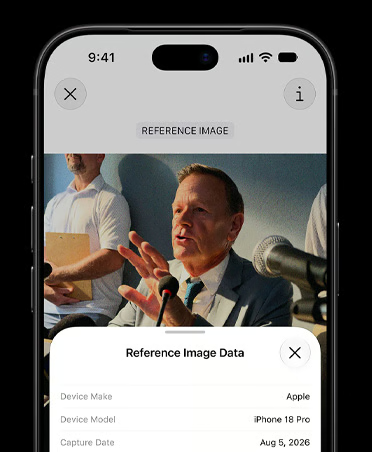
Apple is trying to address the loss of trust in photography caused by the rise of images created or altered with artificial intelligence. The iPhone camera will be able to cryptographically verify what it actually captured at the moment a photo was taken. A new privacy-preserving mode called Apple Reference Image will debut on the main camera sensor of the iPhone 18 Pro and iPhone 18 Pro Max.
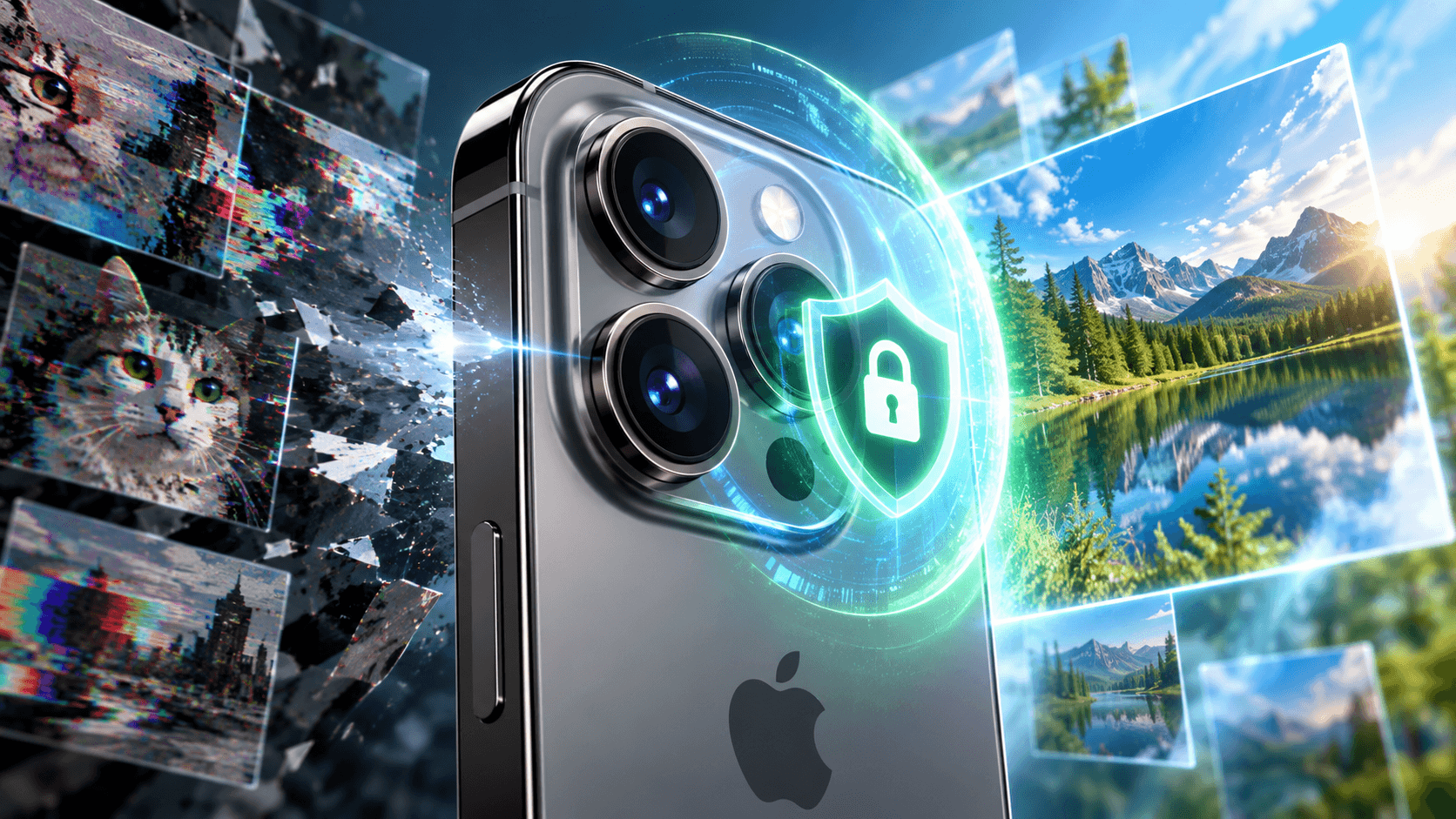
Apple has introduced a new approach to verifying the authenticity of photographs. The system adds cryptographic proof to an image, allowing viewers to confirm that the photo was genuinely captured by a camera and was not substituted or altered during processing.
To achieve this, Apple built a complete chain of trust that extends from the camera sensor to the final stage of image processing in the company’s cloud infrastructure. Any subsequent editing of the finished JPEG changes its pixels and causes the cryptographic verification to fail.
Apple also says the system will not reveal the photographer’s identity, will be resistant to different forms of compromise, and could establish a new standard for verified digital photography.
Anyone viewing such a photo will be able to confirm that the image was genuinely captured by a physical iPhone camera sensor within a specific time window.
“Apple Reference Image offers a reliable and scalable guarantee that a reference image really is what it claims to be,” Apple Security Engineering and Architecture said in a blog post.
“iPhone is the world’s most popular camera and the most secure consumer mobile device, giving Apple a unique ability to address this challenge.”
The new mode will be available only on the latest Pro models, whose main camera sensor will support a specialized secure Reference Mode. To ensure that the image is not altered at any stage, Apple decided to perform the final processing not on the iPhone itself, but in its Private Cloud Compute (PCC) environment.
Apple explains that the challenge is far more complex than simply signing a finished image. Modern photographs go through several processing stages, and each one must be independently secured and verified as part of a single chain of trust.
“We designed the core Apple Reference Image pipeline to withstand a compromise of the operating system or a data injection attack on the sensor bus,” Apple said.
When Reference Mode is enabled, the camera sensor reboots into a specialized secure capture mode. At the moment the photo is taken, the sensor cryptographically signs the raw pixel data and original metadata before any software can access them. The iPhone itself adds only a few additional parameters, including digital zoom limits and focal length, and these values are signed by the Secure Enclave Processor (SEP), the device’s dedicated security component.
Apple also uses its own cryptographic timestamping service, which sends the device a protected timestamp roughly every 15 minutes on average. The iPhone stores the most recently received timestamp as the lower time boundary and requests another one after the photo is taken, which becomes the upper boundary. Both timestamps are embedded in the sensor data and signed together with it, protecting the capture time from tampering even if the device’s software is compromised.
“Although previous industry systems relied on timestamps provided by the device’s general-purpose operating system, we believe this is clearly insufficient to provide the level of assurance required in real-world conditions,” Apple explains.
The company also does not rely on the iPhone itself to convert the digital negative into a finished image, since the device’s software could theoretically be compromised.
Instead, the protected digital negative is uploaded to Private Cloud Compute, where all necessary processing stages are performed, including demosaicing, tone mapping, and compression. The final image is created only after the system successfully verifies all required components.
Apple says PCC is a “highly secure, private, and verifiable” environment. Independent experts can inspect the software responsible for processing, while all production versions of PCC are recorded in a cryptographically protected transparency log that cannot be altered without detection.
“When designing Apple Reference Image, we considered a wide range of possible attacks and built the system to withstand compromise from multiple directions,” Apple said.
All final Apple Reference Images are signed by Apple’s signing service. At the same time, an outside observer should not be able to determine whether two different images were created by the same sensor or the same photographer.
Apple’s service does, however, keep private records of photo GUIDs and the sensors associated with them. This is necessary for the revocation mechanism, allowing a particular image or sensor to be invalidated if it is later found to have been compromised.
These records do not provide access to the images themselves and are not publicly available. According to Apple, the revocation service cannot see the actual photo pixels, and third parties cannot use it to establish links between individual images.