
09.07.2026
3 min
339



Jonathan Morrison, head of the U.S. National Highway Traffic Safety Administration (NHTSA), said autonomous vehicle manufacturers must urgently address a growing problem in which driverless cars interfere with police officers, firefighters, and other emergency responders.
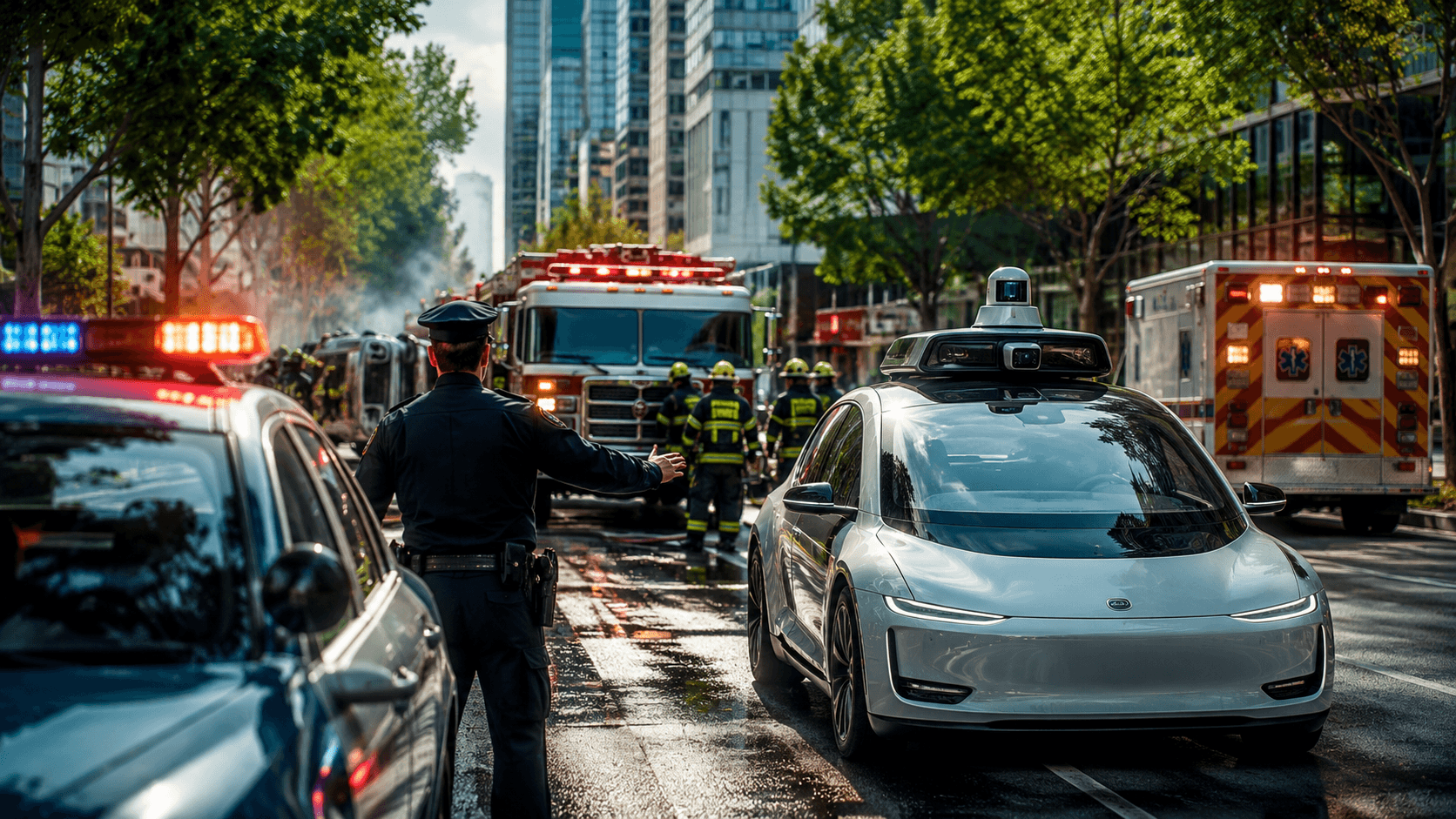
In a letter sent to the industry, Morrison said the NHTSA has documented numerous cases in which autonomous vehicles drove into active emergency scenes. The agency also recorded incidents where driverless cars blocked the paths of fire trucks and ambulances or failed to recognize and respond to critical safety cues, including flashing emergency lights, road flares, smoke, fire, and traffic cones.
“An automated vehicle that cannot safely interact with first responders is a danger to the general public.”
The regulator did not disclose specific incidents or identify which companies received the letter.
Meanwhile, local media in Texas reported that in late May, a Waymo driverless vehicle in Dallas partially blocked the route of fire trucks responding to a burning apartment building. Other videos have also shown Waymo vehicles blocking ambulances and driving through active police scenes.
Separately, the NHTSA and the U.S. National Transportation Safety Board (NTSB) are continuing to investigate other incidents involving Waymo driverless vehicles. One investigation focuses on autonomous cars that drove around stopped school buses with flashing lights, a violation of Texas state law.
Another incident occurred on January 23 in Santa Monica, California, when a Waymo driverless vehicle struck a nine-year-old girl who ran into the street on her way to school from behind a double-parked SUV.
Morrison said incidents like these highlight a serious flaw in autonomous driving systems.
“Let me be clear: the inability to detect and appropriately respond to these situations is a functional deficiency.”
The NHTSA said it plans to meet with autonomous vehicle developers before the end of the month to discuss potential solutions. The agency also urged manufacturers and operators of self-driving systems to prioritize fixing the issue as quickly as possible.