

08.12.2025
2 min
652



Some AI researchers are reportedly so confident in the technology’s future capabilities that they have started smoking to demonstrate their belief that AI will eventually cure cancer. Palantir CTO Shyam Sankar described this unusual trend, although he provided no evidence of how widespread it is.
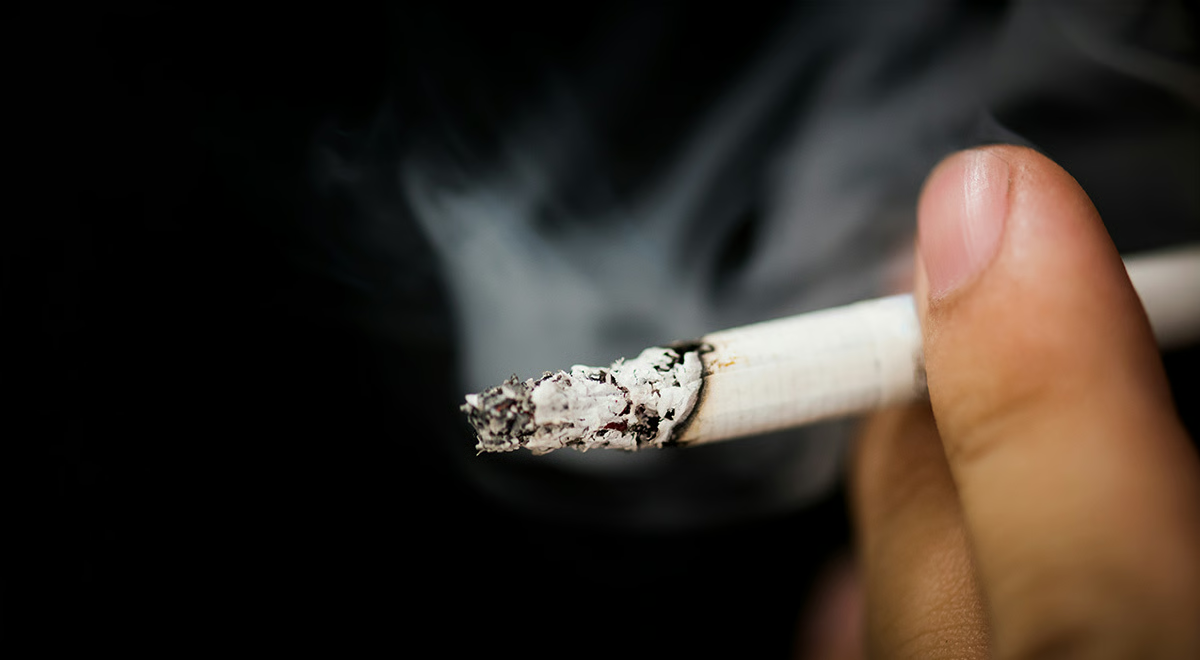
Shyam Sankar discussed the unusual behavior of some AI industry professionals during an interview on CBS’s Face the Nation. According to him, some researchers have deliberately started smoking to demonstrate to their colleagues how confident they are in the future of the technology.
“A lot of researchers have started smoking to show other researchers just how much they believe in AI,” Sankar said.
This belief is based on the idea that artificial intelligence will be able to discover effective cancer treatments before smoking causes serious health problems. However, Sankar himself does not support such behavior. Instead, he sees it as a sign of excessive enthusiasm for the technology and a kind of collective delusion surrounding its future capabilities.
“I’m showing that I’m betting everything on this. So there’s a kind of mass psychosis, a social delusion forming around it,” the Palantir CTO explained.
Despite the striking claim, there is currently no independent evidence that smoking as a way of demonstrating faith in AI is becoming widespread among researchers.
The idea that AI will soon defeat cancer frequently appears in statements by technology entrepreneurs. However, scientists emphasize that cancer is far more complex than it might seem. Cancer is not a single disease. There are more than 200 different types of cancer, involving various genetic mutations and biological processes.
These cancers are generally classified according to the organs or tissues in which they develop. Examples include breast, prostate, lung, brain, and pancreatic cancers, as well as blood cancers. Treatment outcomes depend on the characteristics of the specific disease, how early it is diagnosed, and the available treatment options. Therefore, developing a single universal cure for all types of cancer cannot be achieved through one technological breakthrough alone.
Artificial intelligence is already helping with early cancer detection, medical image analysis, and the search for promising treatment approaches. However, this does not mean the technology can independently eliminate all forms of cancer. Meanwhile, the link between smoking and the development of cancer has long been scientifically established. Deliberately exposing oneself to such risks based on assumptions about AI’s future capabilities has no scientific justification.
Sankar’s statement comes amid reports of growing interest in nicotine among certain members of the technology industry. Fortune previously reported that Palantir had installed vending machines offering free nicotine pouches to employees at its Washington, DC, office.
Meanwhile, Business Insider reported on the so-called “Cig Tech bros,” members of the tech community who have taken up smoking, partly as a way to build professional connections. As a result, cigarettes may be becoming not just a habit in certain tech circles, but also a means of socializing or demonstrating belonging to a particular community.
Another notable statement came from Avi Schiffmann, CEO of Friend, a startup developing wearable AI devices.
“By the time you develop lung cancer, our AI robots will probably have figured out how to cure it,” Schiffmann said.
His statement reflects the optimism of some AI industry figures, but it is not supported by medical forecasts.
According to data from the US Centers for Disease Control and Prevention (CDC), more than 40% of American adults smoked in 1966. By 2022, that figure had fallen to 11.6%. Over several decades, smoking became significantly less common, partly due to increased awareness of its harmful health effects.
Now, amid the rapid development of artificial intelligence, some technology entrepreneurs and researchers are making statements that effectively place future medical breakthroughs above already established health risks. However, there is currently no evidence that such beliefs are affecting overall smoking rates in the United States.
Artificial intelligence is opening up new possibilities for cancer diagnosis and treatment, but it does not guarantee the development of a universal cancer cure. Meanwhile, claims that smoking is becoming widespread among AI researchers remain unverified.