A Spanish court has ordered NordVPN and ProtonVPN to immediately block access to IP addresses linked to illegal LaLiga football streams. The ruling was issued without prior notification to the VPN providers and is non-appealable.

Commercial Court No. 1 of Córdoba ruled in favor of LaLiga and its broadcast partner Telefónica Audiovisual Digital (TAD). The court instructed VPN providers to configure their systems to block specific IP addresses identified by the claimants as sources of unauthorized match streaming.
LaLiga has long taken an aggressive stance against digital piracy. Previously, it targeted Cloudflare, accusing it of facilitating illegal sports streams. In this case, the league argued that VPN providers fall under the EU Digital Services Act (DSA), making them responsible for preventing copyright infringement on their networks.
The court emphasized that VPN services are “highly effective and accessible” tools for bypassing geographic restrictions. It also noted that providers promote their ability to circumvent blocks. The decision was issued inaudita parte, meaning the defendants were not heard before the ruling.
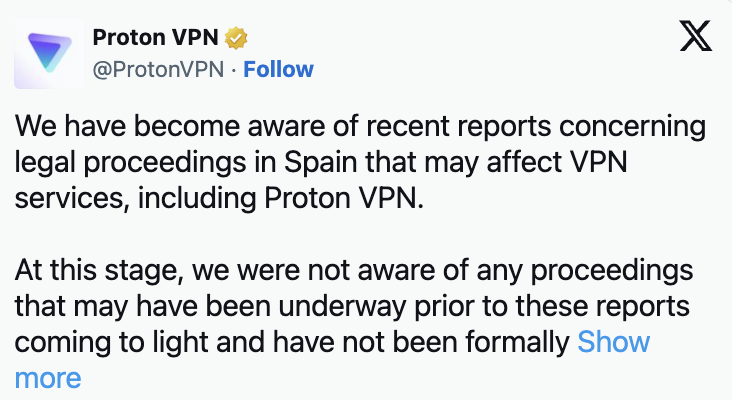
ProtonVPN publicly questioned the legitimacy of the proceedings, stating it had not received any formal notification of the case and stressing that issuing a judicial order without giving affected parties the opportunity to be heard contradicts fundamental due process principles.
NordVPN likewise stated that it has not received judicial documentation and was not aware of being part of any Spanish proceedings. The company warned that such measures could affect how the open internet operates. Both providers argue that domain or IP blocking is not an effective long-term anti-piracy strategy. According to them, such measures primarily impact legitimate paid VPN services, while free or unregulated providers remain largely unaffected.
Spain has been one of the most active EU markets in combating online sports piracy. LaLiga has consistently pressured technology companies to restrict access to illegal broadcasts. Under the Digital Services Act framework, EU member states have gained broader authority to impose obligations on digital service providers.
This case may set a significant precedent, as it directly obliges major VPN providers to filter traffic at the request of rights holders.
The Spanish court’s decision marks a new phase in the clash between copyright holders and VPN providers. If similar rulings spread across the EU, they could reshape how VPN services operate, raising complex questions about the balance between anti-piracy enforcement and digital privacy protections.