

Cybersecurity researcher Jeremiah Fowler discovered a publicly accessible database containing nearly two billion records, including passwords, email addresses, cookies, and authentication tokens. The server was completely unsecured, allowing anyone to access the information without a password or special permissions. Most of the records were associated with Google services, but the database also contained user data from Facebook, Instagram, Microsoft, Amazon, and other platforms.
The massive database was discovered by independent researcher Jeremiah Fowler, who published his findings on November 24, 2026. According to Fowler, it was the largest collection of credentials he had encountered during his years working in cybersecurity. The database was hosted on a publicly accessible server without password protection or encryption. Inside, the researcher identified 8,471 folders containing account information, device details, and other sensitive data.
A review of selected records revealed that the database contained more than just username and password combinations. It also included logs generated by malicious software designed to steal information from users’ computers. In particular, the researcher found browser-saved passwords, cookies, active session tokens, details about installed applications, and device specifications.
According to Jeremiah Fowler’s research published by ExpressVPN, some documents were organized by country. File names contained abbreviations such as US, UK, FR, DE, ES, and MX, corresponding to the United States, United Kingdom, France, Germany, Spain, and Mexico. After discovering the unsecured server, Fowler reported the issue to the hosting provider. Public access to the database was restricted several days later.
The analysis revealed that the largest number of records in the database was associated with Gmail accounts – approximately 608 million. Another 114.3 million records were linked to other Google services. Researchers also identified tens of millions of records associated with popular online platforms, including Facebook, Instagram, Amazon, Roblox, Yahoo, Microsoft, X, and other services.
The infographic below, provided by ExpressVPN, shows the number of records associated with various online services and email account categories.
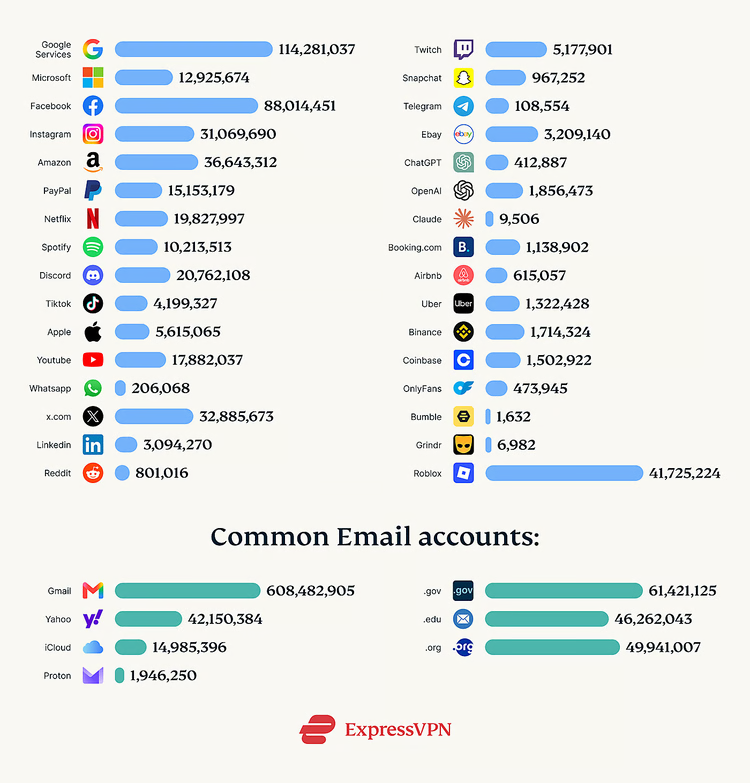
The database also contained more than 61 million records associated with government email addresses using the .gov domain, approximately 46 million linked to educational institutions with .edu addresses, and nearly 50 million associated with .org domains.
However, two billion records do not mean that two billion people were affected. A single user may have dozens of accounts, and the same information may have appeared in multiple data breaches. Some passwords may also no longer be valid. Furthermore, the presence of Gmail, Facebook, or Microsoft records does not indicate that these companies’ internal systems were compromised. The data may have been stolen directly from users’ devices through malicious software.
The researcher paid particular attention to approximately 400,000 documents that were likely generated by more sophisticated types of infostealers — malicious programs designed to steal sensitive information. Such malware can create separate folders containing user data on infected computers. The exposed database included directories named applications, cookies, edge, important files, and operating systems. These were accompanied by text files named system, process, clipboard, brute force, and passwords.
Together, this information could allow attackers to build detailed profiles of individuals, including which applications they use, which accounts they own, and what data they store on their devices. The database also contained thousands of Tor network website addresses with .onion domains, accompanied by usernames and passwords. According to Fowler, he had never previously encountered such a large collection of credentials for dark web resources in a single data exposure.
One of the greatest dangers is that stolen cookies and session tokens can sometimes allow unauthorized individuals to access accounts where users are already logged in, without needing to enter a password again. This means that simply changing a password may not always solve the problem. If a computer remains infected with an infostealer, the malware can steal newly updated credentials again. Additionally, compromising a primary email account can put other accounts at risk, since email addresses are frequently used for password recovery.
The researcher was unable to identify the owner of the massive database. One possibility is that it belonged to cybercriminals collecting stolen information for resale. Another theory suggests that the data may have been gathered by cybersecurity researchers, analytics companies, or fraud prevention specialists. However, there is currently no evidence that definitively establishes the database’s origin. Fowler emphasized that he did not download the entire collection, instead examining only a limited number of records necessary to confirm the exposure.
The researcher recommends keeping operating systems, browsers, and applications up to date, avoiding suspicious browser extensions, and enabling multifactor authentication. If users suspect their devices are infected with an infostealer, they should first scan for and remove malicious software. Once the system has been cleaned, they should change their passwords, terminate active sessions, and review the security of their primary accounts.
The main danger of this data exposure lies not only in the number of stolen passwords. When combined with cookies, authentication tokens, and device information, these credentials could give attackers access to multiple services belonging to the same person.