


Researchers led by Stanford University have used generative artificial intelligence for the first time to create fully functional bacteriophage genomes. The technology could help fight antibiotic-resistant infections, although experts are already warning about potential biosecurity risks.

Bacteriophages are a special type of virus that infect and destroy bacteria without infecting human cells. They have long been considered a promising way to combat antimicrobial resistance, which occurs when bacteria stop responding to conventional antibiotics.
In the new study, scientists used so-called genomic language models, or gLMs. They work on a similar principle to generative language models, but instead of being trained on ordinary text, they learn from millions of naturally occurring genomes.
Using these models, researchers created bacteriophage genomes specifically designed to target Escherichia coli C. E. coli is linked to thousands of deaths worldwide each year.
In viruses, the genome is the genetic material contained inside the viral particle. In practice, AI was used to design this genetic material so that the resulting bacteriophage could perform a specific function.
At the same time, the experiment showed that the technology is still far from perfect. Of nearly 300 bacteriophages synthesized by the researchers, only 16 proved viable.
Despite the potential benefits of this approach, the study’s authors themselves highlighted important concerns around biosecurity, biological containment, and safeguards against potential misuse of the technology.
It is still unclear whether a similar AI-based method for creating functional viral genomes could be applied to other types of viruses. The researchers specifically warned against experimenting with pathogens capable of infecting humans, animals, or plants.
Patrick Cai, Professor of Synthetic Genomics at the University of Manchester, described the findings as “an important milestone for synthetic genomics.”
“This suggests that genomic language models are beginning to learn the design principles encoded by evolution, opening the way to writing genomes with AI,” he said.
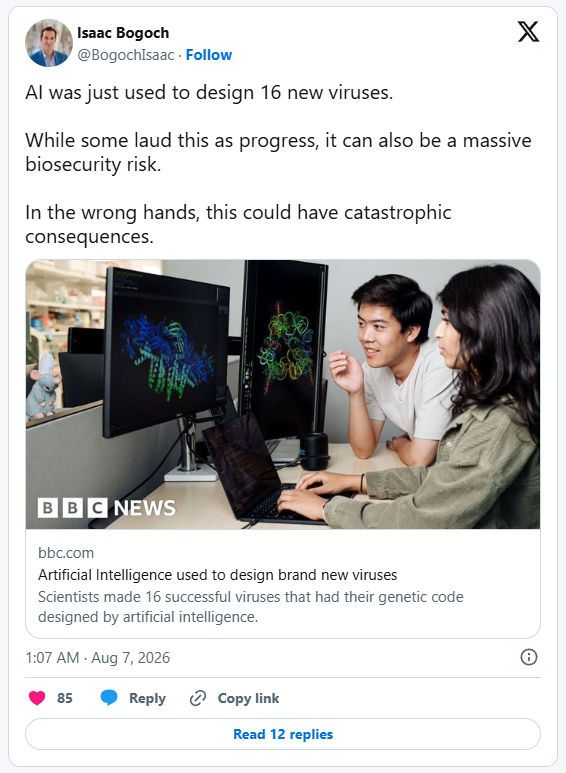
Meanwhile, Toronto General Hospital infectious disease specialist Isaac Bogoch believes that AI-generated bacteriophages could pose a “huge biosecurity risk.”
“In the wrong hands, this could have catastrophic consequences,” Bogoch wrote.
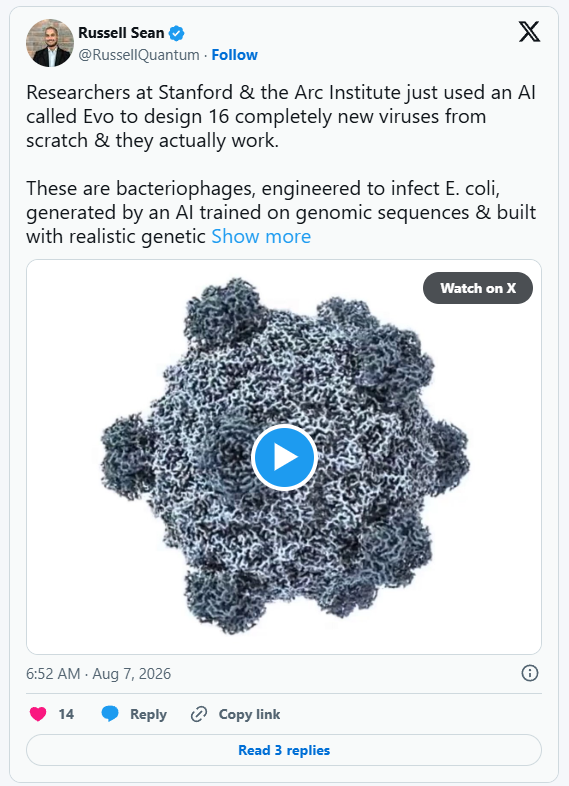
Not all experts, however, believe that the current technology already poses a direct threat to humans. Russell Shone, CTO of QuanMed AI and CEO of Quantum Labs, pointed out that the models used in the study were deliberately not trained on viruses that infect humans.
There are also technical limitations on the size of the genomes these models can generate.
“The genome size it can create is limited to that of a small phage, meaning it is nowhere near large enough to create anything capable of infecting a human,” Shone explained.
Concerns surrounding such technologies go beyond the possibility of creating dangerous viruses. Researchers are also discussing the potential use of AI capabilities in the development of biological or chemical weapons.
The 2026 International AI Safety Report notes that accurately assessing the capabilities of current models in this area is difficult because of legal restrictions and international treaties.
Researchers who conduct or publish experiments involving the use of AI to assist in weapons development could inadvertently violate national security laws or international agreements, including the Biological Weapons Convention.
At the same time, significant barriers to actually creating chemical or biological weapons remain. These include the need for specialized equipment and access to regulated materials.
The experiment shows that generative AI is already capable of contributing to the creation of functional viral genomes, although the technology remains relatively inefficient. It could open up new possibilities for fighting antibiotic-resistant bacteria, while also raising new questions about how such systems should be controlled and used safely.
