
30.07.2026
13 min
261



More than forty years ago, an event took place that barely made headlines and attracted little public attention at the time. On March 15, 1985, the American company Symbolics Inc. registered symbolics.com, becoming the first owner of a .com domain name. What seemed like a routine technical procedure back then would later be recognized as one of the most significant milestones in the history of the Internet.
Today, it is hard to imagine life without domain names. Every day, we type familiar website addresses into our browsers without thinking about the system that allows billions of devices to find one another online. But until the mid-1980s, no such system existed. Every computer was identified only by a numerical IP address, and the network itself was far smaller than it is today. The search for a way to make the Internet easier for people to use ultimately led to the creation of the Domain Name System (DNS) and the registration of the world’s first domain name.

Today, all it takes is typing a website’s name into your browser’s address bar to reach it within seconds. It’s such a routine action that most people never stop to think about what happens behind the scenes. But in the early days of the Internet, nothing like this existed. The network was much smaller, and its primary users were research institutions, universities, government agencies, and military organizations.
At the time, every computer on the network was identified only by a numerical IP address. This served as its unique identifier, allowing devices to communicate with one another. Instead of entering a familiar address like example.com, users had to remember a string of numbers such as 192.0.2.1. While this approach worked when the network consisted of only a relatively small number of computers, it quickly became impractical as the Internet expanded.
Remembering dozens or even hundreds of numerical addresses was inconvenient not only for everyday users but also for system administrators. Every time an IP address changed, records had to be updated manually, and a single incorrect digit could make an entire system unreachable. As more computers joined the network, it became increasingly clear that this method simply could not scale.
By the early 1980s, researchers were actively looking for a better solution—one that would allow people to access computers using memorable names instead of long strings of numbers. That search ultimately led to the creation of a technology that remains one of the fundamental building blocks of the modern Internet.

In 1983, American researchers Jon Postel and Paul Mockapetris introduced the Domain Name System (DNS), a breakthrough that fundamentally changed how people interact with the Internet. Its primary purpose was to hide complex numerical IP addresses behind simple, human-readable names. Instead of memorizing long strings of numbers, users could simply type a website’s name, while the system handled all the technical processes automatically in the background.
The easiest way to think of DNS is as the Internet’s phonebook. When you enter a website address into your browser, DNS looks up the corresponding IP address of the server and directs your request to the correct destination. As a result, people interact with short, memorable domain names, while computers continue communicating using numerical IP addresses. More than four decades later, this fundamental principle remains unchanged.
DNS also introduced a structured system of top-level domains. This laid the foundation for familiar extensions such as .com, .org, .net, and .edu, each of which originally served a specific purpose. The new system not only made the Internet much easier to navigate but also allowed it to grow without becoming unmanageable as the number of connected computers increased rapidly.
Just two years after DNS was introduced, another seemingly routine event took place. At the time, it appeared to be nothing more than a standard technical registration. In reality, however, it marked the beginning of a new chapter in Internet history and ushered in the era of domain names that continues to shape the online world today.

On March 15, 1985, a seemingly ordinary event took place—one that is now widely regarded as a defining milestone in the history of the modern Internet. On that day, the American company Symbolics Inc. registered symbolics.com, becoming the first organization to own a .com domain name. At the time, the registration attracted little attention. The Internet was still a niche network used primarily by researchers and technical specialists, and domain names were viewed simply as a new tool for organizing computer systems.
Symbolics was one of the pioneers in manufacturing specialized workstations designed for software development in the Lisp programming language. Its machines were widely used by universities, research laboratories, and organizations involved in early artificial intelligence research. As a result, the company was among the first to recognize the need for a more practical way to identify computers on the growing network and decided to register its own domain name.
Interestingly, few people in the mid-1980s realized how significant this moment would become. Registering a domain was not seen as a historic achievement or the beginning of a new era. It was simply another technical task—one that would eventually be repeated millions of times. Only years later did it become clear that symbolics.com had marked the beginning of a new chapter in the evolution of the Internet, laying the foundation for the global addressing system that underpins today’s online world.
Today, the world’s first domain serves as a reminder of a time when the Internet was just beginning to move beyond research laboratories and into the broader public sphere. It became the starting point for the countless websites, online services, and digital businesses that would go on to shape the modern Internet.
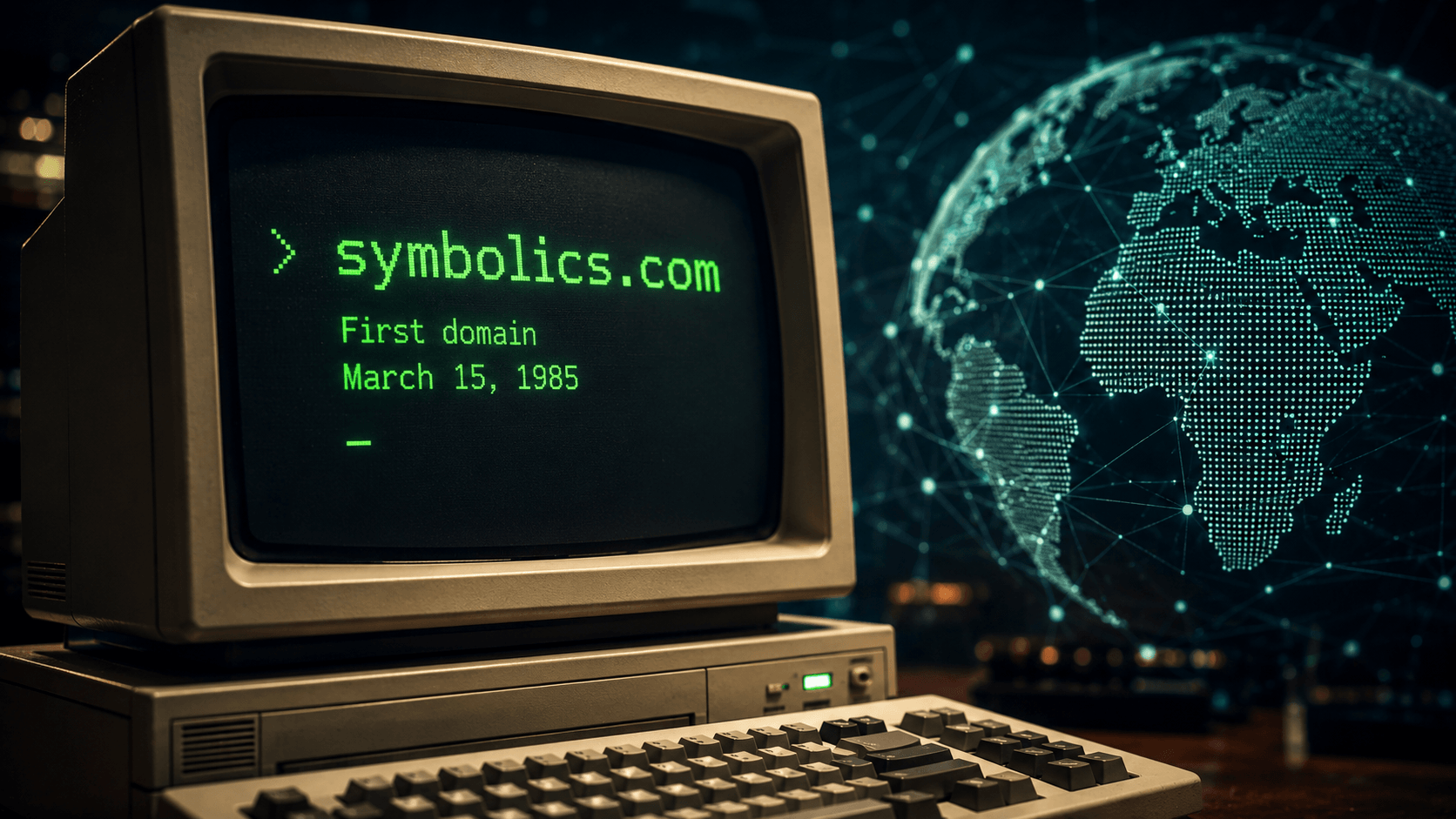
Following the registration of symbolics.com, the Domain Name System began to evolve at a remarkable pace. At first, domain names were used primarily by universities, government agencies, and technology companies. However, it quickly became clear that they would be essential for anyone planning to establish a presence on the Internet. By the late 1980s—and especially throughout the 1990s—the number of registered domains was growing at an extraordinary rate.
As the World Wide Web expanded, a domain name became much more than just a website address. It evolved into a key part of a company’s identity and brand. People began recognizing businesses by their domain names, reading news online, shopping on websites, and using digital services every day. For many organizations, a short and memorable domain became just as valuable as a logo or trademark.
At the same time, the domain name system itself continued to expand. What began with only a handful of top-level domains eventually grew into hundreds of extensions designed for businesses, governments, educational institutions, nonprofit organizations, and even individual cities. This expansion allowed the Internet to scale without sacrificing usability, making it easier for people to navigate an ever-growing number of websites.
Today, hundreds of millions of domain names are registered worldwide, while the Domain Name System processes billions of requests every day. What began with the registration of symbolics.com has become one of the fundamental technologies that powers the modern Internet and the global digital economy.
Despite the historical significance of the first domain, the company behind it did not share the same lasting success. During the second half of the 1980s, the computer industry changed rapidly. Specialized workstations gradually lost ground to more affordable and increasingly powerful personal computers, while competition intensified across the market. Unable to keep pace with these changes, Symbolics eventually ceased operations.
The domain itself, however, survived long after the company disappeared. In 2009, symbolics.com was acquired by XF Investments, which chose not to use the historic address for commercial purposes. Instead, it transformed the website into a virtual museum dedicated to the history of the Internet, the birth of the Domain Name System, and the evolution of the web.
Today, visitors to symbolics.com can explore the early history of the Internet, learn about the first domain names, and discover how the technologies that underpin today’s digital infrastructure came into existence. For many technology enthusiasts and historians, the site is more than just a historical curiosity—it is a reminder of how a single technical decision helped shape the online world we know today.

More than four decades have passed since symbolics.com was registered, yet the core principle introduced in the mid-1980s remains virtually unchanged. Just as they did then, people type familiar website names into their browsers, while the Domain Name System (DNS) locates the correct server in a fraction of a second among millions of others. This simple but powerful process is one of the reasons the Internet remains accessible and easy to use for billions of people around the world.
Over the years, domain names have become an essential part of the digital economy. They are used not only for websites but also for email services, cloud platforms, online stores, government portals, and countless other digital applications. For businesses, a domain name has evolved into a valuable brand asset, while for users it serves as one of the primary ways to navigate the online world.
The story of symbolics.com is a reminder that the most transformative technological revolutions often begin with seemingly ordinary events. In 1985, registering a domain name appeared to be little more than a routine technical task. Yet that single registration marked the first step toward building the Internet as we know it today. Hundreds of millions of domain names, billions of websites, and much of the modern digital economy can trace their origins back to that one historic entry in the domain name registry.