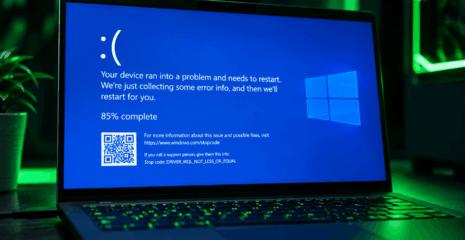


Microsoft declared its highest level of internal alert, Code Red, following a massive outage that disrupted Outlook, Teams, Exchange Online, Copilot, and other Microsoft 365 services for nearly 24 hours. The incident affected government agencies, businesses, and airlines across multiple countries. An internal investigation revealed serious problems with engineering systems and incident response procedures. The company now aims to resolve global outages within just one hour.
The massive outage occurred on November 12–13, 2026. For approximately 24 hours, users in multiple countries experienced problems accessing Exchange Online corporate email, Outlook, Microsoft Teams, the Copilot AI assistant, and other Microsoft 365 products. The disruptions affected government agencies in Australia, Japan, and the United States, delayed retail operations, and disrupted communications in the aviation industry.
Microsoft attributed the incident to a hidden Windows scaling bug introduced back in July 2026 that had gone undetected until the major outage. The company specifically emphasized that the incident was not caused by a cyberattack or the actions of AI agents. Microsoft CEO Satya Nadella publicly apologized for the service disruptions.
According to Reuters, Microsoft declared an internal Code Red following the incident. This is the highest level of urgency, meaning that resolving the identified issues becomes the top priority for engineering teams.
Jason Henderson, President of M365 Core, described the incident in an internal memo as the most significant customer-impacting outage in Exchange Online’s history. According to Henderson, never before had so many users been left without email access for such an extended period.
The problem turned out to be much broader than a single software bug. During the recovery process, Microsoft engineers encountered difficulties that prevented them from quickly identifying the root cause and coordinating their efforts across teams.
Amanda Silver, Microsoft’s Corporate Vice President responsible for M365 Core and the Work IQ platform, described the situation as a fog of war. Even involving the company’s most experienced specialists did not make it possible to quickly establish a complete picture of what was happening.
During the incident response, employees exchanged more than 11,000 messages across 11 Microsoft Teams chats. Meanwhile, diagnostic information was scattered across different internal systems, making it difficult to track engineers’ assumptions and decisions. As a result, teams spent additional time coordinating their efforts instead of directly resolving the problem.
One internal memo also cited an assessment by Microsoft Executive Vice President Charles Lamanna. According to him, the component responsible for the outage experienced approximately as many failures as would normally be considered acceptable over a ten-year period.
Following its analysis of the incident, Microsoft’s leadership identified several areas requiring urgent improvements. The company plans to:
Improve mechanisms for distributing and reducing workloads during outages.
Separate network traffic by geographic region to prevent local problems from spreading across the entire infrastructure.
Accelerate service recovery following large-scale outages.
Use AI agents to analyze diagnostic data and identify failures more quickly.
Strengthen coordination between engineering teams and improve oversight of corrective actions.
Microsoft’s primary goal is to reduce global outage recovery times to one hour. To achieve this, the company intends to automate parts of its diagnostic processes and improve incident response tools. However, this is a target rather than a guarantee that every future outage will be resolved within 60 minutes.
Another issue was the speed at which emergency updates could be deployed. According to Henderson, during another recent incident, rolling out a critical fix across Microsoft’s global infrastructure took between five and six days.
The company considers this timeframe unacceptable for the most severe security issues. Microsoft therefore plans to reduce the time between discovering a critical vulnerability and safely deploying a fix worldwide to just one hour.
Henderson also announced daily meetings with the leadership of the Substrate engineering division, which is responsible for core Microsoft 365 services. In addition, weekly reviews will be conducted to monitor the implementation of corrective measures identified after the outage.
A Microsoft spokesperson confirmed that the company continues to address the consequences of the incident even after services have been fully restored. According to the spokesperson, the main objective is not only to resolve outages quickly but also to prevent similar incidents from happening again.
The massive outage demonstrated how heavily government agencies, businesses, and other organizations depend on Microsoft’s cloud infrastructure. Even a single hidden software bug can simultaneously disrupt email, corporate communications, and other critical services across multiple countries.
The Code Red alert is expected to push Microsoft to reconsider not only its technical safeguards but also how its engineering teams operate. Whether the company can fulfill its promise to restore global services within an hour will become clear only after the new incident response mechanisms are implemented.