
04.08.2026
6 min
268



After claims surfaced on social media that Windows 11 had introduced a new service to spy on users, Microsoft publicly explained the purpose of its Windows Health and Optimized Experiences (whesvc) process. The company says the service does not secretly collect user data or automatically send it to Microsoft servers.
The controversy began after an X user known as @Xilly, who regularly shares PC optimization, FPS, and gaming performance tips, claimed that Microsoft had added a new background service to Windows 11. According to the post, the service launches automatically with the operating system, monitors the CPU, temperature, and battery, and sends the collected data to Microsoft every 15 minutes.
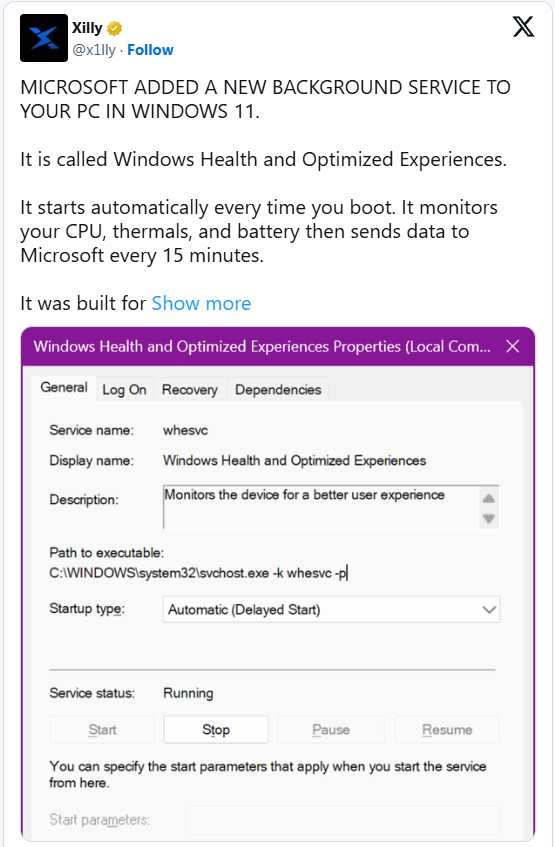
However, the service works quite differently from what was claimed.
Windows Health and Optimized Experiences runs quietly in the background, monitoring local system performance, power usage, and thermal conditions. If Windows detects that the PC is running slowly or experiencing performance issues, the service generates local diagnostic logs to help identify the cause.
Importantly, this information is not automatically transmitted to Microsoft. The diagnostic data remains on the device unless the user chooses to submit a report through the Feedback Hub. Users can also disable the service if they prefer.
It’s also worth noting that the component is not new. Microsoft first introduced it in 2025, meaning it has been part of Windows 11 for well over a year.
The viral claims sparked mixed reactions online. Some users pointed out that the service has existed for quite some time and questioned why it was suddenly being portrayed as a new discovery.
“Microsoft added this back in May 2025. Why are you acting like this is something new?”
Others said they planned to disable the service or questioned whether it was necessary at all.
“Sometimes I’m not sure what’s worse: Microsoft or plain old rage bait.”
Microsoft Vice President Scott Hanselman also weighed in on the discussion, explaining that the service was specifically designed to detect when a system becomes slow or sluggish.
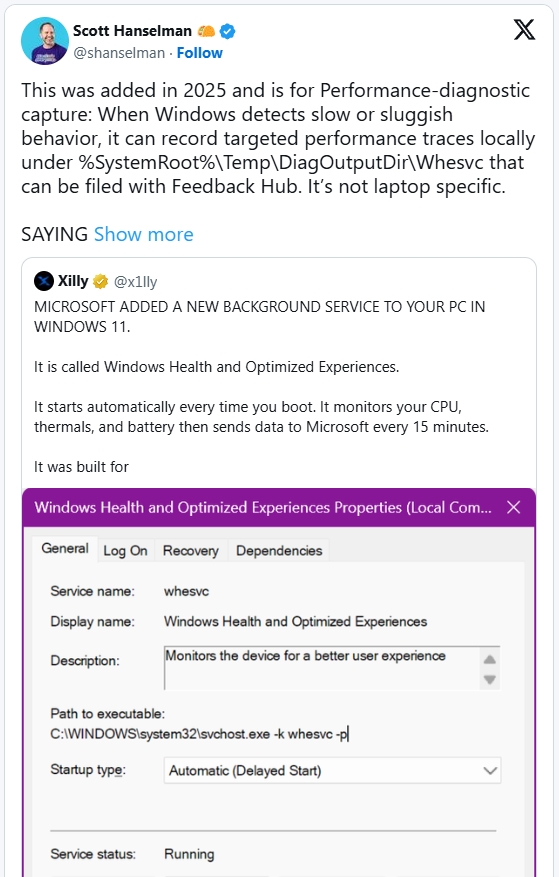
Responding to users’ questions, Hanselman also dismissed claims that the service records users’ screens.
“Performance traces are not screen recordings. They use Windows performance counters, among other things.”
Despite Microsoft’s clarification, the controversy once again highlighted how sensitive Windows 11 users have become to changes in the operating system. Much of that skepticism stems from the platform’s recent history.
Earlier this year, some Dell PCs were unable to install Windows 11’s July update because of serious system issues. Users reported unexpected shutdowns, excessive heat, faster battery drain, and reduced performance after installing the update.
At the same time, Microsoft is developing a redesigned Windows 11 context menu that promises faster performance and greater customization. Even so, many users have been unimpressed, arguing that these improvements should have arrived years ago.
Overall, criticism of Windows 11 has continued to grow, with many users unhappy about Microsoft’s increasing focus on AI-powered features. In response, the company has already begun scaling back some of its AI-first approach, making certain parts of Windows 11 less dependent on artificial intelligence.