

19.03.2024
9 min
790



Swedish researchers have developed a system that uses Wi-Fi signals to identify people carrying concealed firearms. During testing, the technology detected up to 91.5% of the objects carried by participants, although its accuracy in identifying actual weapons remains inconsistent.

According to a study by the Swedish Defence Research Agency (FOI), scientists have proposed using ordinary Wi-Fi radio signals to detect handguns concealed under clothing.
The idea is that radio waves travel differently through people and objects. A metal handgun, a water bottle, a smartphone, or a plastic toy gun each affects the signal in a different way. These differences can be detected and analyzed using artificial intelligence.
To test the technology, researchers built an experimental system consisting of two Wi-Fi transmitters and two receivers. The equipment was positioned on opposite sides of a room, allowing radio waves to pass through the area where participants were moving.
The experiment involved up to four people moving simultaneously within a room measuring up to 12 square meters. Some participants carried various objects, including a real deactivated metal handgun, a plastic replica, a metal water bottle, or a mobile phone.
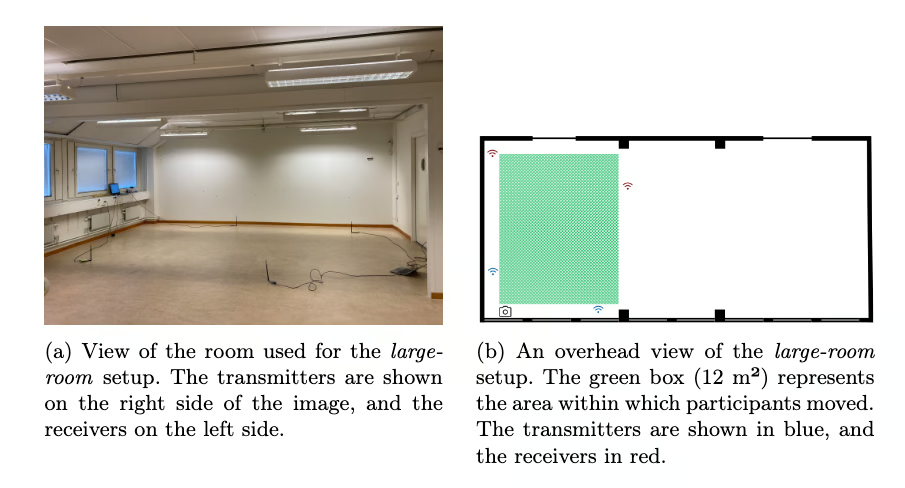
The system operated at a frequency of 5.68 GHz, which is also used by many home Wi-Fi routers. The channel bandwidth was 20 MHz, corresponding to the narrowest standard Wi-Fi channel.
To collect data, the researchers used a modified open-source implementation of the IEEE 802.11a standard, introduced back in 1999, along with the free radio signal processing software GNU Radio. A conventional video camera simultaneously recorded the participants’ movements so the collected data could be used to train the model.
In the scientific paper Concealed Handgun Detection using WiFi Signals, the researchers state:
“Our baseline results demonstrate that Wi-Fi signals do contain sufficient information to detect concealed handguns carried by people in groups of up to four individuals, even in the presence of other everyday objects.”
The technology is based on Channel State Information (CSI), which describes how radio waves propagate through space, reflect off surfaces, and change in response to surrounding objects.
Wi-Fi equipment typically uses this type of data to optimize connections and maintain stable internet speeds. Swedish researchers decided to apply it to an entirely different task.
During the experiment, the 20 MHz channel was divided into 52 narrow frequency subchannels. The system analyzed the signal’s amplitude and phase 80 times per second, tracking how its characteristics changed as people carrying different objects moved around.
Using this data, the researchers developed a deep learning model called WiFireNet. It was trained to identify characteristic changes in radio signals associated with the presence of a handgun and estimate the location of the person carrying it.
The result is displayed as a two-dimensional bounding box around the person suspected of carrying the weapon. To achieve this, the model converts Wi-Fi signal characteristics into data that can be analyzed using computer vision algorithms.
The system was trained to distinguish between four categories of objects: a real handgun, a plastic handgun, a metal water bottle, and a mobile phone.
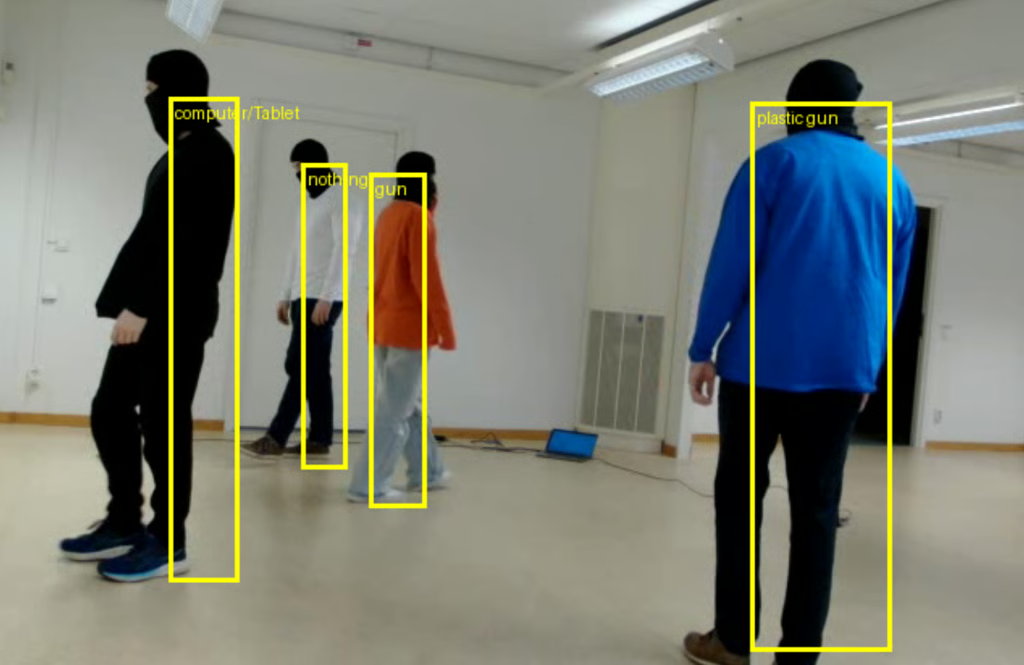
During testing, the system successfully detected between 83% and 91.5% of the objects carried by participants. The results depended on the size of the room, the number of people, and the equipment configuration.
However, the overall number of detected objects does not necessarily mean that the system correctly identifies each one.
According to the mean Average Precision (mAP) metric, which measures the accuracy of object classification and localization, the results ranged from approximately 35% to 50%. This indicates a significant number of recognition errors.
For the real handgun category, average precision ranged from approximately 30% to 72%. In other words, the system performed considerably better under certain conditions than others.
Despite these limitations, the researchers consider the results promising. They believe Wi-Fi could become an additional security tool in situations where conventional surveillance cameras or metal detectors have limited capabilities.
“A Wi-Fi-based security system could potentially serve as an additional detection tool, capable of operating under conditions of visual obstruction or object concealment without requiring strict spatial positioning,” the researchers explain.
Unlike metal detectors, such a system does not require every person to pass through a narrow security checkpoint. It can also detect concealed objects that conventional cameras cannot see.
Wi-Fi signals are already used to detect intruders indoors, determine human presence, and even in research exploring technologies that can track objects through walls.
However, previous experiments involving the detection of suspicious objects were mostly conducted under controlled conditions, with objects remaining stationary or being examined individually.
In the new study, researchers tested whether concealed weapons could be detected while multiple people moved simultaneously within the same room.
“To the best of our knowledge, no previous studies have investigated handgun detection using Wi-Fi in a dynamic environment involving multiple people,” the study’s authors note.
To allow other research teams to verify the results and improve the technology, the researchers published the WiFire dataset on Hugging Face, along with the source code and trained models on GitHub.
For now, WiFireNet remains an experimental technology. The system has already demonstrated the potential to detect concealed weapons using radio signals, but recognition errors mean it cannot yet fully replace traditional security screening methods.