

09.06.2026
4 min
292



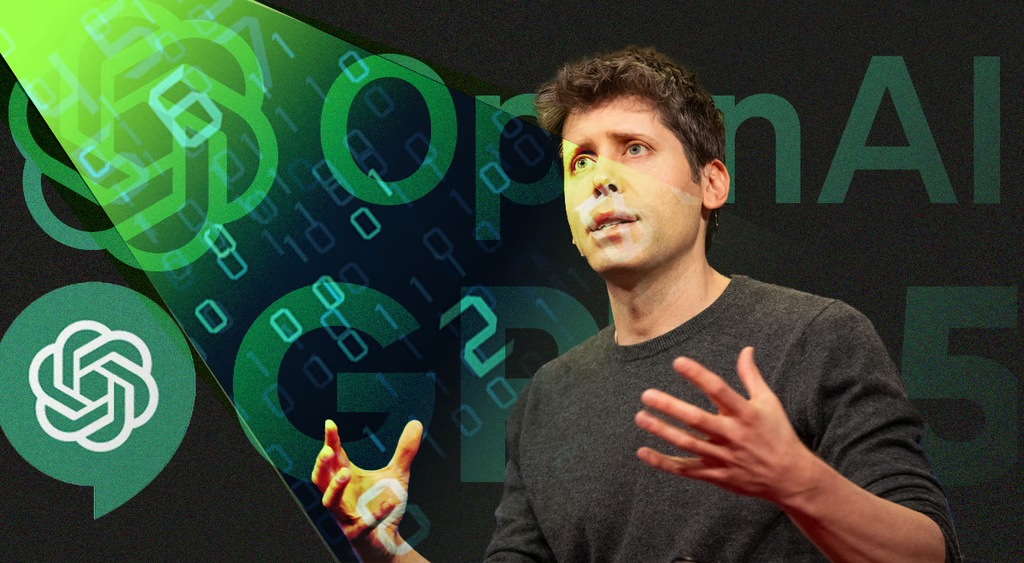
OpenAI has confidentially filed paperwork for an initial public offering (IPO) in the United States. The creator of ChatGPT has become the latest major player in the artificial intelligence industry preparing to go public amid unprecedented investor interest in AI companies.

The company confirmed the filing but has not disclosed the size of the offering or its terms. It is also unclear when OpenAI could make its stock market debut. In a statement, the company said the process may take some time, as certain planned changes are currently easier to implement while remaining a private company.
According to Reuters, OpenAI is targeting a valuation of up to $1 trillion when it goes public. If achieved, it would become one of the most valuable companies ever to launch an IPO.
The filing comes amid intensifying competition among the biggest players in artificial intelligence. Earlier in June, Anthropic, the company behind the popular AI assistant Claude, announced that it had also confidentially filed for an IPO. The move came just weeks after a funding round that valued the company at nearly $965 billion.
At the same time, Elon Musk’s SpaceX is preparing for its own public debut. The company is reportedly seeking a valuation of around $1.75 trillion and a $75 billion IPO that could become the largest in history.
“OpenAI is keeping all options open, as Anthropic beat it to filing after a massive funding round,” said Michael Ashley Schulman, partner at Cerity Partners.
Prediction markets had largely expected OpenAI to be the first major AI company to file for an IPO. However, Anthropic ultimately moved first.
Many analysts now view the planned public listings of OpenAI and Anthropic as the beginning of a new era for the technology sector. Artificial intelligence has become the defining investment theme of the decade, with leading companies raising enormous amounts of capital to expand their models and infrastructure.
Earlier this year, OpenAI announced a $110 billion funding round that valued the company at $840 billion. Investors included SoftBank, Amazon, and Nvidia.
The company has also said that ChatGPT now has more than 900 million weekly active users and over 50 million paying subscribers. Another important step ahead of the IPO was the revision of OpenAI’s partnership with Microsoft, allowing the company to expand its relationships with other tech giants, including Amazon and Google.
Microsoft remains one of OpenAI’s most important investors. Since 2019, the company has invested approximately $13 billion in the creator of ChatGPT. Those investments played a major role in OpenAI’s rapid growth while also strengthening the position of Microsoft’s Azure cloud platform.
OpenAI’s financial performance continues to accelerate. In March, the company reported that its monthly revenue had reached $2 billion. By comparison, its quarterly revenue at the end of 2024 was around $1 billion. Despite this rapid growth, OpenAI has previously told investors that it does not expect to become profitable before 2030.
At the same time, competition in the artificial intelligence market is becoming increasingly intense. One of OpenAI’s biggest rivals is Anthropic, whose Claude models are widely used by software developers. Some companies have already adopted its flagship Mythos model to identify vulnerabilities in their code.
Some bankers have also warned that multiple mega-IPOs happening at the same time could divert investment capital away from smaller companies.
“OpenAI doesn’t want public market capital to run dry. SpaceX and Anthropic are not only ahead in terms of IPO timing, but large public competitors could also raise tens of billions of dollars each in secondary markets,” said Gil Luria, Managing Director at DA Davidson.
The company’s legal history has also attracted significant attention. OpenAI was founded in 2015 as a nonprofit research organization, but in 2019 it created a for-profit subsidiary to help fund the growing costs of developing advanced AI systems.
That unusual structure became a source of internal conflict. In late 2023, OpenAI’s board briefly removed Sam Altman as CEO, but he returned to the role just days later following a strong backlash from employees.
In December 2024, OpenAI announced a major governance overhaul, including plans to establish a public benefit corporation. The company said the change would help attract more investment while preserving its broader mission.
The restructuring drew sharp criticism from Elon Musk, one of OpenAI’s early supporters. Musk later sued the company and Sam Altman, accusing its leadership of abandoning the organization’s original mission of benefiting humanity.
In May this year, a U.S. jury ruled in OpenAI’s favor. Analysts believe the verdict removed one of the most significant legal obstacles standing in the way of a future IPO.
With that hurdle cleared, the company can now focus on preparing for a stock market debut that could become one of the most significant financial events in the history of the artificial intelligence industry.