
09.08.2026
24 min
212



GeoCities was one of the most iconic symbols of the 1990s internet, where anyone could create their own website and design it however they wanted. We look back at the story of this legendary digital city, its quirky pages, enormous popularity, and the legacy that still offers a glimpse into a very different era of the internet.
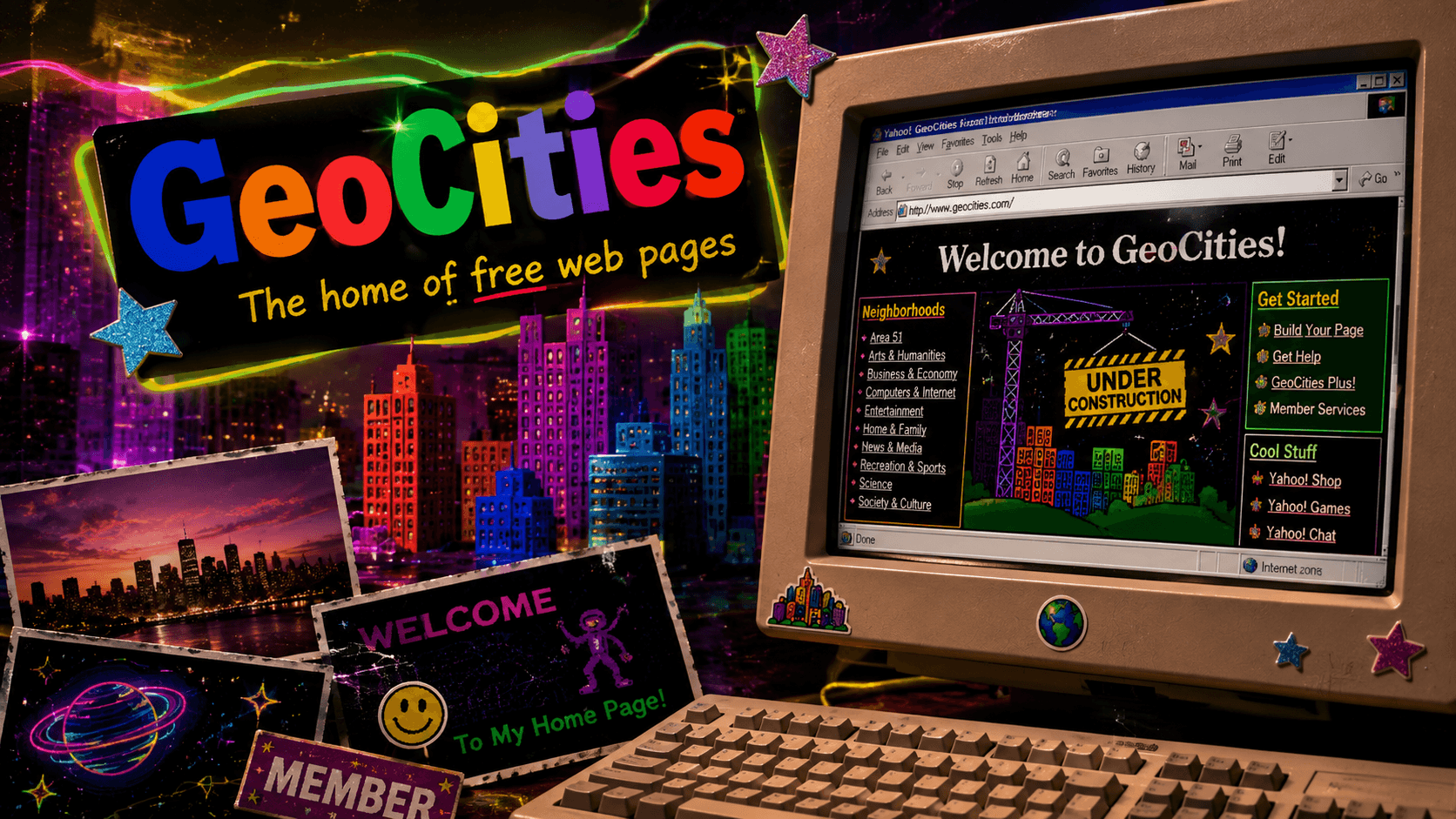
To understand the phenomenon of GeoCities, you have to forget about the modern internet for a moment. In 1994, there was no Google, YouTube, Facebook, Wikipedia, Twitter, Instagram, Reddit, or most of the other platforms that now seem inseparable from life online. Amazon was only just getting started, Yahoo! was still taking shape, and Netscape Navigator, which would later become one of the defining symbols of the early web, appeared that same year. The World Wide Web itself was still remarkably young. The first website had gone online only a few years earlier, and the number of resources available was tiny compared with what we have today.
The internet was not yet a place where people spent a significant part of their day. For many, it remained a mysterious network of computers that you could connect to over a telephone line, listen to the distinctive screech of a modem, and then watch as a webpage slowly appeared on the screen, sometimes loading piece by piece. Even browsing the web required a certain amount of patience, while creating your own website was still something associated with technical know-how. Today, anyone can create a profile in a minute and immediately start posting. On the early web, simply getting a personal homepage online already felt like a small achievement.
In that world, having your own website offered an entirely new kind of experience. For the first time, an ordinary person could publish something that could theoretically be seen by anyone with an internet connection, whether they lived next door or on another continent. But doing so required infrastructure: a server, storage space for files, some basic knowledge of HTML, and an understanding of how the web actually worked. For the average internet user of the mid-1990s, any one of those requirements could become a serious obstacle. That was the problem a small California company called Beverly Hills Internet set out to solve.
In 1994, David Bohnett and John Rezner founded Beverly Hills Internet, or BHI. At first, the company focused on web hosting and related services, but it soon began developing a much more interesting concept. Instead of treating the web simply as an enormous collection of documents and servers, the service’s creators borrowed a model everyone already understood: a real city. If people were going to have their own pages, why not organize them like houses located in different themed neighborhoods?
Users were offered free space to build personal homepages, while the owners of those sites became known as “Homesteaders.” The name perfectly captured the spirit of the internet at the time. You weren’t simply opening an account; it felt more like claiming a small plot of land on a largely unsettled digital frontier. There was a powerful psychological element to the idea. Instead of offering a dry web-hosting service, the platform invited users to become part of a community, find a place among other residents, and gradually shape that space however they wanted.
Users were initially given around 2 MB of storage for their pages. Today, that figure sounds almost laughably small: a single smartphone photo can take up more space, while just a few seconds of modern video can easily exceed the entire limit. But the web of the mid-1990s operated under very different constraints. HTML files were measured in kilobytes, images had to be compressed, and building a media-heavy website made little sense when home internet connections were so slow. Two megabytes could therefore be enough for a modest website with several sections, photos, buttons, background images, animated GIFs, and dozens of links.
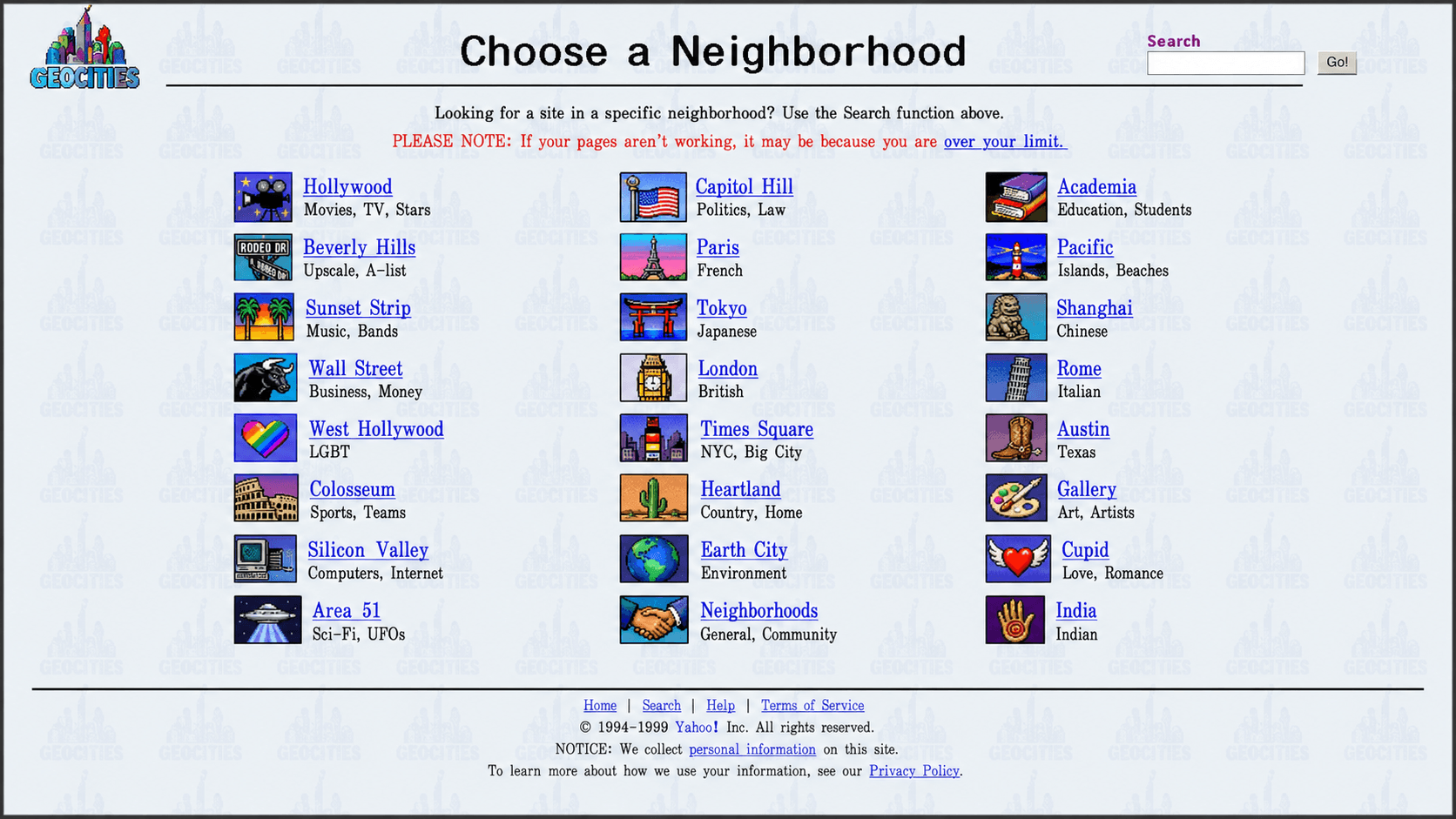
One of the defining features of Beverly Hills Internet, which would soon become GeoCities, was its system of themed neighborhoods. Websites weren’t simply thrown into one enormous directory. Owners chose a neighborhood based on their interests and the subject of the site they wanted to build. Well-known neighborhoods included Hollywood, RodeoDrive, SunsetStrip, WallStreet, WestHollywood, and Colosseum. As the service expanded, areas such as SiliconValley, Area51, CapitolHill, Paris, Tokyo, TimesSquare, Heartland, and many others were added.
Those neighborhood names were far from random. SiliconValley naturally attracted pages about computers, programming, and technology. Hollywood appealed to movie and entertainment fans, CapitolHill was associated with politics, while Area51 became home to pages about science fiction, space, UFOs, paranormal phenomena, and other subjects that fit neatly with the image of America’s famously mysterious military base. The system meant users weren’t simply finding somewhere to host a website; they were effectively moving into a community of people who shared similar interests.
Each user received what was essentially a digital street address combining the neighborhood name with a number that resembled a house number. An address might look something like GeoCities.com/SiliconValley/1234, and that small detail mattered far more than it might seem today. Visitors could enter a neighborhood devoted to a particular subject and then move between the pages of people with similar interests. As GeoCities grew, its neighborhoods expanded and gained additional sections and subdivisions, but the central idea remained the same: people weren’t simply storing files on the same server. They were living next to one another in an enormous virtual city.
GeoCities’ technical limitations were both a weakness and a source of incredible creativity. Users couldn’t simply upload hundreds of full-resolution photos, add several gigabytes of video, or load dozens of resource-heavy libraries. Every kilobyte mattered, so personal homepages were built with whatever was available: basic HTML, small JPEG images, GIFs, background textures, tables, buttons, and simple animations. Limited resources forced people to experiment with a relatively small set of tools, while also making every page the product of dozens of individual creative choices.
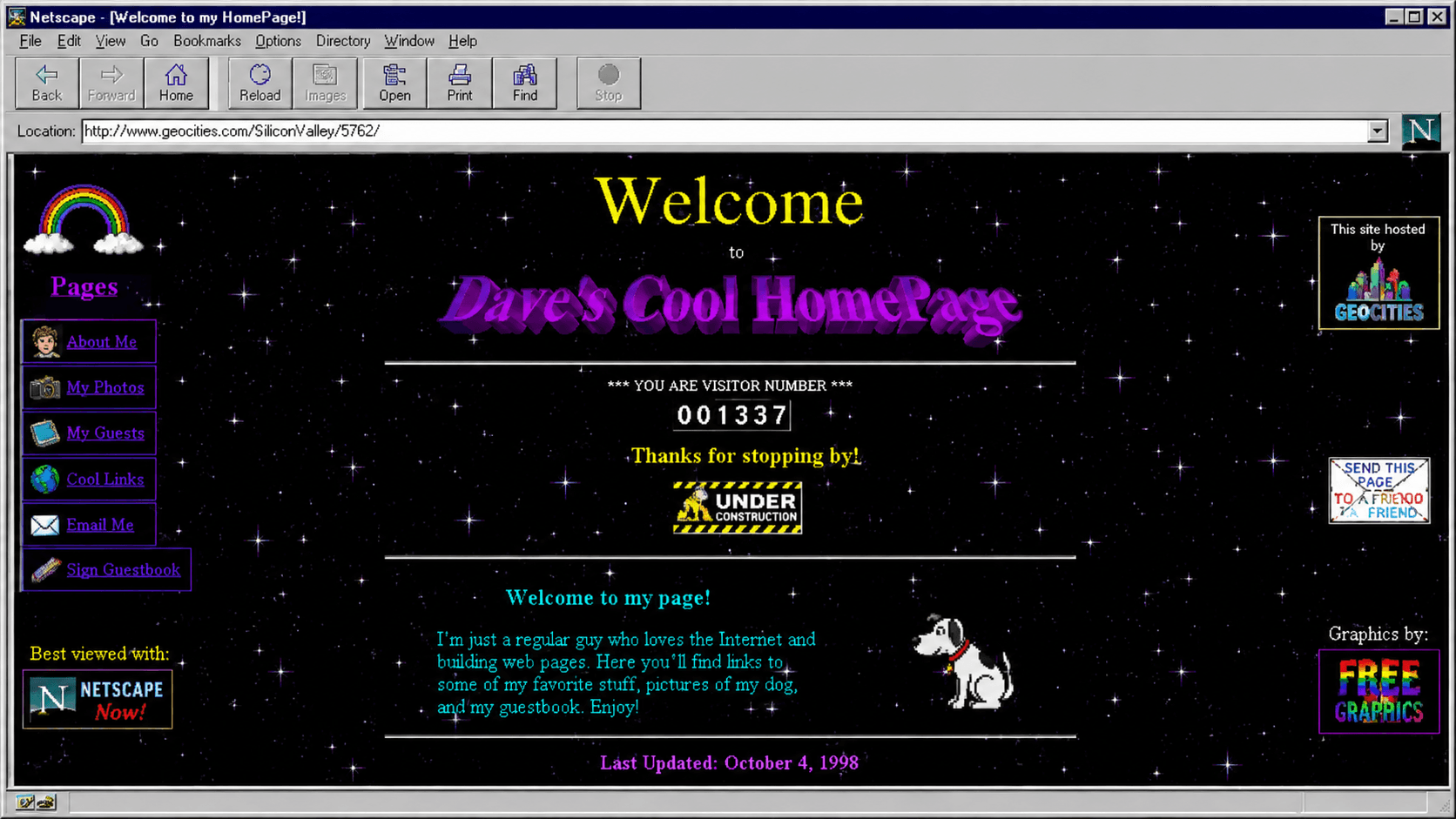
Out of those basic ingredients emerged an aesthetic that is almost impossible to confuse with any other era of the internet. While modern designers generally aim for clean, predictable, and visually consistent websites, the typical homepage creator of the 1990s often followed a much simpler rule: if something could be added to a website, it was probably worth trying. A single page might feature blinking text, animated flames, a GIF of a dancing dog, an endlessly repeating starry background, a visitor counter, and an enormous Netscape Navigator button, all competing for attention at once.
“Under Construction” signs became another defining symbol of the era, announcing that a page was still being worked on, even when the sign remained there for years. If the browser supported automatic audio playback, visitors might suddenly be greeted by a MIDI version of the owner’s favorite song. Colors often clashed, fonts changed halfway down the page, buttons were enormous, and navigation could require genuine patience. By modern web design standards, many of these sites looked disastrous, but that imperfection was precisely what made them so charming: each page was a direct digital reflection of the person who created it.
GeoCities represented one of those rare periods in internet history when huge numbers of ordinary people began experimenting with web design with almost no rules to follow. Most weren’t programmers or professional designers. They hadn’t studied UX, and they weren’t thinking about conversions, audience retention, or advertising metrics. They simply wanted to make a page that looked good to them. That absence of professional constraints turned GeoCities into something resembling a giant laboratory of grassroots web design.
As a result, two websites located right next to each other in the same GeoCities neighborhood could look as though they had been created by entirely different civilizations. One might feature a black background, green text, and skulls, while the next was covered in pink hearts, pet photos, and flowers. A third could resemble an obsessive fan archive for a television series, a fourth might be devoted entirely to military aircraft, and a fifth could consist of the owner’s autobiography alongside an enormous collection of links. There was no centralized design system forcing any of these people to make their pages look alike.
That was one of the defining characteristics of the early personal web: the page itself was a form of self-expression. Modern social platforms work very differently. Instagram determines how profile elements are arranged, YouTube defines the structure of a channel, Facebook controls the appearance of a page, and TikTok gives creators very little control over the interface itself. On GeoCities, if someone wanted yellow text on a red background alongside twenty animated GIFs playing at the same time, nobody was going to stop them. The result might have been terrible from a design perspective, but it was unmistakably personal.
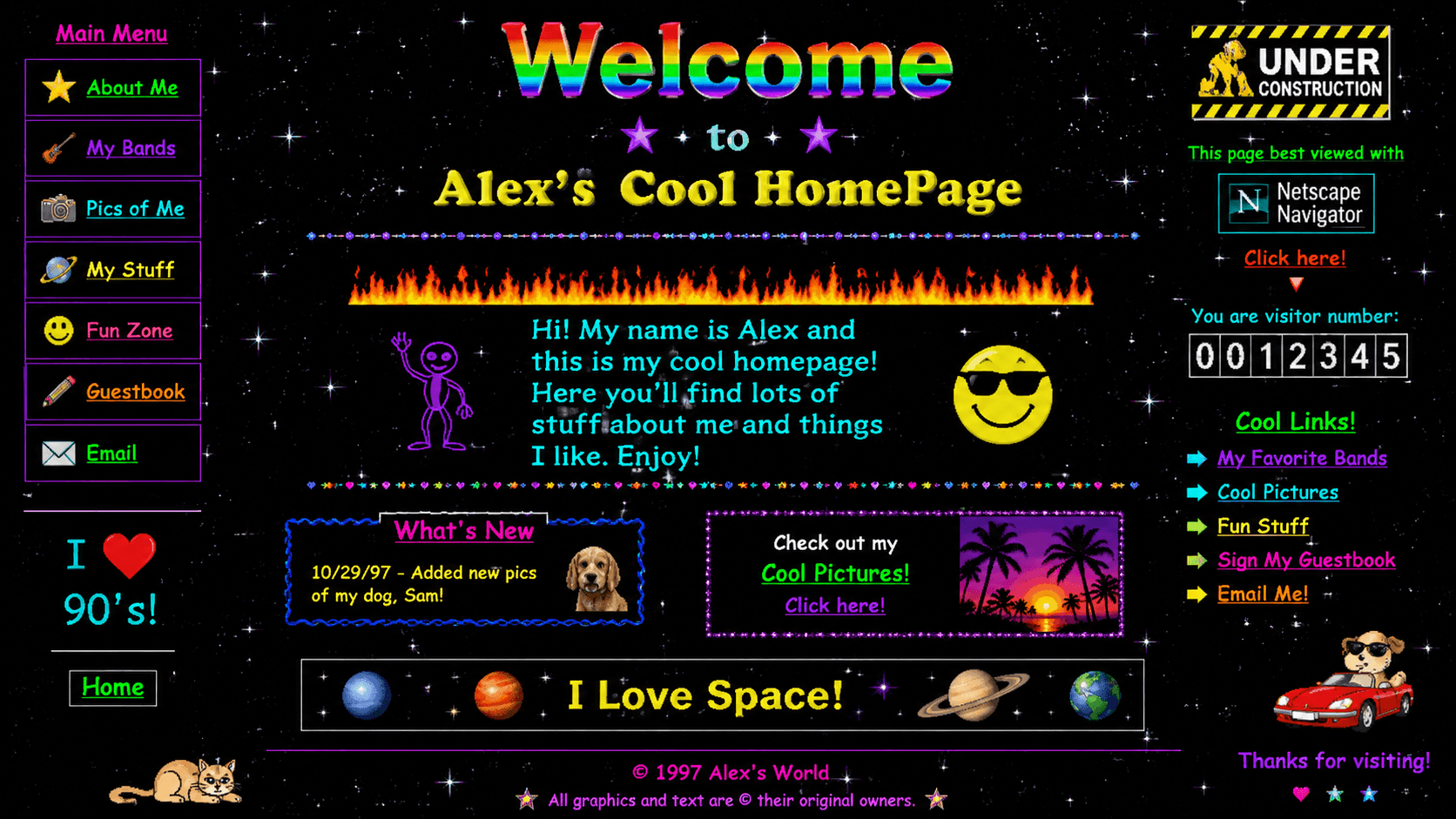
As GeoCities grew, its neighborhoods turned into an extraordinary catalog of human interests. You could find websites about local fire departments, military aircraft, cars, computers, pets, music, television shows, science fiction, religion, politics, sports, and family history. Some people posted vacation photos, others built detailed family trees, students uploaded school projects, and fans collected photos and trivia about their favorite actors.
Enthusiasts created sprawling pages about UFOs and alien abductions, small workshops showcased their handmade products, collectors displayed their prized collections, and fans of TV shows and bands built dedicated websites long before modern fandom culture migrated to major social platforms. Among all this variety, almost no subject was too niche or too strange to deserve its own homepage. If something fascinated even one person enough that they wanted to share it with others, that was reason enough for a new website to exist.
Most of these pages never attracted large audiences, and that is one of the biggest differences between them and much of today’s online content. Publishing now is almost automatically tied to reach: how many views did it get, how many people followed, did the post make it into recommendations, did the algorithm pick it up? A GeoCities homepage owner could spend months adding new sections to a site regularly visited by only ten or twenty people. The page existed primarily because someone wanted to create it, not because an algorithm promised to reward them with views.
GeoCities is often described as an early precursor to Web 2.0, although treating the two as the same thing would be misleading. The term Web 2.0 would become popular much later and would be used to describe a broader transformation of the web toward interactive platforms, social services, and user-generated content. Still, GeoCities demonstrated one of the fundamental ideas that would shape the internet’s future: the web didn’t have to be filled exclusively by universities, companies, news organizations, and professional developers.
Ordinary people could build it too. Today, that idea feels so obvious that we barely think about it. Billions of users publish photos, videos, comments, memes, and personal stories every day. In the mid-1990s, however, this culture was only beginning to emerge. The ability not just to consume information online but to contribute something of your own fundamentally changed the way people thought about what the internet was for.
GeoCities lowered the barrier to publishing on the web, even if it didn’t eliminate it entirely. Users still needed at least some understanding of HTML, files, and webpage structure, but they no longer had to provide their own server infrastructure. The web was gradually becoming more than a place people visited to consume ready-made information. It was turning into a space where anyone could leave something of their own behind. In that sense, there is a direct cultural connection between the strange personal homepages of GeoCities and the social media profiles we use today.
The digital city concept worked far better than its creators could have expected. The number of Homesteaders grew rapidly, neighborhoods expanded, and GeoCities gradually became one of the main gateways into the early personal web. By the end of the decade, the service had reached an enormous scale. In 1999, GeoCities was considered the third most visited site on the World Wide Web, an extraordinary achievement for a platform built largely around amateur personal homepages.
Millions of people came not only to browse but to create, edit, and rebuild their own digital homes. As the platform grew, users created more content, and that content in turn attracted more visitors. GeoCities was effectively using a model that would later become fundamental to countless social platforms: the users themselves created most of the service’s value, while the company provided the infrastructure that made it possible.
By this point, it was difficult to describe GeoCities as merely a free web-hosting service. The company had built an enormous community and accumulated a vast amount of user-generated content, while its themed-neighborhood concept had made the brand recognizable even among people who had never created a homepage there. By the late 1990s, an audience of that size was an incredibly valuable asset, as the biggest technology companies competed to become the main gateways to the internet. That was when GeoCities caught the attention of Yahoo!.
By the late 1990s, Yahoo! was one of the defining symbols of the internet. Google had yet to establish itself as the dominant search engine, and major web portals were trying to bring everything a user might need under a single brand: search, email, news, finance, website directories, chat rooms, communities, and entertainment. GeoCities fit perfectly into that model because it brought not only an enormous audience but millions of pages of content that Yahoo! didn’t have to create itself.
In January 1999, Yahoo! announced that it would acquire GeoCities in a stock deal valued at approximately $3.57 billion. Today, paying that much for a personal-homepage service might sound extraordinary, but the deal has to be understood in the context of the dot-com boom. Internet companies were receiving staggering valuations, investors were pouring huge sums into online businesses, and rapid audience growth was often considered more important than immediate profitability. GeoCities had exactly what companies were willing to pay billions for at the time: millions of users, a powerful brand, and significant potential for future monetization.
On paper, the deal looked almost perfect: one of the world’s largest web portals was acquiring one of its biggest online communities. For Yahoo!, it was an opportunity to gain an enormous body of user-generated content and draw people even deeper into its ecosystem. For GeoCities, the acquisition could mean access to the resources of a major technology company and new opportunities for growth. But it soon became clear that the residents of this digital city and its new corporate owner did not always share the same vision for its future.
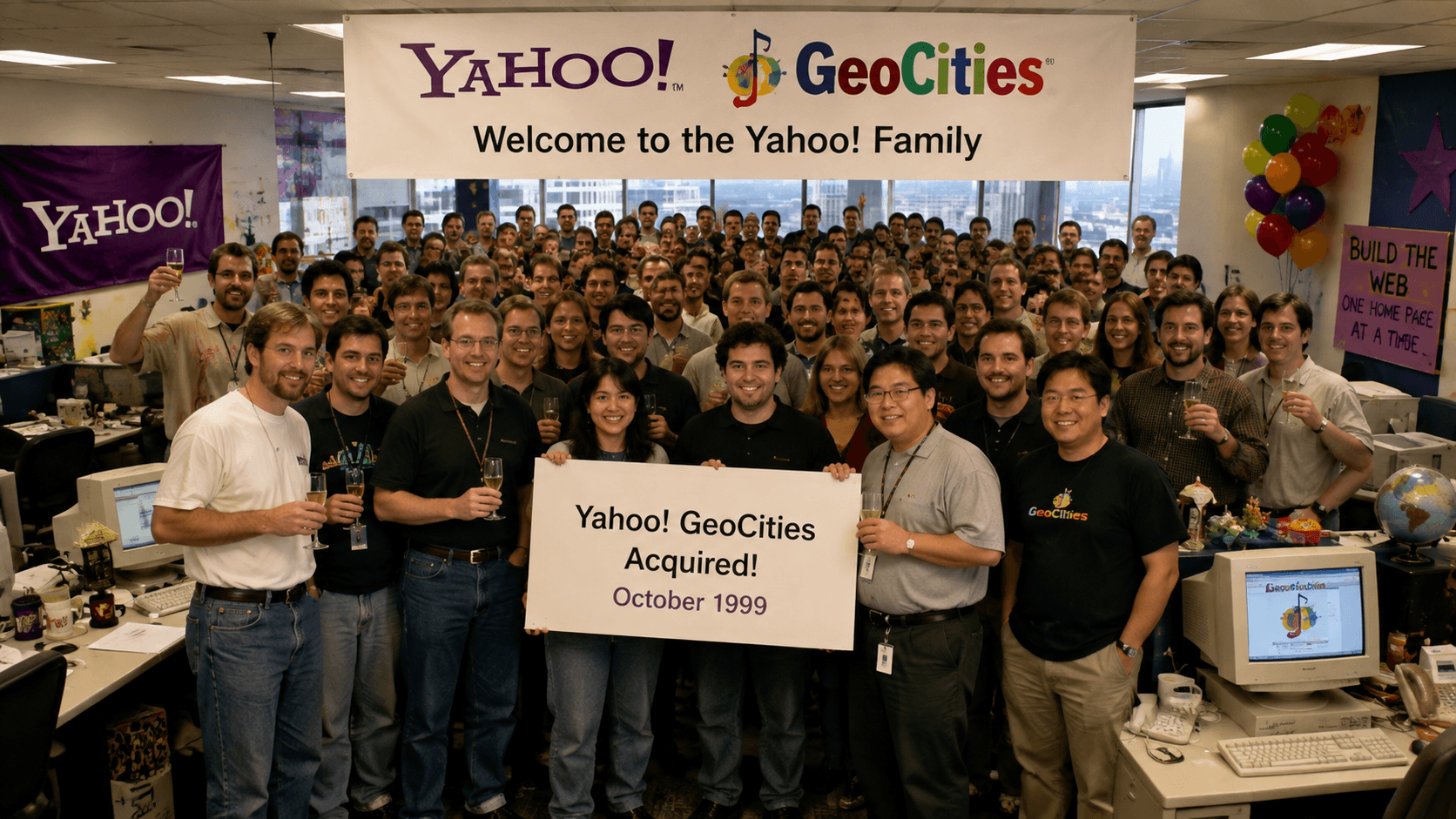
After GeoCities came under Yahoo!’s control, the company changed the service’s terms of use, and one of the new provisions sparked particularly strong outrage. Users felt that the terms granted Yahoo! overly broad rights to the material they had published themselves. This was an especially sensitive issue for the community, as people had spent years treating their pages like personal digital homes, filling them with photographs, writing, artwork, and other content of their own.
The backlash was so intense that some users began leaving GeoCities, while others protested directly on their own pages. Yahoo! eventually had to revise the controversial terms, but the dispute left a noticeable mark on the relationship between the company and its community. For many users, this was the moment when the romantic idea of owning a “home” in a digital city collided with the reality of living on a corporate-owned platform.
The situation feels remarkably familiar today. Someone can spend years building a profile, creating content, growing an audience, and treating their digital space as their own, yet ultimate control still belongs to the company that runs the platform. It can change the rules, algorithms, design, monetization options, or even shut the service down entirely. GeoCities exposed this tension long before the rise of modern social media, and a decade later, it would become crucial to the fate of the digital city itself.
The changes went beyond legal terms and policies. Gradually, the city metaphor that had once made GeoCities so distinctive began to disappear. Yahoo! started moving away from the old system of addresses based on themed neighborhoods and house-like numbers in favor of simpler URLs tied to usernames. From a practical standpoint, the decision made sense: a personal name was much easier to remember than a combination of a neighborhood name and a string of numbers.
But for GeoCities, the old addresses were more than just a technical detail. SiliconValley, Hollywood, Area51, CapitolHill, and the other neighborhoods created the feeling of a real place where a page wasn’t simply stored but actually seemed to “live.” Moving away from that system gradually blurred the distinction between GeoCities and an ordinary free web-hosting service. As the neighborhoods faded into the background, so did the sense of digital community and proximity that had been such an important part of the original concept.
At the same time, the internet itself was changing. What had seemed innovative, even revolutionary, in the mid-1990s was beginning to feel cumbersome by the start of the next decade. Users wanted faster ways to publish photos and updates, easier ways to find friends, and fewer reasons to think about HTML. At that point, the greatest threat to GeoCities was no longer any single mistake made by Yahoo!, but a new generation of web services built around an entirely different idea of what having a personal presence online should look like.
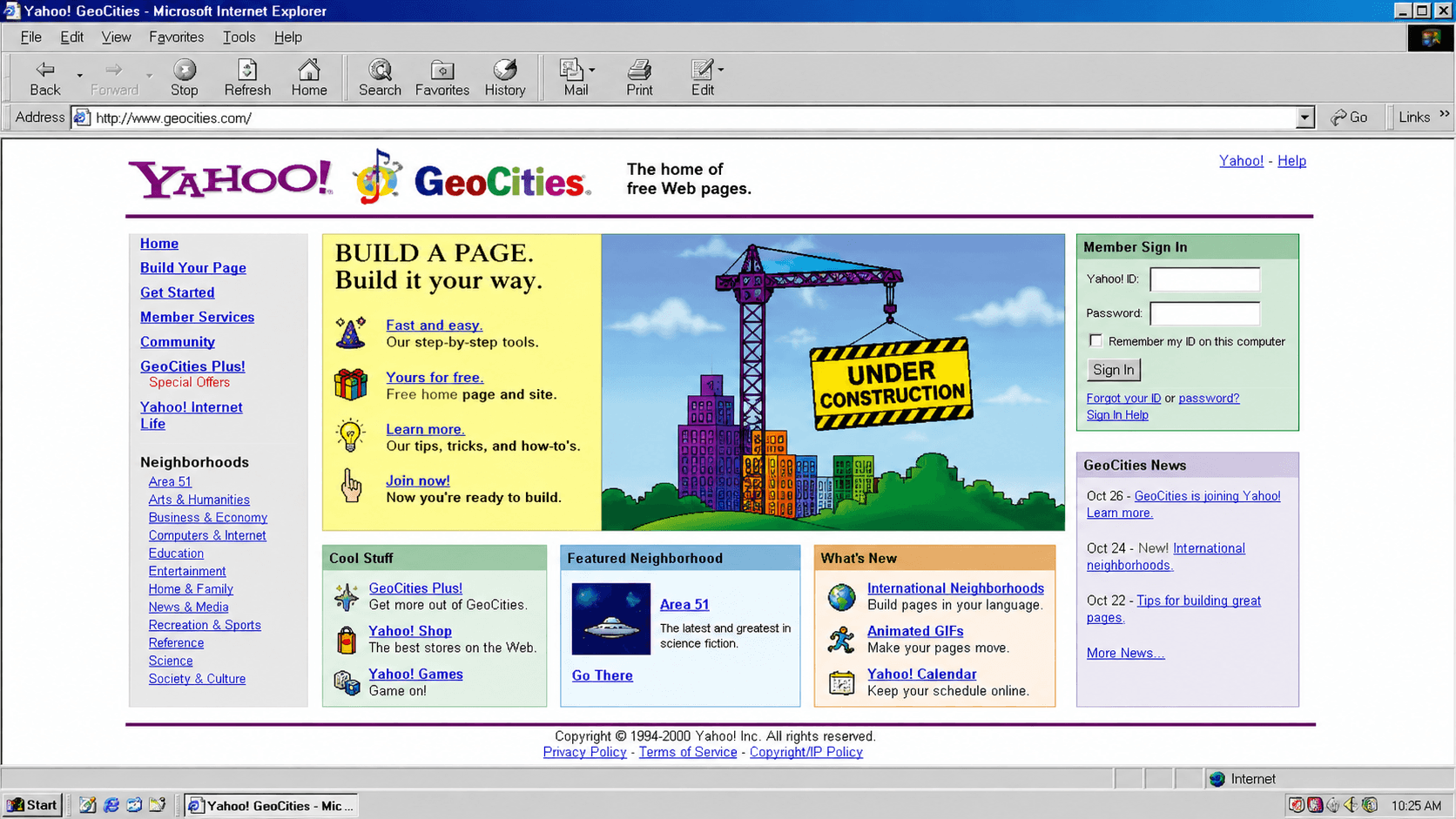
In hindsight, it’s easy to turn the story of GeoCities into a simple drama: there was a wonderful independent community, then a giant corporation came along, ruined it with advertising and new rules, and eventually shut it down. There is some truth to that version of events, but the real story is much more complicated. Even if Yahoo! had never acquired GeoCities, the service would still have had to survive a fundamental transformation of the internet. In the 1990s, a personal homepage was one of the few accessible ways to establish your own presence online, but by the following decade, more and more alternatives were emerging.
Blogs, forums, new hosting services, and content management systems were becoming increasingly popular, followed by MySpace, Facebook, and other social platforms. They offered something the traditional personal homepage lacked: simplicity and immediacy. If you wanted to tell your friends about your day, you no longer had to open an HTML file, edit the code, and upload it to a server. Adding a photo no longer meant manually dealing with files and links, and finding someone you knew no longer required knowing the address of their personal website.
Social platforms gradually turned publishing online from a somewhat technical activity into an ordinary part of everyday life. GeoCities found itself caught between two eras. It had already made the personal web more accessible, but compared with newer services, it still required too much manual work from its users. Its decline was therefore not simply the result of decisions made by Yahoo!, but also a consequence of a natural shift in how people wanted to use the internet.
This is where the story of GeoCities stops being just a nostalgic tale about strange websites from the 1990s and becomes part of the broader story of how the internet itself evolved. The modern web is vastly more convenient. Few people would seriously want to return to a time when a large image could take a minute to load and changing a single paragraph on a personal homepage meant editing HTML. Social networks, website builders, and content management systems removed an enormous number of technical barriers.
That is what made it possible for billions of people with no interest in programming to publish things online. The internet became mainstream not only because connections grew faster and cheaper, but also because users no longer needed to understand what was happening “under the hood.” In that sense, standardization was a huge step forward: familiar buttons, recognizable interfaces, and ready-made templates made the online world far more accessible.
But some freedom was lost in exchange for that convenience. Millions of completely different personal homepages gave way to billions of profiles built around a handful of standardized templates. Today, users can change their profile picture, bio, and content, but they can rarely redesign the space itself. On GeoCities, the owner controlled almost every element of the page. Sometimes that resulted in genuine design disasters, but it was precisely the lack of strict rules that made those websites feel so personal.
Over time, more and more GeoCities users stopped updating their websites. Some moved to other hosting services, some started blogs or created profiles on social networks, while others simply lost interest in publishing online. Yet their pages remained on the servers. Promises of future updates that would never arrive still sat on the screen, links pointed to websites that had long since disappeared, email addresses stopped working, and old animated GIFs continued looping through the same handful of frames forever.
GeoCities gradually began to resemble an abandoned city whose residents had moved away but left their homes almost exactly as they had been on their final day. There was something unusual about this in a digital environment: the pages seemed frozen in time. A website last updated in 1998 or 2001 could remain online years later with the same colors, text, images, and messages for visitors.
What makes this especially interesting is that most of these digital ruins contained nothing particularly remarkable. They might feature photos of someone’s dog, a list of favorite movies, a story about a vacation, or a page created for a school club. Yet it was precisely this everyday quality that would eventually make GeoCities so valuable to researchers of digital culture. Major events are usually documented by someone, while the everyday lives of ordinary users disappear much more easily. Almost by accident, GeoCities had accumulated an enormous archive of exactly that kind of life.
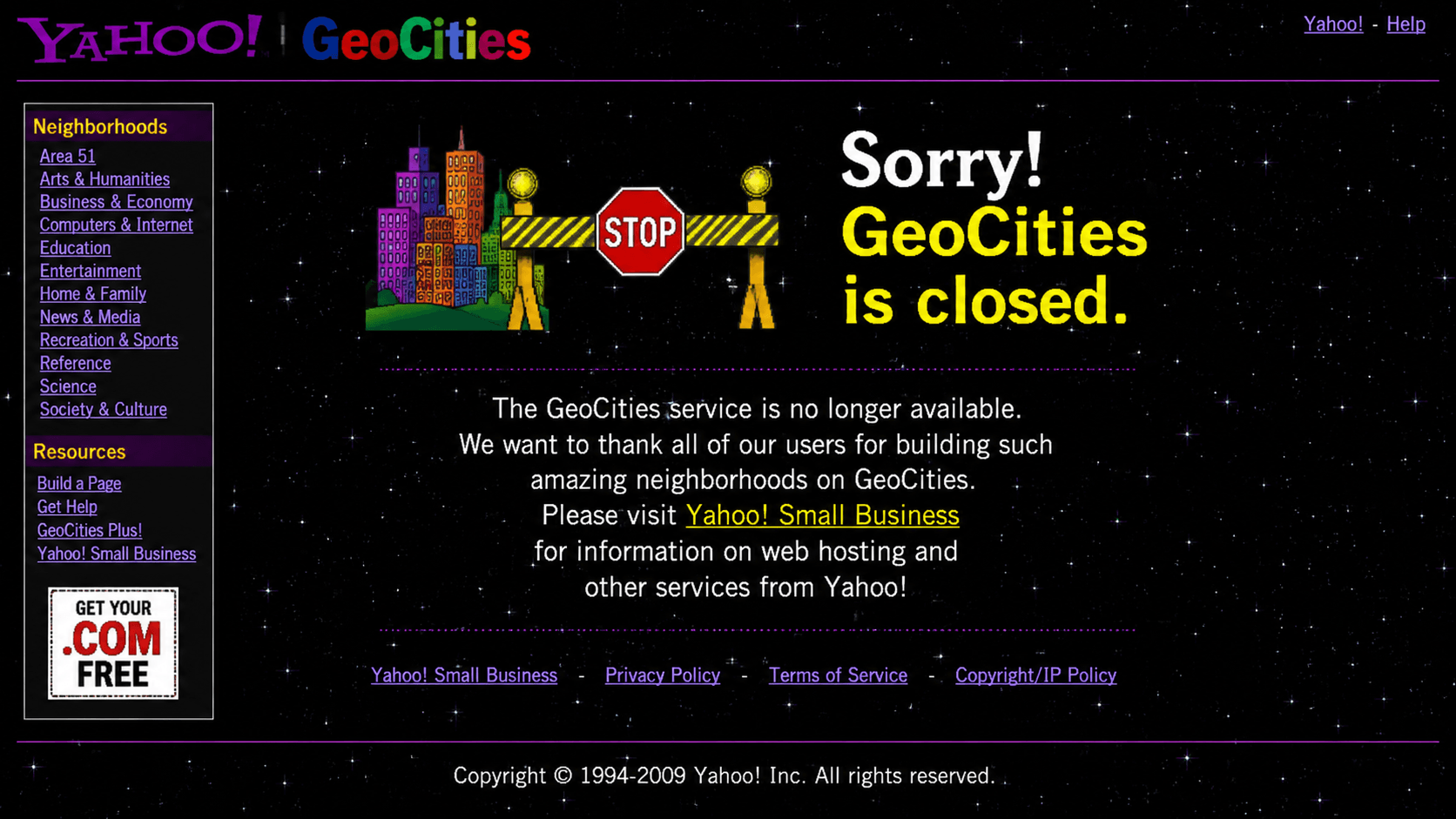
In April 2009, Yahoo! announced that GeoCities would be shutting down. From the perspective of a technology company, it was an understandable business decision: the service had long since lost its former popularity, the internet was moving in a different direction, and maintaining an aging platform no longer made enough commercial sense. From the perspective of internet history, however, the situation looked very different. The servers still contained an enormous snapshot of early mainstream online culture.
This wasn’t just about popular websites that had once attracted thousands of visitors. Some of the most historically valuable pages belonged to completely ordinary people who had never imagined that their personal websites might one day become part of a cultural record. Newspapers can be preserved in libraries, books end up in archives, and photographs of major events are catalogued by museums. But no comparable preservation system existed for millions of amateur webpages.
The problem was that digital information was far less permanent than it appeared. A webpage exists only as long as its server remains online and someone continues maintaining the infrastructure behind it. When a company switches off that infrastructure, millions of documents can disappear almost at once. Who would preserve the homepage of an unknown school student from 1997, a fan page dedicated to a TV series, or a GIF someone had placed next to a photo of their cat? Once Yahoo! announced the shutdown, it became clear that without outside intervention, a huge part of the early internet’s history would simply cease to exist.
After GeoCities announced its shutdown, digital archivists sprang into action. One of the most prominent groups involved was Archive Team, a volunteer community dedicated to rescuing information from online services at risk of disappearing. The Internet Archive also carried out extensive preservation work, while other initiatives joined the effort as well. For many people, it was one of the clearest reminders that the web needs its own archaeologists and librarians, except instead of working with paper and stone, they work with servers and files.
The scale of the task was enormous. With limited time remaining, archivists had to find and download as many HTML pages, photographs, GIFs, background images, and other materials as possible before Yahoo! finally switched off the servers. In a way, it really did resemble evacuating a city before demolition, except instead of rescuing furniture, letters, and family photo albums, volunteers were saving files and fragments of HTML code. And there was no guarantee that absolutely everything could be found and preserved.
Archive Team worked throughout 2009 to preserve GeoCities, using large numbers of computers and the help of volunteers. Ultimately, various archival projects managed to rescue an enormous amount of data, measured in hundreds of gigabytes, with some of the largest collections approaching a terabyte in size. By modern standards, that amount of storage may no longer sound extraordinary, but the importance of the archive was never about the number of bytes. What it contained were millions of traces of human life.
The main U.S. GeoCities service shut down on October 26, 2009. A platform that, roughly a decade earlier, had been one of the most visited destinations on the entire internet ceased to exist in its familiar form. By various estimates, tens of millions of pages had existed on the platform over the years, and a significant number of them were no longer accessible at their original addresses.
For most internet users, the shutdown wasn’t a disaster because by 2009 the world had already moved into a very different digital era. Facebook was growing rapidly, YouTube had become a global video platform, Google had long dominated search, blogs were a normal part of online life, and social services made staying connected with friends far easier than old-fashioned personal homepages ever had. To many people, GeoCities had become a relic: an old, inconvenient service filled with strange websites from a bygone era.
Yet its disappearance demonstrated just how easily the internet can lose its own history. We often repeat the idea that “the internet never forgets,” but in reality, that is far from true. A server can be switched off, a domain can expire, a company can go out of business, a file format can become obsolete, and a link that worked for a decade can suddenly return an error. Without deliberate preservation efforts, even enormous parts of digital culture can disappear far faster than physical documents.
Thanks to the work of archivists, a significant part of the digital city was not lost. The preserved pages allow us to see the internet today not as it is described in books about Microsoft, Apple, Netscape, Yahoo!, or AOL, but as it was actually built and experienced by ordinary users. That distinction matters. The history of major technology companies can tell us which browsers appeared, which standards prevailed, and how infrastructure evolved, but it doesn’t always show what ordinary people actually did with all those new possibilities.
The GeoCities archives preserve teenagers’ digital bedrooms, family photo albums, fan clubs, tiny online shops, collectors’ pages, school projects, strange theories, jokes, fears, passions, and dreams. This isn’t the official history of the internet; it’s its everyday history, and that is precisely what makes it so valuable. The fact that an old website might look ridiculous doesn’t make it any less important. On the contrary, its imperfections reveal how ordinary people learned to navigate and shape an entirely new environment without established rules or instructions.
In that sense, the GeoCities archive became a kind of time machine. It allows us not merely to read about the early web, but to step inside it and see how people presented themselves to the world before social media existed. Even broken links, bizarre backgrounds, and awkward navigation matter because they were all part of the environment in which mainstream internet culture began to take shape.
Over the years, attitudes toward the GeoCities aesthetic have changed as well. What was considered the epitome of bad web design in the 2000s now inspires nostalgia, curiosity, and even deliberate imitation. Blinking GIFs, pixelated buttons, repeating backgrounds, strange fonts, visitor counters, and “Under Construction” signs have become a recognizable visual language of the early web.
Artistic and research projects dedicated to preserving and exploring this aesthetic have since appeared. One Terabyte of Kilobyte Age, for example, explored the enormous GeoCities archive and systematically published screenshots of old pages, turning random amateur websites into objects of digital archaeology. The Computer History Museum also exhibited Deleted City, an interactive visualization of the archive that allowed visitors to experience GeoCities almost literally as a vast, lost digital landscape.
There is nothing particularly unusual about this transformation. Old advertising posters, postcards, amateur photographs, product packaging, and everyday objects were rarely created with the intention of becoming museum exhibits either. Their historical value became clear only later, after the world they belonged to had disappeared. The same thing happened to GeoCities. Websites that once seemed like digital junk now help us understand how people responded to a new technology and how they learned to represent themselves online.
Although Yahoo!’s main GeoCities service shut down in 2009, the name lived on for some time in Japan. The Japanese version remained online much longer and did not finally close until 2019. In that sense, the story of GeoCities officially continued for almost another decade after most Western users had already come to see the platform as a relic of the past.
At the same time, the idea of the personal web began to reappear in new forms. One of the best-known examples is Neocities, launched in 2013. Its very name is a direct reference to GeoCities, while the service itself gives users the freedom to create simple personal websites and decide for themselves how those sites should look. It isn’t a literal recreation of the old platform, but rather a modern interpretation of the same basic idea.
This is particularly interesting in an increasingly centralized internet. Years after social media supposedly made personal homepages obsolete, some users once again began looking for spaces they could truly shape themselves. Not a profile whose design could be changed tomorrow by the company running the platform, and not an algorithmic feed where visibility depends on recommendations, but an ordinary website where the creator decides exactly what visitors see and how they experience it.
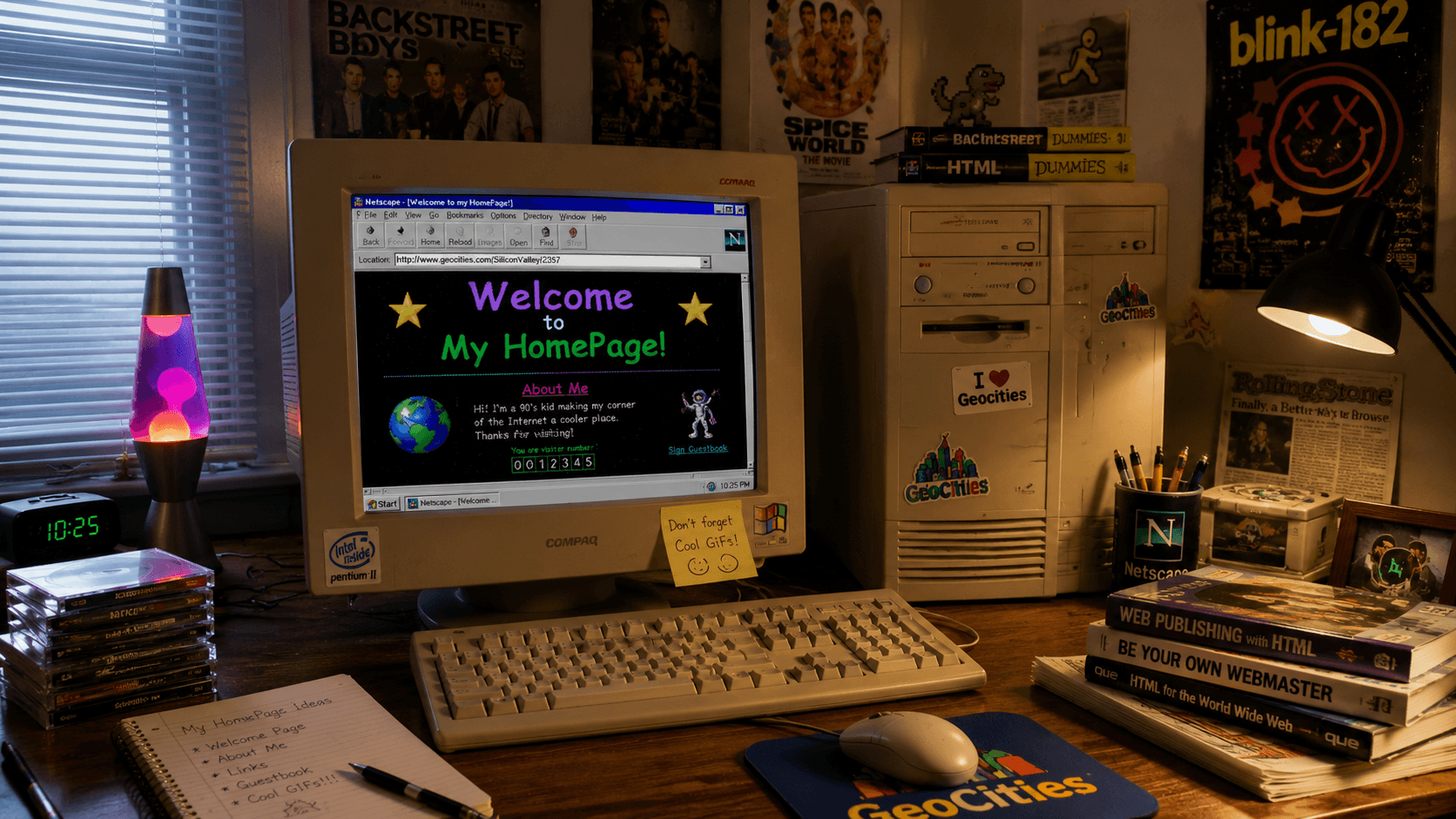
It’s easy to explain nostalgia for GeoCities as people simply romanticizing their younger years, and there is certainly some truth to that. For some, the service brings back memories of their first home computer. For others, it’s the unmistakable sound of a dial-up modem, their first encounter with HTML, or the first webpage they ever managed to publish themselves. When people remember GeoCities, they often aren’t really remembering a particular hosting service. They’re remembering their first experiences of discovering the internet.
But nostalgia isn’t the whole story. GeoCities represented a different model of the web, one where people primarily built their own spaces rather than creating profiles inside a handful of enormous platforms. Today, Meta gives users a page on Instagram or Facebook, Google gives them a channel on YouTube, and TikTok gives creators a profile. Each platform defines the shape of the space in which its users can operate. On GeoCities, users were given what amounted to an almost empty digital plot of land and were left to build whatever they wanted.
The resulting “house” could be hideous: green text, a purple background, twenty blinking GIFs, and music that started playing without the visitor’s permission. But every one of those choices belonged to the person who made the page. That’s why browsing old websites can sometimes create such a strange sense of presence. Without knowing anything about the person behind a page, you can see what images they found funny, what bands they loved, what colors they chose to welcome visitors, and what they considered important enough to put on their homepage.
GeoCities and today’s platforms have far more in common than might appear at first glance. GeoCities helped demonstrate that ordinary people didn’t just want to read the internet; they wanted to create it. Social media took that idea and removed almost all of the technical barriers. Today, you don’t need to know HTML, understand directory structures, manually optimize every image, or use an FTP client. You simply upload a photo, write something, and hit “Post.”
That simplicity transformed online content creation from a hobby largely associated with tech enthusiasts into an everyday activity for billions of people. In that sense, modern social media fulfilled the dream of the early personal web on a scale that would have been difficult to imagine in the 1990s. Almost anyone can now instantly share something about themselves with the entire world without ever thinking about servers, code, or storage space.
But as the complexity disappeared, some control disappeared with it. A social network decides what a user’s page looks like, who gets to see their posts, what content is allowed, how monetization works, what features will be available tomorrow, and whether the service itself will still exist ten years from now. The fate of GeoCities demonstrated this dependence long before the modern platform era. If your entire digital world exists inside someone else’s platform, you never fully control it.

Perhaps the most fascinating thing about GeoCities is that its users almost certainly never thought about the historical value of their pages. Someone building a website about their favorite TV show in 1998 wasn’t trying to document the culture of the late 20th century; they simply loved that show. Parents posting family photos weren’t creating a digital archive of everyday life, and a school student who made a page about dinosaurs could hardly have imagined that decades later someone might look at it as an example of early web culture.
That is exactly what makes these materials so fascinating. They weren’t created for museums, researchers, or future generations, which means they preserved the immediacy of their era. Old pages reveal the colors people liked, the images they shared with one another, the software they used, the jokes they found funny, and even how they imagined their own presence on the internet.
Major technology archives usually preserve products: computers, operating systems, browsers, advertisements, and documentation. The GeoCities archive, to a large extent, preserved the users themselves, or more precisely, the digital traces of their everyday lives. Sometimes that means a few sentences and a photo of a cat; sometimes it’s an enormous fan site that someone spent years building. Together, however, these pages create a picture of the early internet that could never be reconstructed from the official histories of technology companies alone.
Memories of GeoCities still occasionally surface in modern digital culture. One such detail is a Google Easter egg associated with searching for GeoCities, which references the distinctive aesthetic of old personal homepages and Comic Sans. Jokes like this only work because the visual language of GeoCities has long since become a cultural symbol in its own right.
All it takes is a mention of blinking GIFs, brightly colored backgrounds, Comic Sans, visitor counters, or an “Under Construction” sign, and anyone who experienced the early personal web will almost immediately know which era you’re talking about. These elements have become so recognizable that today they’re often used deliberately to recreate the atmosphere of the 1990s internet.
Once, all of this was considered a sign of amateur web design, something the professional web wanted to leave behind as quickly as possible. Today, those same elements function almost like a time machine. It’s a perfect example of how quickly attitudes toward digital culture can change: what one generation found awkward and irritating can become a comforting piece of nostalgia for the next.
GeoCities lasted for roughly fifteen years, counting from the launch of Beverly Hills Internet in 1994 to the shutdown of the main service in 2009. For a real city, that isn’t even a generation, but for the internet, it represented an entire era. During those years, the web evolved from simple pages that slowly loaded over dial-up connections into a world of global video platforms, search engines, and social networks with hundreds of millions of users.
GeoCities stood at the very beginning of that transformation and showed people that the internet could be more than a library of information or territory controlled by large companies. You could move in, get an address, decorate your own page, invite other people over, and build something completely ridiculous that might only ever be seen by a few dozen visitors, yet still enjoy the simple fact that something you had created existed on the World Wide Web. That sense of personal ownership and participation became one of the most important things GeoCities left behind.
Today’s internet is incomparably faster, more polished, and more convenient, but it has also become more professional, more centralized, and more dependent on a handful of major platforms. GeoCities was clumsy, slow, painfully colorful, and packed with pages that broke almost every rule of good design. Yet behind every one of those pages was a person who sat down at a computer one day and decided to build a tiny piece of the internet with their own hands. Yahoo! could shut down the servers and close the digital city, but the idea behind it outlived the service itself.
GeoCities earned its place in internet history not because it was a perfect service, but because it was one of the first to give millions of ordinary people the chance to create a corner of the web of their own. It has been gone for years, but it was within those strange, colorful, and often awkward personal homepages that an internet built not only by companies and programmers, but by ordinary users themselves, began to take shape.