
29.09.2026
17 min
199



Most people have had a digital footprint for years, but it is often difficult to understand its true scale until you try to look at yourself through the eyes of a stranger. In just one hour of searching open sources, it is possible to gather enough information to build a surprisingly detailed picture of someone’s life.

This is the core principle behind OSINT. Similar methods are actively used by investigative organizations such as Bellingcat, as well as by journalists, researchers, and analysts when they try to establish connections between people, events, and organizations.
A simple search by name can quickly reveal where a person lives, where they work, what they do, and which social media accounts they have used over the years. Old biographies, profiles, and posts can gradually help fill in the gaps.
Personal websites often contain publicly available email addresses. Public databases may reveal a mailing address and, in some cases, other personal information. LinkedIn can help reconstruct parts of a person’s employment and education history, while older profiles often expose usernames that have been reused across different platforms.
Social media provides even more context. Recent posts can reveal major events in a person’s private life, travel details, marital status, or even disputes with companies and service providers.
Individually, most of this information does not look particularly sensitive. People often publish it themselves. The problem begins when dozens of small details are combined into a single profile that can then be used for fraud or a targeted attack.
A basic digital footprint search can reveal:
Email address: often found on personal websites, author pages, or public profiles.
Location: a city, neighborhood, mailing address, and in some cases even a home address obtained from public databases.
Employment and career: current workplace, job title, previous employers, and professional history.
Education: schools, universities, fields of study, and other academic details.
Social media: active and old accounts, as well as usernames reused across different platforms.
Personal life events: marriage, family connections, and other recent milestones.
Travel and interactions with companies: destinations, routes, and public complaints about services or airlines.
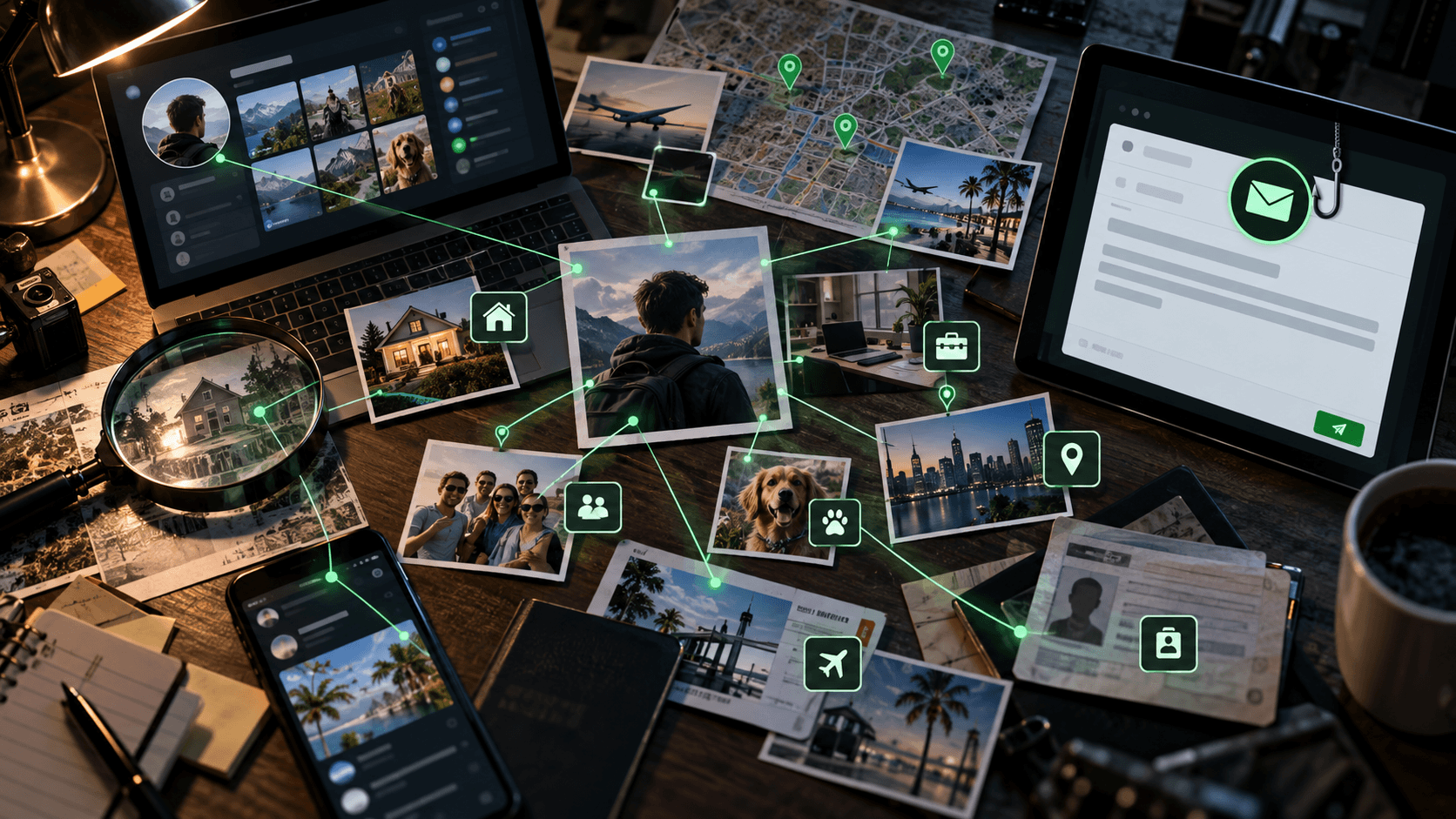
Today, attackers no longer need to rely on crude emails built around an obviously fake story. Publicly available information allows them to create much more convincing scenarios.
For example, if someone publicly complains about an airline, a scammer can find their email address and contact them while pretending to be customer support. The message may mention the real route, the person’s city, workplace, or details of the dispute.
This makes a phishing email look far more believable and increases the likelihood that the victim will click a link or hand over personal information.
Similar schemes are already widely used on social media. Scammers monitor public complaints about airlines and other services, then reply while pretending to represent official customer support.
People continue to lose significant amounts of money to these attacks. The U.S. Federal Trade Commission reports that in 2025 consumers reported losses of $3.5 billion to impersonation scams. Nearly one in three fraud reports involved this type of scheme.
The UK National Cyber Security Centre also warns that criminals use information available online, including social media posts, to make phishing messages more convincing.
This type of data collection is not limited to cybercrime. Data brokers also gather information from multiple sources, combine it into profiles, and sell or provide access to those profiles for profit.
There are also people-search services that can make it easier to find names, addresses, phone numbers, and other personal information.
To understand how much information is visible to strangers, one of the simplest things users can do is search for themselves. A good starting point is to enter a full name in quotation marks in a search engine, then repeat the process using old usernames and email addresses. It is also worth reviewing social media profiles and checking what information is available through public records.
After that, unnecessary information should be removed wherever possible. Accounts that do not need to be public can be made private. Public profiles can also be cleaned up by removing unnecessary birth dates, precise location details, and excessive information about family members.
Users can also contact data brokers and request that their profiles be removed where possible. In some cases, they may also ask search engines to remove certain results if those pages contain personal information and significantly infringe on their privacy rights.
Completely erasing a digital footprint is almost impossible, but reducing the amount of publicly available information can make personalized phishing, social engineering, and other fraudulent attacks much harder to carry out.