08.08.2025
13 min
2031



Part 9 of the series “In Memory of Kevin Mitnick” tells about a new stage in the life of the legendary hacker after his escape from Denver. Having changed his identity, he settles in Seattle – a city of rain, coffee and rapid development of IT, trying to hide from persecution. But even under a new name, Mitnick does not stop investigating vulnerabilities, works in technical support, penetrates CERT systems and stays in the game. The material contains an atmosphere of constant risk, fog and paranoia, when every helicopter or police visit can be the beginning of the end.

So, due to an idiotic coincidence, Kevin Mitnick — who in some centuries was really not at all guilty — was fired from his job, deprived of his fake identity under the name Eric Weiss, and was forced to urgently flee Denver, which he had grown very fond of. He had to find a new place to live and finally officially become in the eyes of the state and society not Kevin Mitnick, but Brian Merrill. Everything was ready for this, there was little left: to settle somewhere where there is a demand for IT specialists, and to try not to attract too much attention to himself with new risky hacking adventures. If everything was not bad and diverse with the first in the USA in the mid-90s, then Kevin was resolutely incapable of the second: he was drawn to other people’s servers and secrets no less than an Irish drunkard to a bottle of whiskey. And Mrs. Fortune does not really like it when her favor is felt every time in a self-confident way.
First of all, Mitnick needed to get out of Denver before his former colleagues, who were horrified by the revelations, turned the police on him. In addition, shortly before the revelation, he was informed that agents had again started visiting his acquaintances and asking where the dangerous hacker Kevin Mitnick might be. He rushed to Vegas, where his mother and grandmother lived: a risk, he himself knew from prison experience that many people end up behind bars because they want to see their relatives at any cost, but there was nothing they could do about it. His life was once again in ruins, and Kevin had to talk to people he could trust.
He organized the meeting with his family, however, in the best traditions of spy thrillers, habitually using radio interception of all the frequencies of law enforcement officers and related agencies known to him, which the police and agents used precisely to avoid the interception of their negotiations by criminals. However, there was a nuance: at that time, negotiations between American security forces were usually encrypted, and the Customs officer was unable to break their encryption. Therefore, he went for a cunning trick, collected equipment and naturally staged an electronic warfare war with the police and the FBI in Vegas. Within a radius of a couple of blocks from him, he jammed their coded negotiations with interference so that as a result they spat and switched to open communication, having an encryption system from Motorola. Well, Kevin listened and found out that no one was hunting him yet.
Taking a breather, he began to consider where he should go next, looking for a new home under a new name. He wanted Silicon Valley most of all—but it was near San Francisco, California, and the local FBI would have been very happy with the “Customsman came himself” option.
However, there was another promising digital technology center on the West Coast that was developing rapidly: the rainy and foggy capital of grunge and proto-hipsters, snobbish and progressive Seattle, Washington. It was there that many of the key offices of Microsoft and other corporations were located, and Mitnik decided that it would be a great place to get lost and build a new life. In addition, Seattle in the mid-90s was known for its significant Thai diaspora and the wide distribution of Thai cuisine, which Kevin simply loved. In many ways, it was Seattle that started the fashion for stylish coffee shops — and Mytnik also really liked good coffee.

Having weighed all the pros and cons, our fugitive hacker boarded a train and headed northwest under the name of Brian Merrill: a man who had died as a child in a car accident in the quiet state of South Dakota, whose data Kevin had managed to extract in a very sexual service. Kevin wanted to burn all the documents in the name of Weiss, but in the end he simply hid them well in a suitcase in case of some emergency. The customs officer arrived in Seattle late in the evening, checked into a motel and almost immediately passed out. And in the morning – precisely on July 4, 1994, on US Independence Day, he received an urgent message from his mother: “Respect the New York Times!”.
Indeed, the article “Cybercriminal number one: Hacker eludes the FBI” by journalist John Markoff was published in The New York Times. The author literally mocked the inability of the powerful Federal Bureau of Investigation to catch Mytnik, and his capabilities and sins were described literally on an apocalyptic scale: they say, he even hacked the computers of the North American Aerospace Defense System NORAD, and almost caused a world nuclear war! Of course, Mytnik had to hack the servers of US military facilities, but he never got to that point. Moreover, the strategically important NORAD networks are completely isolated from the external Internet, and hacking them from outside well-guarded military facilities is technically impossible.

Mytnik understood that this article, where he was called no less than the most dangerous hacker in the USA, would not only attract unnecessary attention to his person, including random passers-by and potential colleagues, but also anger those comrades who were supposed to catch him. As he later found out, in many ways this sensational delusion was the result of the journalist’s communication with his former acquaintances, some of whom decided to embellish reality a little, and some to make up for the fugitive’s past grievances.
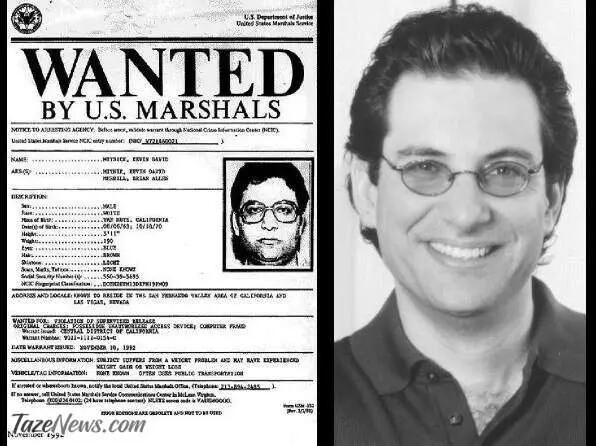
One thing was amusing: the attached photo was very old, six years old, and Mytnik was still very fat, shaved and with a short haircut, while by the time of the summer of 1994, the healthy lifestyle and overgrown Kevin looked diametrically opposite. It was possible to learn from this photo, and even in a jackal quality (prison shooting and newspaper printing), but for this you need to make some effort. And yet, just in case, from that moment on, our hero began to constantly wear dark glasses — which looked especially strange in Seattle, a city not just northern, but the cloudiest of the major cities in the U.S. He explained to surprised interlocutors that he constantly worked at the computer at night, and therefore his eyes began to perceive even diffused daylight poorly.
Breathing out again, Mytnik found housing near the local university. However, the Californian’s experience had failed him: if the university districts of Los Angeles and Frisco were usually very decent, beautiful and picturesque, then the surroundings of the University of Washington were more reminiscent of the depressive landscapes from the movie “Robocop”. But the housing there was cheap, the landlords were not too interested in the details of the personality and biography of the tenant, and nearby there was a free YMCA gym and an authentic Thai restaurant with proper food. Kevin even tried to drive up to the local mystery waitress, and she showed mutual interest, but he was stopped by paranoia, the fear of revealing something in a close relationship.
Kevin got a job at Virginia Mason Medical Center – an even more yin-yin-yin than at the law firm in Denver. The work in the hospital’s technical support was frankly boring, and the bosses melancholy played off all of Mytnik’s rational proposals about how to fix something, improve it, secure it, upgrade it, do it faster and more efficiently. Worse still, despite the general progressiveness and IT-savvyness of the city, one often had to deal with people who were completely lacking in computer literacy. I’m afraid to imagine what Kevin said about himself and not only him when one of the clinic employees who contacted technical support complained that he couldn’t remove data from a floppy disk, literally photocopying it. With a Xerox. Floppy disk. Yes.
Mytnik was bored. And when Mytnik was bored, he did what he found most interesting: hacking and extracting other people’s data. Soon after his training in Seattle, he found a new target: DEC’s VMS operating system. To get the treasured data, he pretended to be an employee of the company and posed as Neil Clift, a person who searched for vulnerabilities in VMS and reported them to DEC, and with whom he had already dealt during the Nokia hacks. Mytnik managed to gain access and learn almost all the vulnerabilities of the VMS system, but one day he could not answer a question about the password encryption algorithm in the system – and got burned. Neil realized that instead of Darrell, Mytnik, whom they had met several years earlier, was dealing with him, and addressed Kevin as Kevin.
Despite all his paranoia, Mytnik agreed to a phone conversation – naturally, through a cleverly modernized mobile phone and a random foreign number – and had more than one long, polite and fascinating conversation with Clift on technical topics. To Kevin’s surprise, the latter was not offended by him because of the problems with Nokia and communication with the Finnish police, and even gave him a lot of useful advice on hacking – from the experience and optics of a vulnerability specialist. However, Mytnik soon found out, having broken into the correspondence, that in parallel he was no less politely and actively communicating with the FBI special agent Caitlin Carson from California, who was dealing with his case, and telling her the details of his conversations with the hacker. Here it was Mytnik’s turn not to be offended: he decided that he was an evil Pinocchio himself, and in general was the first to start fooling Clift’s head.
Months passed in Seattle. Neither the FBI nor the state police showed any apparent interest in our hero. The customs officer relaxed again, enthusiastically contacted other hackers, and continued to hack and extract everything he could get his hands on. Hacker Ron Olson helped him get into the closed California vehicle registration database. Together with a Dutch hacker under the nickname RGB, Kevin managed to penetrate the holiest of holies in US information security: the data of the CERT (computer emergency response team), a federal anti-hacker group for rapid response to computer security breaches with its headquarters in Pittsburgh, Pennsylvania. It was created in 1988 after the worm of graduate student Morris managed to knock out 10% of Internet nodes, and it became clear that hackers could pose a threat to national security. However, Mitnik and RGB climbed there not just for the love of art: their goal was to get access to the latest data on vulnerabilities that had not yet been published in the official bulletin of the organization for the fastest possible correction. Which they did, and were very happy about it.
However, in October 1994, Mitnik’s quiet hacking life in Seattle was disturbed by a strange incident. One lunch, Kevin went out, in fact, to lunch and discovered the sound of a helicopter. Nothing special for Seattle, the largest metropolis in the American Northwest, but the sound began to approach. The helicopter literally hovered over the street not far from Mitnik, who was walking down the street, and began to follow him. Having put down the bricks on a small office center, Kevin began to meander through the alleys and shops – but the helicopter stubbornly found him again and again. He was terrified and felt like a character in a thriller.

Finally, Mitnik figured out how to turn off the phone – and finally, those who were in the helicopter lost him. After sitting under a tree and catching their breath, he found a way to contact his father, but he laughed at him and advised him to treat his nerves. Kevin’s paranoia intensified again, and there was every reason for this. Unfortunately, for him, this was only the first act of great trouble. Shortly after, Mitnik was fired from the clinic – on the grounds that “you are clearly bored with us”, he did not fight for a place, because he really was very bored there and at times was heartbroken by the idiocy of the bosses and users.
Well, when Kevin went to the 24-hour Kinko’s mail office near the rented apartment to write a few fake resumes, print them out and send them to the companies that interested him – voices began to come from the radio scanner he usually had with him on the frequencies of the security forces. The voices indicated that some kind of operation was underway in the area, during which someone was being searched. However, it all ended with the phrase “we’re coming in,” but no agents attacked him. Having driven home with his resume in the north, Kevin set off home — but decided not to rush, but to observe the apartment from the side. When he went out onto a familiar street, it became clear that something was wrong: the window was not lit, although he had the habit of leaving the light on, including to avoid theft. Had the light bulb burned out?
A truck was parked outside the house, and a couple was kissing in the cab. Deciding that it would be paranoia to think that they were being watched from the outside by the FBI or the police (oh, no way, really), Kevin approached and asked if they had seen his acquaintance there, who was supposed to be waiting for him. They said they hadn’t, but instead they had seen some people carrying some boxes out of the house. The suspense was building. More and more signs indicated that they were coming with him.
Overcoming his fear, the customs officer entered the house and went up the stairs to his landlord’s apartment. The landlord, sleepy and angry, told him that the cops had broken into Kevin’s apartment, left a business card and told him to give the tenant a number to call immediately. Immediately asking when Kevin would pay for the broken door. He promised to call the police and pay for the damage as soon as possible, ran down the stairs and for some time crept in terror through the dark alleys, trying to find the outside group of the capture. There seemed to be no one. In addition, according to the landlord, the cops came, not the feds – so they probably did not come for the famous hacker Kevin Mitnick.
He didn’t risk going into the apartment from where they had been taken anyway: he suspected that even ordinary cops could well have left someone there to meet the suspect. With him, the Customs officer had only a backpack with a minimum of things, which he always carried with him just in case, and a briefcase with documents, including completely illegal blank forms borrowed from a sleepy office in South Dakota. He was in a cold sweat, and only by an effort of will could he force himself to walk through the night streets at a normal pace, without breaking into a run. A few blocks later, Kevin realized that he was having a panic attack. The last thing he managed to do was go into a lively night bar, where everyone was drinking and partying, and huddle in the farthest toilet stall.
Gradually regaining his ability to think, Kevin headed downtown and rented a room at a motel in the name of Eric Weiss, for whom he had very fortunately not liquidated the documents before arriving in Seattle. Then he took his clothes from the laundry, which he had no less fortunately given there, so as not to be left with only what he had on: jeans, a jacket, and a Hard Rock T-shirt. The cops took almost everything from his apartment, even his laptop, which he had not taken with him because the post office had its own computers, and a bunch of disks and magnetic tapes, where he had been loading a large number of files downloaded from other people’s databases for several years. Having calmed down even more, Mytnik decided to find out at any cost: what exactly were the cops’ claims against him, and how likely was it that they would start digging through his files, or would his equipment and data carriers simply gather dust in the evidence warehouse?
Social engineering and the help of Lewis’s old friend were used. With all their efforts and twists and turns, they managed to quickly break the system – and find out what was happening from the police’s point of view. As it turned out, the cops had no idea what they were dealing with Kevin Mitnick. Employees of the cell phone fraud unit detected suspicious phone calls from various numbers coming from the apartment in question and believed that some self-taught hacker was using technical tricks to make free calls in order to avoid paying the telephone operator. The offense was, yes, and even interesting for the cops, who even used a helicopter to search for “Kulibin” on the streets of Seattle, but nothing really serious.
That’s why they didn’t even record the conversations, in which Kevin talked about a lot of very personal things, but only recorded the very fact of suspicious and clearly illegal connections. And that’s why, instead of organized surveillance and seizure, they limited themselves to confiscating things and left the landlord a business card: they believed that the self-taught programmer would get scared and run to the police to turn himself in. However, Mytnik was not going to surrender at all. Having gathered his things, he took the Greyhound to Tacoma, and from there he took the train via Portland and headed south again.

He didn’t know yet that the troubles in the inhospitable foggy Seattle were just a demo of what awaited him further on the dangerous path of a hacker on the run. In addition to FBI agents, he will have a personal enemy who will play a very dramatic role in his life. But more on that in the next part.